

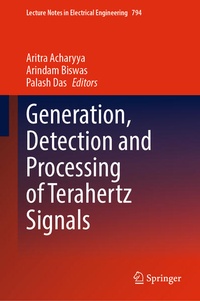
Generation, Detection and Processing of Terahertz Signals
1st Edition
Published on 21. September 2021
XIV, 363 pages
978-981-16-4947-9 (ISBN)
Description

This book contains detailed descriptions and associated discussions regarding different generation, detection and signal processing techniques for the electrical and optical signals within the THz frequency spectrum (0.3-10 THz). It includes detailed reviews of some recently developed electronic and photonic devices for generating and detecting THz waves, potential materials for implementing THz passive circuits, some newly developed systems and methods associated with THz wireless communication, THz antennas and some cutting-edge techniques associated with the THz signal and image processing. The book especially focuses on the recent advancements and several research issues related to THz sources, detectors and THz signal and image processing techniques; it also discusses theoretical, experimental, established and validated empirical works on these topics. The book caters to a very wide range of readers from basic science to technological experts as well as students.
Reviews / Votes
"This book was written by experts in the field, and it is dedicated to all aspects of THz fields. . The book is beautifully illustrated and contains references at the end of each chapter. The book is recommended for all working in the emerging area of research regarding THz fields, 6G communications and biomedical analysis using electromagnetic fields." (Mircea Dragoman, optica-opn.org, June 30, 2022)More details
Series
Language
English
Place of publication
Singapore
Singapore
Publishing group
Springer Singapore
Target group
Professional and scholarly
Product notice
Reflowable
Illustrations
XIV, 363 p. 288 illus., 108 illus. in color.
File size
11,36 MB
ISBN-13
978-981-16-4947-9 (9789811649479)
DOI
10.1007/978-981-16-4947-9
Schweitzer Classification
Other editions
Additional editions
Aritra Acharyya | Arindam Biswas | Palash Das
Generation, Detection and Processing of Terahertz Signals
Book
09/2021
Springer
€192.59
Shipment within 3-4 weeks
Persons
Dr. Aritra Acharyya
is currently working at Department of Electronics and Communication Engineering, Cooch Behar Government Engineering College, Harinchawra, Ghughumari, West Bengal, 736170, India, as Assistant Professor. He was born in 1986. He received B.E. and M.Tech. degrees from IIEST, Shibpur, India, and Institute of Radio Physics and Electronics, University of Calcutta, India, in the years 2007 and 2010, respectively. Finally, he obtained Ph.D. degree from Institute of Radio Physics and Electronics, University of Calcutta, in the year 2016. His research interests are high-frequency semiconductor devices, nano-structures, semiconductor physics, transport phenomena, quantum mechanics, optoelectronics, etc. He has published 81 research papers in peer-reviewed national and international journals, 60 research papers in national and international conference proceedings, and several book chapters. He also authored and edited 06 and 03 numbers of books, respectively.
Dr. Arindam Biswas is Assistant Professor, School of Mines and Metallurgy, Kazi Nazrul University, Asansol, Burdwan, West Bengal, 713340, India. He was born in West Bengal, India, in 1984. He received M.Tech. degree in Radio Physics and Electronics from University of Calcutta, India, in 2010 and Ph.D. from NIT Durgapur in 2013. He was Postdoctoral Researcher at Pusan National University, South Korea, with prestigious BK21PLUS Fellowship, Republic of Korea. He got Visiting Professor at Research Institute of Electronics, Shizouka University, Japan. He has been selected for IE(I) Young Engineer Award: 2019-2020 in Electronics and Telecommunication Engineering discipline, Institute of Engineers, India. Dr. Biswas has ten years' of experience in teaching research and administration. Presently, Dr. Biswas is working as Assistant Professor in School of Mines and Metallurgy at Kazi Nazrul University, Asansol, West Bengal, India. He has 48 technical papers in different journals and 30 conference proceedings and six books, one edited volume and one book chapter with international repute. Dr. Biswas received research grant from Science and Engineering Research Board, Government of India, under Early Career Research Scheme for research in Terahertz-based GaN Source. He also received Research Grant from Centre of Biomedical Engineering, Tokoyo Medical and Dental University in association with RIE, Shizouka University, Japan, for study of biomedical THz imaging based on WBG semiconductor IMPATT source. Presently, Dr. Biswas is serving as Associate Editor of Cluster Computing, Springer (SCI Indexed), and as Guest Editor of Nanoscience and Nanotechnology-Asia (Scopus Indexed), Recent Patent in Material Science (Scopus Indexed), Bentham Science Publisher. Dr. Biswas has produced four Ph.D. students in different topics of applied optics and high-frequency semiconductor device. He has organized and chaired difference International Conferences in Indiaand abroad. His research interest is in carrier transport in low-dimensional system and electronic device, nonlinear optical communication, and THz semiconductor source. Dr. Biswas acted as Reviewer for reputed journals, Member of the Institute of Engineers (India), and Regular Fellow of Optical Society of India (India).
Dr. Palash Das is currently working at Cooch Behar Government Engineering College as Assistant Professor. He did his M.S. and Ph.D. from IIT Kharagpur and B.Tech. from Kalyani Government Engineering College, West Bengal, India. His current research interest involves GaN optical devices, GaN HEMT, HRXRD of GaN/AlGaN thin film, ideation of new device structures, simulation and modeling, and simulation tool development using Visual Basic 6, automated measurement instrument development with embedded hardware and visual basic-based software. He is currently guiding one Ph.D. scholar working on GaN optical devices for intra-device communication applications. He has guided around 15 B.Tech. projects as well. Palash is owning 1 US patent and 3 Indian patents; he authored 11 journal papers, 19 conference papers, and 02 book chapters. He developed a few software to simulate/demonstrate/measure certain semiconductor physical characteristics. He recently developed one measurement instrument product for automated I-V characterization of electronic devices.
Dr. Arindam Biswas is Assistant Professor, School of Mines and Metallurgy, Kazi Nazrul University, Asansol, Burdwan, West Bengal, 713340, India. He was born in West Bengal, India, in 1984. He received M.Tech. degree in Radio Physics and Electronics from University of Calcutta, India, in 2010 and Ph.D. from NIT Durgapur in 2013. He was Postdoctoral Researcher at Pusan National University, South Korea, with prestigious BK21PLUS Fellowship, Republic of Korea. He got Visiting Professor at Research Institute of Electronics, Shizouka University, Japan. He has been selected for IE(I) Young Engineer Award: 2019-2020 in Electronics and Telecommunication Engineering discipline, Institute of Engineers, India. Dr. Biswas has ten years' of experience in teaching research and administration. Presently, Dr. Biswas is working as Assistant Professor in School of Mines and Metallurgy at Kazi Nazrul University, Asansol, West Bengal, India. He has 48 technical papers in different journals and 30 conference proceedings and six books, one edited volume and one book chapter with international repute. Dr. Biswas received research grant from Science and Engineering Research Board, Government of India, under Early Career Research Scheme for research in Terahertz-based GaN Source. He also received Research Grant from Centre of Biomedical Engineering, Tokoyo Medical and Dental University in association with RIE, Shizouka University, Japan, for study of biomedical THz imaging based on WBG semiconductor IMPATT source. Presently, Dr. Biswas is serving as Associate Editor of Cluster Computing, Springer (SCI Indexed), and as Guest Editor of Nanoscience and Nanotechnology-Asia (Scopus Indexed), Recent Patent in Material Science (Scopus Indexed), Bentham Science Publisher. Dr. Biswas has produced four Ph.D. students in different topics of applied optics and high-frequency semiconductor device. He has organized and chaired difference International Conferences in Indiaand abroad. His research interest is in carrier transport in low-dimensional system and electronic device, nonlinear optical communication, and THz semiconductor source. Dr. Biswas acted as Reviewer for reputed journals, Member of the Institute of Engineers (India), and Regular Fellow of Optical Society of India (India).
Dr. Palash Das is currently working at Cooch Behar Government Engineering College as Assistant Professor. He did his M.S. and Ph.D. from IIT Kharagpur and B.Tech. from Kalyani Government Engineering College, West Bengal, India. His current research interest involves GaN optical devices, GaN HEMT, HRXRD of GaN/AlGaN thin film, ideation of new device structures, simulation and modeling, and simulation tool development using Visual Basic 6, automated measurement instrument development with embedded hardware and visual basic-based software. He is currently guiding one Ph.D. scholar working on GaN optical devices for intra-device communication applications. He has guided around 15 B.Tech. projects as well. Palash is owning 1 US patent and 3 Indian patents; he authored 11 journal papers, 19 conference papers, and 02 book chapters. He developed a few software to simulate/demonstrate/measure certain semiconductor physical characteristics. He recently developed one measurement instrument product for automated I-V characterization of electronic devices.
Content
Introduction to Generation, Detection and Processing of Terahertz Signals.- Investigating Absorption Cross-Section and Oscillator Strength for Double Quantum Well with Pöschl-Teller Potential.- Channel Characterization and CE-OFDM Modulation for Terahertz System.- Investigation on Antennas for Terahertz Applications.- All Optical Encryption and Decryption Circuit.- Gallium Oxide Based IMPATT Sources for THz Applications.- All Optical XOR gate using Quantum Dot Semiconductor Optical Amplifier based Terahertz Optical Asymmetric Demultiplexer (TOAD).- Generation, Detection and Analysis of Sub-Terahertz Over The Air (OTA) Test Bed for 6G Mobile Communication Use Cases.- THz Image Processing and Its Applications.- A DC Analysis of Single Gate TFET using in as Channel Material.- Cutting-Edge Technologies for Terahertz Wave Generation: A Brief History from the Inception till the Present State-of-the-Art.
