

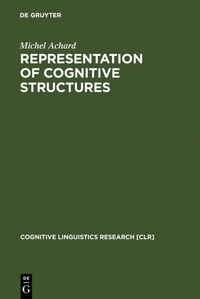
Representation of Cognitive Structures
Syntax and Semantics of French Sentential Complements
1st Edition
Published on 17. August 2011
XII, 377 pages
978-3-11-080595-6 (ISBN)
Description

No detailed description available for "Representation of Cognitive Structures".
More details
Series
Edition
Reprint 2011
Language
English
Place of publication
Berlin/Boston
Germany
Publishing group
de Gruyter Mouton
Target group
Professional and scholarly
US School Grade: College Graduate Student
Illustrations
38 Abbildungen
38 ill.
File size
8,72 MB
ISBN-13
978-3-11-080595-6 (9783110805956)
Schweitzer Classification
Other editions
Additional editions
Michel Achard
Representation of Cognitive Structures
Syntax and Semantics of French Sentential Complements
Book
06/1998
1st Edition
De Gruyter Mouton
€149.95
Shipment within 7-9 days
Michel Achard
Representation of Cognitive Structures
Syntax and Semantics of French Sentential Complements
Book
01/1998
1st Edition
De Gruyter Mouton
€209.00
Article exhausted; check different version
Content
- Intro
- Preface
- Chapter 1. Introduction: meaning and form
- 1.1. Semantics, syntax, and linguistic theory
- 1.2. Cognitive linguistics
- 1.3. Claims and advantages of the construal approach
- 1.4. Summary
- Chapter 2. Dimensions of construal
- 2.1. Introduction
- 2.2. The coding of events: basic elements of clause structure
- 2.3. Conceptualization of complex clauses
- 2.4. Construal of French complements
- 2.5. Summary
- Chapter 3. Causation/perception constructions
- 3.1. Introduction
- 3.2. Structural solutions
- 3.3. VOV and W: different construals on the same base
- 3.4. Main verbs and complement structures
- 3.5. Discussion and conclusion
- Chapter 4. Perspective: modal constructions
- 4.1. Introduction
- 4.2. French modals
- 4.3. The complements of modals
- 4.4. Discussion and conclusion
- Chapter 5. Conceptualizing subject constructions. Finite and infinitival complements
- 5.1. Introduction
- 5.2. Main verbs and the meaning of the CSC
- 5.3. Infinitival and finite complements
- 5.4. Main verbs and complement structures
- 5.5. Discussion and conclusion
- Chapter 6. Grounding
- 6.1. Introduction
- 6.2. The indicative/subjunctive distinction
- 6.3. Main verbs and complement structures
- 6.4. Discussion and conclusion
- Chapter 7. Impersonal constructions
- 7.1. Introduction
- 7.2. The meaning of French impersonals
- 7.3. The meaning of simple impersonals
- 7.4. The meaning of complex impersonals
- 7.5. Complement distribution in impersonal clauses
- 7.6. Relation between constructions
- 7.7. Conclusion and discussion
- Chapter 8. Concluding remarks
- 8.1 Recapitulation
- 8.2 Discussion
- Notes
- Chapter one
- Chapter two
- Chapter three
- Chapter four
- Chapter five
- Chapter six
- Chapter seven
- References
- Index
