

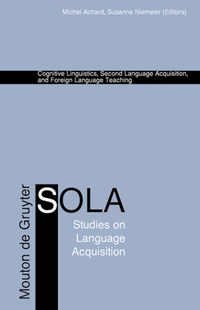
Cognitive Linguistics, Second Language Acquisition, and Foreign Language Teaching
Description

This collection of twelve papers demonstrates that the concepts developed within the Cognitive Linguistics movement afford an insightful perspective on several important areas of second language acquisition and pedagogy.
In the first part of the book, three papers show how three Cognitive Linguistics constructs provide a useful theoretical frame within which second language acquisition data can be analyzed. First, Talmy's typology of motion events is argued to constitute the base relative to which acquisition discrepancies in motion events are most valuably investigated. Secondly, the notion of "construction" is invoked in order to account for systematic differences between the native and non-native speakers' use of the English verb get. Finally, frequency and similarity effects are shown to play a crucial part in the learning of prepositions in a second language.
The second part of the book shows that the key concepts commonly invoked in Cognitive Linguistics analyses allow language teachers to insightfully structure the presentation of problematic material in the foreign language classroom. These concepts include among others polysemy, the figure/ground gestalt, the usage-based conception of grammar, the radial organization of categories, metaphors, and cultural scripts. The Cognitive Linguistics paradigm has already shown its viability to analyze a wide array of linguistic phenomena.
This book establishes its relevance in the areas of second language acquisition and language pedagogy. Its intended public is composed of Cognitive Linguists, Second Language Acquisition specialists, as well as foreign language pedagogy researchers, instructors, and students.
More details
Other editions
Additional editions
Persons
Content
2 - Contents [Seite 5]
3 - Introduction: Cognitive Linguistics, Language Acquisition, and Pedagogy [Seite 7]
4 - Expressing Motion Events in a Second Language: a Cognitive Typological Perspective [Seite 19]
5 - Construal, Convention, and Constructions in L2 Speech [Seite 57]
6 - Input Versus Transfer? - The Role of Frequency and Similarity in the Acquisition of L2 Prepositions [Seite 83]
7 - Linguistic and Cultural Relativity - Reconsidered for the Foreign Language Classroom [Seite 101]
8 - The Figure / Ground Gestalt and Language Teaching Methodology [Seite 125]
9 - "Cultural Scripts": a New Medium for Ethnopragmatic Instruction [Seite 149]
10 - Grammatical Instruction in the Natural Approach: a Cognitive Grammar View [Seite 171]
11 - Teaching Temporal Connectors and their Prototypical Non-temporal Extensions [Seite 201]
12 - Expanding Learners' Vocabulary Through Metaphor Awareness: What Expansion, What Learners, What Vocabulary? [Seite 217]
13 - A Cognitive Linguistic View of Polysemy in English and its Implications for Teaching [Seite 239]
14 - Applying Cognitive Linguistics to Pedagogical Grammar: The Case of Over [Seite 263]
15 - Backmatter [Seite 287]
