

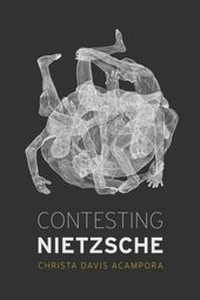
Contesting Nietzsche
1st Edition
Published on 31. May 2024
276 pages
978-0-226-92391-8 (ISBN)
Description

A brilliant exploration of a significant and understudied aspect of Nietzsche's philosophy.
In this groundbreaking work, Christa Davis Acampora offers a profound rethinking of Friedrich Nietzsche's crucial notion of the agon. Analyzing an impressive array of primary and secondary sources and synthesizing decades of Nietzsche scholarship, she shows how the agon, or contest, organized core areas of Nietzsche's philosophy, providing a new appreciation of the subtleties of his notorious views about power. By focusing so intensely on this particular guiding interest, she offers an exciting, original vantage from which to view this iconic thinker: Contesting Nietzsche.
Though existence-viewed through the lens of Nietzsche's agon-is fraught with struggle, Acampora illuminates what Nietzsche recognized as the agon's generative benefits. It imbues the human experience with significance, meaning, and value. Analyzing Nietzsche's elaborations of agonism-his remarks on types of contests, qualities of contestants, and the conditions in which either may thrive or deteriorate-she demonstrates how much the agon shaped his philosophical projects and critical assessments of others. The agon led him from one set of concerns to the next, from aesthetics to metaphysics to ethics to psychology, via Homer, Socrates, Saint Paul, and Wagner. In showing how one obsession catalyzed so many diverse interests, Contesting Nietzsche sheds fundamentally new light on some of this philosopher's most difficult and paradoxical ideas.
In this groundbreaking work, Christa Davis Acampora offers a profound rethinking of Friedrich Nietzsche's crucial notion of the agon. Analyzing an impressive array of primary and secondary sources and synthesizing decades of Nietzsche scholarship, she shows how the agon, or contest, organized core areas of Nietzsche's philosophy, providing a new appreciation of the subtleties of his notorious views about power. By focusing so intensely on this particular guiding interest, she offers an exciting, original vantage from which to view this iconic thinker: Contesting Nietzsche.
Though existence-viewed through the lens of Nietzsche's agon-is fraught with struggle, Acampora illuminates what Nietzsche recognized as the agon's generative benefits. It imbues the human experience with significance, meaning, and value. Analyzing Nietzsche's elaborations of agonism-his remarks on types of contests, qualities of contestants, and the conditions in which either may thrive or deteriorate-she demonstrates how much the agon shaped his philosophical projects and critical assessments of others. The agon led him from one set of concerns to the next, from aesthetics to metaphysics to ethics to psychology, via Homer, Socrates, Saint Paul, and Wagner. In showing how one obsession catalyzed so many diverse interests, Contesting Nietzsche sheds fundamentally new light on some of this philosopher's most difficult and paradoxical ideas.
All prices
More details
Other editions
Additional editions
Christa Davis Acampora
Contesting Nietzsche
Book
04/2013
University of Chicago Press
€44.57
Shipment within 10-20 days
Person
Christa Davis Acampora is associate professor of philosophy at Hunter College and the Graduate Center at City University of New York.
Content
- Intro
- Contents
- Acknowledgments
- Abbreviations and Citations of Nietzsche's Works
- Introduction
- 1. Agon as Analytic, Diagnostic, and Antidote
- 1.1 Valuing Animals
- 1.2 "Homer's Wettkampf" and the Good of the Second Eris
- 1.3 What Is an Agon? A Typology of Nietzsche's Contests
- 1.4 Lessons from Pindar: The Economy of Agonistic Values and the Circulation of Power
- 1.5 The End of the Game: Hybris and Violence
- 1.6 Agon Model as Diagnostic
- 1.7 Wrestling with the Past: Nietzsche's Agonistic Critique and Use of History
- 1.8 Introducing Nietzsche's Agonists
- 2. Contesting Homer: The Poiesis of Value
- 2.1 Homer's Contest as Exemplary Revaluation
- 2.2 The Apollinian (and the Dionysian): The Agon Begins
- 2.3 Deadly Modifications and the End of Agon
- 2.4 The Agon: Pessimism, Conservatism, and Racism
- 2.5 The Logic of the Contest
- 2.6 The "Ultimate Agony": Agonistic Antipodes
- 3. Contesting Socrates: Nietzsche's (Artful) Naturalism
- 3.1 Toward a "Superior Naturalism"
- 3.2 The Relation between Value and Inquiry
- 3.3 Toward the "Music-Practicing Socrates"
- 3.4 Semblance and Science
- 3.5 Artful Naturalism
- 3.6 Nietzsche's Problem of Development and His Heraclitean Solution
- 3.7 The Subject Naturalized: Nietzsche's Agonistic Model of the Soul
- 4. Contesting Paul: Toward an Ethos of Agonism
- 4.1 On the Possibility of Overcoming Morality
- 4.2 Fighting to the Death: The Agonies of Pauline Christianity
- 4.3 Conflicting Values and Worldviews
- 4.4 Sittlichkeit, Moral, and the Nature of Nietzsche's Postmoralism
- 4.5 The (Moral) Subject Naturalized
- 4.6 "Das Thun ist Alles"
- 5. Contesting Wagner: How One Becomes What One Is
- 5.1 Becoming What One Is
- 5.2 The Promise and Problem of Wagner
- 5.3 Nietzsche's Inheritance
- 5.4 Orders of Rank, Types, and Ruling Thoughts
- 5.5 Nietzsche as a Lover: Selfi shness versus Selfl essness
- 5.6 The Feeling of Power
- 5.7 Nietzsche's Responsibility
- 5.8 Fighting Writing: Nietzsche's Kriegs-Praxis
- 5.9 How One Becomes What One Is
- Afterword
- Notes
- Bibliography
- Index

