

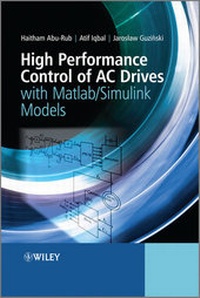
High Performance Control of AC Drives with Matlab / Simulink Models
Published on 23. March 2012
240 pages
978-1-119-96923-5 (ISBN)
Description

A comprehensive guide to understanding AC machines withexhaustive simulation models to practice design and control
Nearly seventy percent of the electricity generated worldwide isused by electrical motors. Worldwide, huge research efforts arebeing made to develop commercially viable three- and multi-phasemotor drive systems that are economically and technicallyfeasible.
Focusing on the most popular AC machines used in industry- induction machine and permanent magnet synchronous machine- this book illustrates advanced control techniques andtopologies in practice and recently deployed. Examples are drawnfrom important techniques including Vector Control, Direct TorqueControl, Nonlinear Control, Predictive Control, multi-phase drivesand multilevel inverters.
Key features include:
* systematic coverage of the advanced concepts of AC motor driveswith and without output filter;
* discussion on the modelling, analysis and control of three- andmulti-phase AC machine drives, including the recently developedmulti-phase-phase drive system and double fed inductionmachine;
* description of model predictive control applied to powerconverters and AC drives, illustrated together with theirsimulation models;
* end-of-chapter questions, with answers and PowerPoint slidesavailable on the companion website www.wiley.com/go/aburub_control
This book integrates a diverse range of topics into one usefulvolume, including most the latest developments. It provides aneffective guideline for students and professionals on many vitalelectric drives aspects. It is an advanced textbook for final yearundergraduate and graduate students, and researchers in powerelectronics, electric drives and motor control. It is also a handytool for specialists and practicing engineers wanting to developand verify their own algorithms and techniques.
Nearly seventy percent of the electricity generated worldwide isused by electrical motors. Worldwide, huge research efforts arebeing made to develop commercially viable three- and multi-phasemotor drive systems that are economically and technicallyfeasible.
Focusing on the most popular AC machines used in industry- induction machine and permanent magnet synchronous machine- this book illustrates advanced control techniques andtopologies in practice and recently deployed. Examples are drawnfrom important techniques including Vector Control, Direct TorqueControl, Nonlinear Control, Predictive Control, multi-phase drivesand multilevel inverters.
Key features include:
* systematic coverage of the advanced concepts of AC motor driveswith and without output filter;
* discussion on the modelling, analysis and control of three- andmulti-phase AC machine drives, including the recently developedmulti-phase-phase drive system and double fed inductionmachine;
* description of model predictive control applied to powerconverters and AC drives, illustrated together with theirsimulation models;
* end-of-chapter questions, with answers and PowerPoint slidesavailable on the companion website www.wiley.com/go/aburub_control
This book integrates a diverse range of topics into one usefulvolume, including most the latest developments. It provides aneffective guideline for students and professionals on many vitalelectric drives aspects. It is an advanced textbook for final yearundergraduate and graduate students, and researchers in powerelectronics, electric drives and motor control. It is also a handytool for specialists and practicing engineers wanting to developand verify their own algorithms and techniques.
More details
Other editions
Additional editions
Haitham Abu-Rub | Atif Iqbal | Jaroslaw Guzinski
High Performance Control of AC Drives with Matlab / Simulink Models
Book
04/2012
Wiley
Unfortunately, price unknown
Article exhausted; check for reprint
Persons
Dr Haitham Abu-Rub, Texas A&M University at Qatar
Dr Abu-Rub has been working in the academic field and has been an active expert in the area of electrical machine drives and power electronics for almost 20 years. He is currently Associate Professor at Texas A&M University at Qatar. From 1997 until 2005 he worked as first assistant professor and then associate professor at Birzet University, Palestine. He was appointed Chairman of the Electrical Engineering Department there for four years. Dr Abu-Rub has published around 80 journal and conference papers and has co-authored four lab manuals.
Dr Atif Iqbal, Aligarh Muslim University, India
Dr Iqbal is presently on academic leave from AMU and is working as Teaching Associate in Electrical & Computer Engineering at Texas A&M University at Qatar. He joined the Electrical Engineering Department at Aligarh Muslim University as a Lecturer in 1991 and was promoted to the post of Associate Professor in 2006. Dr Iqbal completed two large R&D projects from AICTE and CSIR, Govt. of India on multi-phase drive control and is currently supervising one large R&D project from CSIR, New Delhi, on Five-phase Matrix Converter and a project on Renewable Energy technology at TAMUQ under UREP. He has filed three patents on the electrical phase transformation systems and published more than is associate editor of International Journal of Electrical & Computer Engineering, SJI, USA.
Dr J. Guzinski, Gdansk University of Technology, Poland
Dr Guzinski is currently an adjunct with the faculty of Electrical and Control Engineering at Gdansk University of Technology. In 2001 he was the design engineer of power electronics converters at Electrotechnical Research Institute, Gdansk, and was invited as visiting professor at Ecole Superieure d'Ingenieurs de Poiters in France. From 2004-2006 and then from 2008-2010 he was head of two grants supported by Polish Government, dedicated to closed loop control of the induction motor with voltage inverter output filter. Dr Guzinski has authored or co-authored more than 80 papers presented in journals and conferences. He is reviewer in IEEE Transactions on Power Systems and IEEE Transactions on Industrial Electronics.
Dr Abu-Rub has been working in the academic field and has been an active expert in the area of electrical machine drives and power electronics for almost 20 years. He is currently Associate Professor at Texas A&M University at Qatar. From 1997 until 2005 he worked as first assistant professor and then associate professor at Birzet University, Palestine. He was appointed Chairman of the Electrical Engineering Department there for four years. Dr Abu-Rub has published around 80 journal and conference papers and has co-authored four lab manuals.
Dr Atif Iqbal, Aligarh Muslim University, India
Dr Iqbal is presently on academic leave from AMU and is working as Teaching Associate in Electrical & Computer Engineering at Texas A&M University at Qatar. He joined the Electrical Engineering Department at Aligarh Muslim University as a Lecturer in 1991 and was promoted to the post of Associate Professor in 2006. Dr Iqbal completed two large R&D projects from AICTE and CSIR, Govt. of India on multi-phase drive control and is currently supervising one large R&D project from CSIR, New Delhi, on Five-phase Matrix Converter and a project on Renewable Energy technology at TAMUQ under UREP. He has filed three patents on the electrical phase transformation systems and published more than is associate editor of International Journal of Electrical & Computer Engineering, SJI, USA.
Dr J. Guzinski, Gdansk University of Technology, Poland
Dr Guzinski is currently an adjunct with the faculty of Electrical and Control Engineering at Gdansk University of Technology. In 2001 he was the design engineer of power electronics converters at Electrotechnical Research Institute, Gdansk, and was invited as visiting professor at Ecole Superieure d'Ingenieurs de Poiters in France. From 2004-2006 and then from 2008-2010 he was head of two grants supported by Polish Government, dedicated to closed loop control of the induction motor with voltage inverter output filter. Dr Guzinski has authored or co-authored more than 80 papers presented in journals and conferences. He is reviewer in IEEE Transactions on Power Systems and IEEE Transactions on Industrial Electronics.
Content
1 - High Performance Control of AC Drives with Matlab/simulink Models [Seite 1]
1.1 - Contents [Seite 9]
1.2 - Acknowledgment [Seite 15]
1.3 - Biographies [Seite 17]
1.4 - Preface [Seite 19]
1.5 - 1 Introduction to High Performance Drives [Seite 21]
1.5.1 - 1.1 Preliminary Remarks [Seite 21]
1.5.2 - 1.2 General Overview of High Performance Drives [Seite 26]
1.5.3 - 1.3 Challenges and Requirements for Electric Drives for Industrial Applications [Seite 30]
1.5.3.1 - 1.3.1 Power Quality and LC Resonance Suppression [Seite 31]
1.5.3.2 - 1.3.2 Inverter Switching Frequency [Seite 32]
1.5.3.3 - 1.3.3 Motor Side Challenges [Seite 32]
1.5.3.4 - 1.3.4 High dv/dt and Wave Reflection [Seite 32]
1.5.3.5 - 1.3.5 Use of Inverter Output Filters [Seite 33]
1.5.4 - 1.4 Organization of the Book [Seite 33]
1.5.5 - References [Seite 36]
1.6 - 2 Mathematical and Simulation Models of AC Machines [Seite 39]
1.6.1 - 2.1 Preliminary Remarks [Seite 39]
1.6.2 - 2.2 DC Motors [Seite 39]
1.6.2.1 - 2.2.1 Separately Excited DC Motor Control [Seite 40]
1.6.2.2 - 2.2.2 Series DC Motor Control [Seite 42]
1.6.3 - 2.3 Squirrel Cage Induction Motor [Seite 45]
1.6.3.1 - 2.3.1 Space Vector Representation [Seite 45]
1.6.3.2 - 2.3.2 Clarke Transformation (ABC to ??) [Seite 46]
1.6.3.3 - 2.3.3 Park Transformation (?? to dq) [Seite 49]
1.6.3.4 - 2.3.4 Per Unit Model of Induction Motor [Seite 50]
1.6.3.5 - 2.3.5 Double Fed Induction Generator (DFIG) [Seite 52]
1.6.4 - 2.4 Mathematical Model of Permanent Magnet Synchronous Motor [Seite 55]
1.6.4.1 - 2.4.1 Motor Model in dq Rotating Frame [Seite 56]
1.6.4.2 - 2.4.2 Example of Motor Parameters for Simulation [Seite 58]
1.6.4.3 - 2.4.3 PMSM Model in Per Unit System [Seite 58]
1.6.4.4 - 2.4.4 PMSM Model in ?-? (x-y)-Axis [Seite 60]
1.6.5 - 2.5 Problems [Seite 62]
1.6.6 - References [Seite 62]
1.7 - 3 Pulse Width Modulation of Power Electronic DC-AC Converter [Seite 65]
1.7.1 - 3.1 Preliminary Remarks [Seite 65]
1.7.2 - 3.2 Classification of PWM Schemes for Voltage Source Inverters [Seite 66]
1.7.3 - 3.3 Pulse Width Modulated Inverters [Seite 66]
1.7.3.1 - 3.3.1 Single-Phase Half-bridge Inverters [Seite 66]
1.7.3.2 - 3.3.2 Single-Phase Full-bridge Inverters [Seite 74]
1.7.4 - 3.4 Three-phase PWM Voltage Source Inverter [Seite 76]
1.7.4.1 - 3.4.1 Carrier-based Sinusoidal PWM [Seite 84]
1.7.4.2 - 3.4.2 Third-harmonic Injection Carrier-based PWM [Seite 87]
1.7.4.3 - 3.4.3 Matlab/Simulink Model for Third Harmonic Injection PWM [Seite 88]
1.7.4.4 - 3.4.4 Carrier-based PWM with Offset Addition [Seite 89]
1.7.4.5 - 3.4.5 Space Vector PWM [Seite 92]
1.7.4.6 - 3.4.6 Discontinuous Space Vector PWM [Seite 97]
1.7.4.7 - 3.4.7 Matlab/Simulink Model for Space Vector PWM [Seite 98]
1.7.4.8 - 3.4.8 Space Vector PWM in Over-modulation Region [Seite 110]
1.7.4.9 - 3.4.9 Matlab/Simulink Model to Implement Space Vector PWM in Over-modulation Regions [Seite 116]
1.7.4.10 - 3.4.10 Harmonic Analysis [Seite 116]
1.7.4.11 - 3.4.11 Artificial Neural Network-based PWM [Seite 116]
1.7.4.12 - 3.4.12 Matlab/Simulink Model of Implementing ANN-based SVPWM [Seite 120]
1.7.5 - 3.5 Relationship between Carrier-based PWM and SVPWM [Seite 120]
1.7.5.1 - 3.5.1 Modulating Signals and Space Vectors [Seite 122]
1.7.5.2 - 3.5.2 Relationship between Line-to-line Voltages and Space Vectors [Seite 124]
1.7.5.3 - 3.5.3 Modulating Signals and Space Vector Sectors [Seite 124]
1.7.6 - 3.6 Multi-level Inverters [Seite 124]
1.7.6.1 - 3.6.1 Diode Clamped Multi-level Inverters [Seite 126]
1.7.6.2 - 3.6.2 Flying Capacitor Type Multi-level Inverter [Seite 129]
1.7.6.3 - 3.6.3 Cascaded H-Bridge Multi-level Inverter [Seite 132]
1.7.7 - 3.7 Impedance Source or Z-source Inverter [Seite 137]
1.7.7.1 - 3.7.1 Circuit Analysis [Seite 140]
1.7.7.2 - 3.7.2 Carrier-based Simple Boost PWM Control of a Z-source Inverter [Seite 142]
1.7.7.3 - 3.7.3 Carrier-based Maximum Boost PWM Control of a Z-source Inverter [Seite 143]
1.7.7.4 - 3.7.4 Matlab/Simulink Model of Z-source Inverter [Seite 144]
1.7.8 - 3.8 Quasi Impedance Source or qZSI Inverter [Seite 147]
1.7.8.1 - 3.8.1 Matlab/Simulink Model of qZ-source Inverter [Seite 149]
1.7.9 - 3.9 Dead Time Effect in a Multi-phase Inverter [Seite 149]
1.7.10 - 3.10 Summary [Seite 153]
1.7.11 - 3.11 Problems [Seite 154]
1.7.12 - References [Seite 155]
1.8 - 4 Field Oriented Control of AC Machines [Seite 159]
1.8.1 - 4.1 Introduction [Seite 159]
1.8.2 - 4.2 Induction Machines Control [Seite 159]
1.8.2.1 - 4.2.1 Control of Induction Motor using V/f Method [Seite 160]
1.8.2.2 - 4.2.2 Vector Control of Induction Motor [Seite 163]
1.8.2.3 - 4.2.3 Direct and Indirect Field Oriented Control [Seite 168]
1.8.2.4 - 4.2.4 Rotor and Stator Flux Computation [Seite 169]
1.8.2.5 - 4.2.5 Adaptive Flux Observers [Seite 170]
1.8.2.6 - 4.2.6 Stator Flux Orientation [Seite 172]
1.8.2.7 - 4.2.7 Field Weakening Control [Seite 172]
1.8.3 - 4.3 Vector Control of Double Fed Induction Generator (DFIG) [Seite 173]
1.8.3.1 - 4.3.1 Introduction [Seite 173]
1.8.3.2 - 4.3.2 Vector Control of DFIG Connected with the Grid (?? Model) [Seite 175]
1.8.3.3 - 4.3.3 Variables Transformation [Seite 176]
1.8.3.4 - 4.3.4 Simulation Results [Seite 179]
1.8.4 - 4.4 Control of Permanent Magnet Synchronous Machine [Seite 180]
1.8.4.1 - 4.4.1 Introduction [Seite 180]
1.8.4.2 - 4.4.2 Vector Control of PMSM in dq Axis [Seite 180]
1.8.4.3 - 4.4.3 Vector Control of PMSM in ?-? Axis using PI Controller [Seite 184]
1.8.4.4 - 4.4.4 Scalar Control of PMSM [Seite 186]
1.8.5 - Exercises [Seite 188]
1.8.6 - Additional Tasks [Seite 188]
1.8.7 - Possible Tasks for DFIG [Seite 188]
1.8.8 - Questions [Seite 189]
1.8.9 - References [Seite 189]
1.9 - 5 Direct Torque Control of AC Machines [Seite 191]
1.9.1 - 5.1 Preliminary Remarks [Seite 191]
1.9.2 - 5.2 Basic Concept and Principles of DTC [Seite 192]
1.9.2.1 - 5.2.1 Basic Concept [Seite 192]
1.9.2.2 - 5.2.2 Principle of DTC [Seite 193]
1.9.3 - 5.3 DTC of Induction Motor with Ideal Constant Machine Model [Seite 199]
1.9.3.1 - 5.3.1 Ideal Constant Parameter Model of Induction Motors [Seite 199]
1.9.3.2 - 5.3.2 Direct Torque Control Scheme [Seite 202]
1.9.3.3 - 5.3.3 Speed Control with DTC [Seite 204]
1.9.3.4 - 5.3.4 Matlab/Simulink Simulation of Torque Control and Speed Control with DTC [Seite 205]
1.9.4 - 5.4 DTC of Induction Motor with Consideration of Iron Loss [Seite 219]
1.9.4.1 - 5.4.1 Induction Machine Model with Iron Loss Consideration [Seite 219]
1.9.4.2 - 5.4.2 Matlab/Simulink Simulation of the Effects of Iron Losses in Torque Control and Speed Control [Seite 222]
1.9.4.3 - 5.4.3 Modified Direct Torque Control Scheme for Iron Loss Compensation [Seite 233]
1.9.5 - 5.5 DTC of Induction Motor with Consideration of both Iron Losses and Magnetic Saturation [Seite 237]
1.9.5.1 - 5.5.1 Induction Machine Model with Consideration of Iron Losses and Magnetic Saturation [Seite 237]
1.9.5.2 - 5.5.2 Matlab/Simulink Simulation of Effects of both Iron Losses and Magnetic Saturation in Torque Control and Speed Control [Seite 238]
1.9.6 - 5.6 Modified Direct Torque Control of Induction Machine with Constant Switching Frequency [Seite 253]
1.9.7 - 5.7 Direct Torque Control of Sinusoidal Permanent Magnet Synchronous Motors (SPMSM) [Seite 253]
1.9.7.1 - 5.7.1 Introduction [Seite 253]
1.9.7.2 - 5.7.2 Mathematical Model of Sinusoidal PMSM [Seite 254]
1.9.7.3 - 5.7.3 Direct Torque Control Scheme of PMSM [Seite 256]
1.9.7.4 - 5.7.4 Matlab/Simulink Simulation of SPMSM with DTC [Seite 256]
1.9.8 - References [Seite 273]
1.10 - 6 Non-Linear Control of Electrical Machines Using Non-Linear Feedback [Seite 275]
1.10.1 - 6.1 Introduction [Seite 275]
1.10.2 - 6.2 Dynamic System Linearization using Non-Linear Feedback [Seite 276]
1.10.3 - 6.3 Non-Linear Control of Separately Excited DC Motors [Seite 278]
1.10.3.1 - 6.3.1 Matlab/Simulink Non-Linear Control Model [Seite 278]
1.10.3.2 - 6.3.2 Non-Linear Control Systems [Seite 279]
1.10.3.3 - 6.3.3 Speed Controller [Seite 280]
1.10.3.4 - 6.3.4 Controller for Variable m [Seite 281]
1.10.3.5 - 6.3.5 Field Current Controller [Seite 282]
1.10.3.6 - 6.3.6 Simulation Results [Seite 282]
1.10.4 - 6.4 Multiscalar model (MM) of Induction Motor [Seite 282]
1.10.4.1 - 6.4.1 Multiscalar Variables [Seite 282]
1.10.4.2 - 6.4.2 Non-Linear Linearization of Induction Motor Fed by Voltage Controlled VSI [Seite 284]
1.10.4.3 - 6.4.3 Design of System Control [Seite 286]
1.10.4.4 - 6.4.4 Non-Linear Linearization of Induction Motor Fed by Current Controlled VSI [Seite 287]
1.10.4.5 - 6.4.5 Stator Oriented Non-Linear Control System (based on ?s, is) [Seite 290]
1.10.4.6 - 6.4.6 Rotor-Stator Fluxes-based Model [Seite 291]
1.10.4.7 - 6.4.7 Stator Oriented Multiscalar Model [Seite 292]
1.10.4.8 - 6.4.8 Multiscalar Control of Induction Motor [Seite 294]
1.10.4.9 - 6.4.9 Induction Motor Model [Seite 295]
1.10.4.10 - 6.4.10 State Transformations [Seite 295]
1.10.4.11 - 6.4.11 Decoupled IM Model [Seite 297]
1.10.5 - 6.5 MM of Double Fed Induction Machine (DFIM) [Seite 298]
1.10.6 - 6.6 Non-Linear Control of Permanent Magnet Synchronous Machine [Seite 301]
1.10.6.1 - 6.6.1 Non-Linear Control of PMSM for a dq Motor Model [Seite 303]
1.10.6.2 - 6.6.2 Non-Linear Vector Control of PMSM in ?-? Axis [Seite 305]
1.10.6.3 - 6.6.3 PMSM Model in ?-? (x-y) Axis [Seite 305]
1.10.6.4 - 6.6.4 Transformations [Seite 305]
1.10.6.5 - 6.6.5 Control System [Seite 308]
1.10.6.6 - 6.6.6 Simulation Results [Seite 308]
1.10.7 - 6.7 Problems [Seite 309]
1.10.8 - References [Seite 310]
1.11 - 7 Five-Phase Induction Motor Drive System [Seite 313]
1.11.1 - 7.1 Preliminary Remarks [Seite 313]
1.11.2 - 7.2 Advantages and Applications of Multi-Phase Drives [Seite 314]
1.11.3 - 7.3 Modeling and Simulation of a Five-Phase Induction Motor Drive [Seite 315]
1.11.3.1 - 7.3.1 Five-Phase Induction Motor Model [Seite 315]
1.11.3.2 - 7.3.2 Five-Phase Two-Level Voltage Source Inverter Model [Seite 324]
1.11.3.3 - 7.3.3 PWM Schemes of a Five-Phase VSI [Seite 348]
1.11.4 - 7.4 Indirect Rotor Field Oriented Control of Five-Phase Induction Motor [Seite 364]
1.11.4.1 - 7.4.1 Matlab/Simulink Model of Field-Oriented Control of Five-Phase Induction Machine [Seite 367]
1.11.5 - 7.5 Field Oriented Control of Five-Phase Induction Motor with Current Control in the Synchronous Reference Frame [Seite 368]
1.11.6 - 7.6 Model Predictive Control (MPC) [Seite 372]
1.11.6.1 - 7.6.1 MPC Applied to a Five-Phase Two-Level VSI [Seite 374]
1.11.6.2 - 7.6.2 Matlab/Simulink of MPC for Five-Phase VSI [Seite 376]
1.11.6.3 - 7.6.3 Using Eleven Vectors with ? = 0 [Seite 376]
1.11.6.4 - 7.6.4 Using Eleven Vectors with ? = 1 [Seite 379]
1.11.7 - 7.7 Summary [Seite 379]
1.11.8 - 7.8 Problems [Seite 379]
1.11.9 - References [Seite 381]
1.12 - 8 Sensorless Speed Control of AC Machines [Seite 385]
1.12.1 - 8.1 Preliminary Remarks [Seite 385]
1.12.2 - 8.2 Sensorless Control of Induction Motor [Seite 385]
1.12.2.1 - 8.2.1 Speed Estimation using Open Loop Model and Slip Computation [Seite 386]
1.12.2.2 - 8.2.2 Closed Loop Observers [Seite 386]
1.12.2.3 - 8.2.3 MRAS (Closed-loop) Speed Estimator [Seite 395]
1.12.2.4 - 8.2.4 The Use of Power Measurements [Seite 398]
1.12.3 - 8.3 Sensorless Control of PMSM [Seite 400]
1.12.3.1 - 8.3.1 Control system of PMSM [Seite 402]
1.12.3.2 - 8.3.2 Adaptive Backstepping Observer [Seite 403]
1.12.3.3 - 8.3.3 Model Reference Adaptive System for PMSM [Seite 405]
1.12.3.4 - 8.3.4 Simulation Results [Seite 408]
1.12.4 - 8.4 MRAS-based Sensorless Control of Five-Phase Induction Motor Drive [Seite 408]
1.12.4.1 - 8.4.1 MRAS-based Speed Estimator [Seite 409]
1.12.4.2 - 8.4.2 Simulation Results [Seite 416]
1.12.5 - References [Seite 416]
1.13 - 9 Selected Problems of Induction Motor Drives with Voltage Inverter and Inverter Output Filters [Seite 421]
1.13.1 - 9.1 Drives and Filters - Overview [Seite 421]
1.13.2 - 9.2 Three-Phase to Two-Phase Transformations [Seite 423]
1.13.3 - 9.3 Voltage and Current Common Mode Component [Seite 424]
1.13.3.1 - 9.3.1 Matlab/Simulink Model of Induction Motor Drive with PWM Inverter and Common Mode Voltage [Seite 425]
1.13.4 - 9.4 Induction Motor Common Mode Circuit [Seite 428]
1.13.5 - 9.5 Bearing Current Types and Reduction Methods [Seite 430]
1.13.5.1 - 9.5.1 Common Mode Choke [Seite 432]
1.13.5.2 - 9.5.2 Common Mode Transformers [Seite 434]
1.13.5.3 - 9.5.3 Common Mode Voltage Reduction by PWM Modifications [Seite 435]
1.13.6 - 9.6 Inverter Output Filters [Seite 440]
1.13.6.1 - 9.6.1 Selected Structures of Inverter Output Filters [Seite 440]
1.13.6.2 - 9.6.2 Inverter Output Filters Design [Seite 445]
1.13.6.3 - 9.6.3 Motor Choke [Seite 455]
1.13.6.4 - 9.6.4 Matlab/Simulink Model of Induction Motor Drive with PWM Inverter and Differential Mode (Normal Mode) LC Filter [Seite 457]
1.13.7 - 9.7 Estimation Problems in the Drive with Filters [Seite 460]
1.13.7.1 - 9.7.1 Introduction [Seite 460]
1.13.7.2 - 9.7.2 Speed Observer with Disturbances Model [Seite 462]
1.13.7.3 - 9.7.3 Simple Observer based on Motor Stator Models [Seite 465]
1.13.8 - 9.8 Motor Control Problems in the Drive with Filters [Seite 467]
1.13.8.1 - 9.8.1 Introduction [Seite 467]
1.13.8.2 - 9.8.2 Field Oriented Control [Seite 469]
1.13.8.3 - 9.8.3 Non-Linear Field Oriented Control [Seite 473]
1.13.8.4 - 9.8.4 Non-Linear Multiscalar Control [Seite 477]
1.13.9 - 9.9 Predictive Current Control in the Drive System with Output Filter [Seite 481]
1.13.9.1 - 9.9.1 Control System [Seite 481]
1.13.9.2 - 9.9.2 Predictive Current Controller [Seite 484]
1.13.9.3 - 9.9.3 EMF Estimation Technique [Seite 487]
1.13.10 - 9.10 Problems [Seite 491]
1.13.11 - 9.11 Questions [Seite 495]
1.13.12 - References [Seite 495]
1.14 - Index [Seite 499]
1.1 - Contents [Seite 9]
1.2 - Acknowledgment [Seite 15]
1.3 - Biographies [Seite 17]
1.4 - Preface [Seite 19]
1.5 - 1 Introduction to High Performance Drives [Seite 21]
1.5.1 - 1.1 Preliminary Remarks [Seite 21]
1.5.2 - 1.2 General Overview of High Performance Drives [Seite 26]
1.5.3 - 1.3 Challenges and Requirements for Electric Drives for Industrial Applications [Seite 30]
1.5.3.1 - 1.3.1 Power Quality and LC Resonance Suppression [Seite 31]
1.5.3.2 - 1.3.2 Inverter Switching Frequency [Seite 32]
1.5.3.3 - 1.3.3 Motor Side Challenges [Seite 32]
1.5.3.4 - 1.3.4 High dv/dt and Wave Reflection [Seite 32]
1.5.3.5 - 1.3.5 Use of Inverter Output Filters [Seite 33]
1.5.4 - 1.4 Organization of the Book [Seite 33]
1.5.5 - References [Seite 36]
1.6 - 2 Mathematical and Simulation Models of AC Machines [Seite 39]
1.6.1 - 2.1 Preliminary Remarks [Seite 39]
1.6.2 - 2.2 DC Motors [Seite 39]
1.6.2.1 - 2.2.1 Separately Excited DC Motor Control [Seite 40]
1.6.2.2 - 2.2.2 Series DC Motor Control [Seite 42]
1.6.3 - 2.3 Squirrel Cage Induction Motor [Seite 45]
1.6.3.1 - 2.3.1 Space Vector Representation [Seite 45]
1.6.3.2 - 2.3.2 Clarke Transformation (ABC to ??) [Seite 46]
1.6.3.3 - 2.3.3 Park Transformation (?? to dq) [Seite 49]
1.6.3.4 - 2.3.4 Per Unit Model of Induction Motor [Seite 50]
1.6.3.5 - 2.3.5 Double Fed Induction Generator (DFIG) [Seite 52]
1.6.4 - 2.4 Mathematical Model of Permanent Magnet Synchronous Motor [Seite 55]
1.6.4.1 - 2.4.1 Motor Model in dq Rotating Frame [Seite 56]
1.6.4.2 - 2.4.2 Example of Motor Parameters for Simulation [Seite 58]
1.6.4.3 - 2.4.3 PMSM Model in Per Unit System [Seite 58]
1.6.4.4 - 2.4.4 PMSM Model in ?-? (x-y)-Axis [Seite 60]
1.6.5 - 2.5 Problems [Seite 62]
1.6.6 - References [Seite 62]
1.7 - 3 Pulse Width Modulation of Power Electronic DC-AC Converter [Seite 65]
1.7.1 - 3.1 Preliminary Remarks [Seite 65]
1.7.2 - 3.2 Classification of PWM Schemes for Voltage Source Inverters [Seite 66]
1.7.3 - 3.3 Pulse Width Modulated Inverters [Seite 66]
1.7.3.1 - 3.3.1 Single-Phase Half-bridge Inverters [Seite 66]
1.7.3.2 - 3.3.2 Single-Phase Full-bridge Inverters [Seite 74]
1.7.4 - 3.4 Three-phase PWM Voltage Source Inverter [Seite 76]
1.7.4.1 - 3.4.1 Carrier-based Sinusoidal PWM [Seite 84]
1.7.4.2 - 3.4.2 Third-harmonic Injection Carrier-based PWM [Seite 87]
1.7.4.3 - 3.4.3 Matlab/Simulink Model for Third Harmonic Injection PWM [Seite 88]
1.7.4.4 - 3.4.4 Carrier-based PWM with Offset Addition [Seite 89]
1.7.4.5 - 3.4.5 Space Vector PWM [Seite 92]
1.7.4.6 - 3.4.6 Discontinuous Space Vector PWM [Seite 97]
1.7.4.7 - 3.4.7 Matlab/Simulink Model for Space Vector PWM [Seite 98]
1.7.4.8 - 3.4.8 Space Vector PWM in Over-modulation Region [Seite 110]
1.7.4.9 - 3.4.9 Matlab/Simulink Model to Implement Space Vector PWM in Over-modulation Regions [Seite 116]
1.7.4.10 - 3.4.10 Harmonic Analysis [Seite 116]
1.7.4.11 - 3.4.11 Artificial Neural Network-based PWM [Seite 116]
1.7.4.12 - 3.4.12 Matlab/Simulink Model of Implementing ANN-based SVPWM [Seite 120]
1.7.5 - 3.5 Relationship between Carrier-based PWM and SVPWM [Seite 120]
1.7.5.1 - 3.5.1 Modulating Signals and Space Vectors [Seite 122]
1.7.5.2 - 3.5.2 Relationship between Line-to-line Voltages and Space Vectors [Seite 124]
1.7.5.3 - 3.5.3 Modulating Signals and Space Vector Sectors [Seite 124]
1.7.6 - 3.6 Multi-level Inverters [Seite 124]
1.7.6.1 - 3.6.1 Diode Clamped Multi-level Inverters [Seite 126]
1.7.6.2 - 3.6.2 Flying Capacitor Type Multi-level Inverter [Seite 129]
1.7.6.3 - 3.6.3 Cascaded H-Bridge Multi-level Inverter [Seite 132]
1.7.7 - 3.7 Impedance Source or Z-source Inverter [Seite 137]
1.7.7.1 - 3.7.1 Circuit Analysis [Seite 140]
1.7.7.2 - 3.7.2 Carrier-based Simple Boost PWM Control of a Z-source Inverter [Seite 142]
1.7.7.3 - 3.7.3 Carrier-based Maximum Boost PWM Control of a Z-source Inverter [Seite 143]
1.7.7.4 - 3.7.4 Matlab/Simulink Model of Z-source Inverter [Seite 144]
1.7.8 - 3.8 Quasi Impedance Source or qZSI Inverter [Seite 147]
1.7.8.1 - 3.8.1 Matlab/Simulink Model of qZ-source Inverter [Seite 149]
1.7.9 - 3.9 Dead Time Effect in a Multi-phase Inverter [Seite 149]
1.7.10 - 3.10 Summary [Seite 153]
1.7.11 - 3.11 Problems [Seite 154]
1.7.12 - References [Seite 155]
1.8 - 4 Field Oriented Control of AC Machines [Seite 159]
1.8.1 - 4.1 Introduction [Seite 159]
1.8.2 - 4.2 Induction Machines Control [Seite 159]
1.8.2.1 - 4.2.1 Control of Induction Motor using V/f Method [Seite 160]
1.8.2.2 - 4.2.2 Vector Control of Induction Motor [Seite 163]
1.8.2.3 - 4.2.3 Direct and Indirect Field Oriented Control [Seite 168]
1.8.2.4 - 4.2.4 Rotor and Stator Flux Computation [Seite 169]
1.8.2.5 - 4.2.5 Adaptive Flux Observers [Seite 170]
1.8.2.6 - 4.2.6 Stator Flux Orientation [Seite 172]
1.8.2.7 - 4.2.7 Field Weakening Control [Seite 172]
1.8.3 - 4.3 Vector Control of Double Fed Induction Generator (DFIG) [Seite 173]
1.8.3.1 - 4.3.1 Introduction [Seite 173]
1.8.3.2 - 4.3.2 Vector Control of DFIG Connected with the Grid (?? Model) [Seite 175]
1.8.3.3 - 4.3.3 Variables Transformation [Seite 176]
1.8.3.4 - 4.3.4 Simulation Results [Seite 179]
1.8.4 - 4.4 Control of Permanent Magnet Synchronous Machine [Seite 180]
1.8.4.1 - 4.4.1 Introduction [Seite 180]
1.8.4.2 - 4.4.2 Vector Control of PMSM in dq Axis [Seite 180]
1.8.4.3 - 4.4.3 Vector Control of PMSM in ?-? Axis using PI Controller [Seite 184]
1.8.4.4 - 4.4.4 Scalar Control of PMSM [Seite 186]
1.8.5 - Exercises [Seite 188]
1.8.6 - Additional Tasks [Seite 188]
1.8.7 - Possible Tasks for DFIG [Seite 188]
1.8.8 - Questions [Seite 189]
1.8.9 - References [Seite 189]
1.9 - 5 Direct Torque Control of AC Machines [Seite 191]
1.9.1 - 5.1 Preliminary Remarks [Seite 191]
1.9.2 - 5.2 Basic Concept and Principles of DTC [Seite 192]
1.9.2.1 - 5.2.1 Basic Concept [Seite 192]
1.9.2.2 - 5.2.2 Principle of DTC [Seite 193]
1.9.3 - 5.3 DTC of Induction Motor with Ideal Constant Machine Model [Seite 199]
1.9.3.1 - 5.3.1 Ideal Constant Parameter Model of Induction Motors [Seite 199]
1.9.3.2 - 5.3.2 Direct Torque Control Scheme [Seite 202]
1.9.3.3 - 5.3.3 Speed Control with DTC [Seite 204]
1.9.3.4 - 5.3.4 Matlab/Simulink Simulation of Torque Control and Speed Control with DTC [Seite 205]
1.9.4 - 5.4 DTC of Induction Motor with Consideration of Iron Loss [Seite 219]
1.9.4.1 - 5.4.1 Induction Machine Model with Iron Loss Consideration [Seite 219]
1.9.4.2 - 5.4.2 Matlab/Simulink Simulation of the Effects of Iron Losses in Torque Control and Speed Control [Seite 222]
1.9.4.3 - 5.4.3 Modified Direct Torque Control Scheme for Iron Loss Compensation [Seite 233]
1.9.5 - 5.5 DTC of Induction Motor with Consideration of both Iron Losses and Magnetic Saturation [Seite 237]
1.9.5.1 - 5.5.1 Induction Machine Model with Consideration of Iron Losses and Magnetic Saturation [Seite 237]
1.9.5.2 - 5.5.2 Matlab/Simulink Simulation of Effects of both Iron Losses and Magnetic Saturation in Torque Control and Speed Control [Seite 238]
1.9.6 - 5.6 Modified Direct Torque Control of Induction Machine with Constant Switching Frequency [Seite 253]
1.9.7 - 5.7 Direct Torque Control of Sinusoidal Permanent Magnet Synchronous Motors (SPMSM) [Seite 253]
1.9.7.1 - 5.7.1 Introduction [Seite 253]
1.9.7.2 - 5.7.2 Mathematical Model of Sinusoidal PMSM [Seite 254]
1.9.7.3 - 5.7.3 Direct Torque Control Scheme of PMSM [Seite 256]
1.9.7.4 - 5.7.4 Matlab/Simulink Simulation of SPMSM with DTC [Seite 256]
1.9.8 - References [Seite 273]
1.10 - 6 Non-Linear Control of Electrical Machines Using Non-Linear Feedback [Seite 275]
1.10.1 - 6.1 Introduction [Seite 275]
1.10.2 - 6.2 Dynamic System Linearization using Non-Linear Feedback [Seite 276]
1.10.3 - 6.3 Non-Linear Control of Separately Excited DC Motors [Seite 278]
1.10.3.1 - 6.3.1 Matlab/Simulink Non-Linear Control Model [Seite 278]
1.10.3.2 - 6.3.2 Non-Linear Control Systems [Seite 279]
1.10.3.3 - 6.3.3 Speed Controller [Seite 280]
1.10.3.4 - 6.3.4 Controller for Variable m [Seite 281]
1.10.3.5 - 6.3.5 Field Current Controller [Seite 282]
1.10.3.6 - 6.3.6 Simulation Results [Seite 282]
1.10.4 - 6.4 Multiscalar model (MM) of Induction Motor [Seite 282]
1.10.4.1 - 6.4.1 Multiscalar Variables [Seite 282]
1.10.4.2 - 6.4.2 Non-Linear Linearization of Induction Motor Fed by Voltage Controlled VSI [Seite 284]
1.10.4.3 - 6.4.3 Design of System Control [Seite 286]
1.10.4.4 - 6.4.4 Non-Linear Linearization of Induction Motor Fed by Current Controlled VSI [Seite 287]
1.10.4.5 - 6.4.5 Stator Oriented Non-Linear Control System (based on ?s, is) [Seite 290]
1.10.4.6 - 6.4.6 Rotor-Stator Fluxes-based Model [Seite 291]
1.10.4.7 - 6.4.7 Stator Oriented Multiscalar Model [Seite 292]
1.10.4.8 - 6.4.8 Multiscalar Control of Induction Motor [Seite 294]
1.10.4.9 - 6.4.9 Induction Motor Model [Seite 295]
1.10.4.10 - 6.4.10 State Transformations [Seite 295]
1.10.4.11 - 6.4.11 Decoupled IM Model [Seite 297]
1.10.5 - 6.5 MM of Double Fed Induction Machine (DFIM) [Seite 298]
1.10.6 - 6.6 Non-Linear Control of Permanent Magnet Synchronous Machine [Seite 301]
1.10.6.1 - 6.6.1 Non-Linear Control of PMSM for a dq Motor Model [Seite 303]
1.10.6.2 - 6.6.2 Non-Linear Vector Control of PMSM in ?-? Axis [Seite 305]
1.10.6.3 - 6.6.3 PMSM Model in ?-? (x-y) Axis [Seite 305]
1.10.6.4 - 6.6.4 Transformations [Seite 305]
1.10.6.5 - 6.6.5 Control System [Seite 308]
1.10.6.6 - 6.6.6 Simulation Results [Seite 308]
1.10.7 - 6.7 Problems [Seite 309]
1.10.8 - References [Seite 310]
1.11 - 7 Five-Phase Induction Motor Drive System [Seite 313]
1.11.1 - 7.1 Preliminary Remarks [Seite 313]
1.11.2 - 7.2 Advantages and Applications of Multi-Phase Drives [Seite 314]
1.11.3 - 7.3 Modeling and Simulation of a Five-Phase Induction Motor Drive [Seite 315]
1.11.3.1 - 7.3.1 Five-Phase Induction Motor Model [Seite 315]
1.11.3.2 - 7.3.2 Five-Phase Two-Level Voltage Source Inverter Model [Seite 324]
1.11.3.3 - 7.3.3 PWM Schemes of a Five-Phase VSI [Seite 348]
1.11.4 - 7.4 Indirect Rotor Field Oriented Control of Five-Phase Induction Motor [Seite 364]
1.11.4.1 - 7.4.1 Matlab/Simulink Model of Field-Oriented Control of Five-Phase Induction Machine [Seite 367]
1.11.5 - 7.5 Field Oriented Control of Five-Phase Induction Motor with Current Control in the Synchronous Reference Frame [Seite 368]
1.11.6 - 7.6 Model Predictive Control (MPC) [Seite 372]
1.11.6.1 - 7.6.1 MPC Applied to a Five-Phase Two-Level VSI [Seite 374]
1.11.6.2 - 7.6.2 Matlab/Simulink of MPC for Five-Phase VSI [Seite 376]
1.11.6.3 - 7.6.3 Using Eleven Vectors with ? = 0 [Seite 376]
1.11.6.4 - 7.6.4 Using Eleven Vectors with ? = 1 [Seite 379]
1.11.7 - 7.7 Summary [Seite 379]
1.11.8 - 7.8 Problems [Seite 379]
1.11.9 - References [Seite 381]
1.12 - 8 Sensorless Speed Control of AC Machines [Seite 385]
1.12.1 - 8.1 Preliminary Remarks [Seite 385]
1.12.2 - 8.2 Sensorless Control of Induction Motor [Seite 385]
1.12.2.1 - 8.2.1 Speed Estimation using Open Loop Model and Slip Computation [Seite 386]
1.12.2.2 - 8.2.2 Closed Loop Observers [Seite 386]
1.12.2.3 - 8.2.3 MRAS (Closed-loop) Speed Estimator [Seite 395]
1.12.2.4 - 8.2.4 The Use of Power Measurements [Seite 398]
1.12.3 - 8.3 Sensorless Control of PMSM [Seite 400]
1.12.3.1 - 8.3.1 Control system of PMSM [Seite 402]
1.12.3.2 - 8.3.2 Adaptive Backstepping Observer [Seite 403]
1.12.3.3 - 8.3.3 Model Reference Adaptive System for PMSM [Seite 405]
1.12.3.4 - 8.3.4 Simulation Results [Seite 408]
1.12.4 - 8.4 MRAS-based Sensorless Control of Five-Phase Induction Motor Drive [Seite 408]
1.12.4.1 - 8.4.1 MRAS-based Speed Estimator [Seite 409]
1.12.4.2 - 8.4.2 Simulation Results [Seite 416]
1.12.5 - References [Seite 416]
1.13 - 9 Selected Problems of Induction Motor Drives with Voltage Inverter and Inverter Output Filters [Seite 421]
1.13.1 - 9.1 Drives and Filters - Overview [Seite 421]
1.13.2 - 9.2 Three-Phase to Two-Phase Transformations [Seite 423]
1.13.3 - 9.3 Voltage and Current Common Mode Component [Seite 424]
1.13.3.1 - 9.3.1 Matlab/Simulink Model of Induction Motor Drive with PWM Inverter and Common Mode Voltage [Seite 425]
1.13.4 - 9.4 Induction Motor Common Mode Circuit [Seite 428]
1.13.5 - 9.5 Bearing Current Types and Reduction Methods [Seite 430]
1.13.5.1 - 9.5.1 Common Mode Choke [Seite 432]
1.13.5.2 - 9.5.2 Common Mode Transformers [Seite 434]
1.13.5.3 - 9.5.3 Common Mode Voltage Reduction by PWM Modifications [Seite 435]
1.13.6 - 9.6 Inverter Output Filters [Seite 440]
1.13.6.1 - 9.6.1 Selected Structures of Inverter Output Filters [Seite 440]
1.13.6.2 - 9.6.2 Inverter Output Filters Design [Seite 445]
1.13.6.3 - 9.6.3 Motor Choke [Seite 455]
1.13.6.4 - 9.6.4 Matlab/Simulink Model of Induction Motor Drive with PWM Inverter and Differential Mode (Normal Mode) LC Filter [Seite 457]
1.13.7 - 9.7 Estimation Problems in the Drive with Filters [Seite 460]
1.13.7.1 - 9.7.1 Introduction [Seite 460]
1.13.7.2 - 9.7.2 Speed Observer with Disturbances Model [Seite 462]
1.13.7.3 - 9.7.3 Simple Observer based on Motor Stator Models [Seite 465]
1.13.8 - 9.8 Motor Control Problems in the Drive with Filters [Seite 467]
1.13.8.1 - 9.8.1 Introduction [Seite 467]
1.13.8.2 - 9.8.2 Field Oriented Control [Seite 469]
1.13.8.3 - 9.8.3 Non-Linear Field Oriented Control [Seite 473]
1.13.8.4 - 9.8.4 Non-Linear Multiscalar Control [Seite 477]
1.13.9 - 9.9 Predictive Current Control in the Drive System with Output Filter [Seite 481]
1.13.9.1 - 9.9.1 Control System [Seite 481]
1.13.9.2 - 9.9.2 Predictive Current Controller [Seite 484]
1.13.9.3 - 9.9.3 EMF Estimation Technique [Seite 487]
1.13.10 - 9.10 Problems [Seite 491]
1.13.11 - 9.11 Questions [Seite 495]
1.13.12 - References [Seite 495]
1.14 - Index [Seite 499]
