

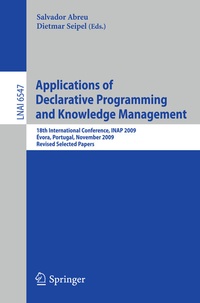
Applications of Declarative Programming and Knowledge Management
18th International Conference, INAP 2009, Évora, Portugal, November 3-5, 2009, Revised Selected Papers
Published on 20. April 2011
X, 239 pages
978-3-642-20589-7 (ISBN)
Description

This book constitutes the thoroughly refereed post-conference
proceedings of the 18th International Conference on Applications of
Declarative Programming and Knowledge Management, INAP 2009, held in
Évora, Portugal, in November 2009.
The 12 revised full papers presented together with 2 invited talks were
carefully reviewed and selected during two rounds of reviewing and
improvement. The conference comprehensively covers the impact
of programmable logic solvers in the internet society, its underlying
technologies, and leading edge applications in industry, commerce,
government, and societal services. The topics of the selected papers
concentrate on three currently important fields: foundations and
extensions of logic programming, databases and query languages,
declarative programming with logic languages, and applications thereof.
More details
Other editions
Additional editions
Salvador Abreu | Dietmar Seipel
Applications of Declarative Programming and Knowledge Management
18th International Conference, INAP 2009, Évora, Portugal, November 3-5, 2009, Revised Selected Papers
Book
04/2011
Springer
€53.49
Shipment within 7-9 days
Persons
Content
- Intro
- Preface
- Organization
- Table of Contents
- Invited Talks
- Design Patterns for Tabled Logic Programming
- Introduction
- Tabling for Definite Programs
- Tabling with Negation
- Answer Subsumption, Constraints, and Other Extensions
- Discussion
- References
- An Alternative High-Level Approach to Interaction with Databases
- Introduction
- Notational Conventions
- The Scheme
- The Modelling Viewpoint
- The Scheme Structure
- Queries
- Illustration of the Main Features
- A Formal Account of Query Answers
- Derived Attributes and Universal Quantification
- Manifold Attributes
- Commands
- Summary of Achievements and Further Work
- References
- Foundations and Extensions of Logic Programming
- ISTO: A Language for Temporal Organizational Information Systems
- Introduction and Motivation
- An Overview of Temporal Contextual Logic Programming
- Contextual Logic Programming
- Temporal Annotated Constraint Logic Programming
- Temporal Contextual Logic Programming
- The ISTO Language
- Classes
- Methods
- Inheritance
- Composition
- Persistence
- Data Manipulation Goals
- Compilation Scheme for ISTO
- (Temporal) Classes
- Temporal Data Manipulation Goals
- Comparison with Other Approaches
- Conclusions and Future Work
- References
- Programming Patterns for Logtalk Parametric Objects
- Introduction
- Accessing Object Parameters
- Parameter Passing
- Programming Patterns
- Using Parameters for Passing Typing Information
- Customizing Object Predicates
- Simplifying Object Interfaces
- Data-Centric Programming
- Restoring Shared Constraint Variables
- Logical Updates of Object State
- Parametric Object Proxies
- Using Both Object Proxies and Regular Objects
- Related Work
- L&O Parametric Theories
- SICStus Parametric Objects
- OL(P) Object Instances
- GNU Prolog/CX Parametric Units
- Conclusions
- References
- Stable Model Implementation of Layer Supported Models by Program Transformation
- Introduction and Motivation
- Integrity Constraints and Inconsistencies
- Background Notation and Definitions
- Layering of Logic Programs
- Layer Supported Models Semantics
- Respect for the Well-Founded Model
- Program Transformation
- Top-Down Transformation
- Number of Models
- Implementation
- Conclusions and Future Work
- References
- Towards Computing Revised Models for FO Theories
- Introduction
- Preliminaries
- The Revision Problem
- Basic Revision Problems
- Domain and Theory Changes
- Weighted Revision Problems
- Solving the Revision Problem
- Grounding
- Optimized Grounding
- Reducing the Search Space
- Search Bounds
- Enlarging the Search Bound
- Implementation and Experiments
- Implementation of the Grounding Phase
- Experiments
- Related and Future Work
- Conclusions
- References
- Adaptive Reasoning for Cooperative Agents
- Introduction
- Theory Building and Refinement
- Strategies for Combining Different Generalizations
- Strategies for Eliminating Learned Contradictions
- Explaining Observations and Meta-learning
- Abduction
- Finding Alternative Explanations for Observations
- Choosing the Best Explanation
- Argumentation
- Intuition
- Assumptions and Argumentation
- Collaborative Opposition
- Conclusions
- References
- Databases and Query Languages
- Extending XQuery for Semantic Web Reasoning
- Introduction
- Ontology Representation
- Extended XQuery
- Prolog Implementation
- Ontology Encoding
- Encoding of XML Documents
- Encoding of XQuery
- Conclusions and Future Work
- References
- Reference Model and Perspective Schemata Inference for Enterprise Data Integration
- Introduction
- Related Work
- The Framework
- Perspective Schema Language
- ``Require'' Declarations
- Matching Functions
- Correspondence Assertions
- Inference Mechanism
- Rewriting Rules
- Inference
- Implementation Details
- Conclusions and Future Works
- References
- JSquash: Source Code Analysis of Embedded Database Applications for Determining SQL Statements
- Introduction
- Management of Java Source Code with Prolog
- Representation of Java Source Code in Xml
- The JSquash Repository
- Static Code Analysis
- Local and Global Variables
- Detection of Flaws and Code Smells
- Backward Tracing of the Control Flow
- Overview of the Evaluation Strategy
- Variable Access Expressions
- Binary Expressions
- Literal Expressions
- Management of Loops
- Input Operations
- Embedded Sql Statements
- Visualization of Sql Statements in the Source Code
- Xml Representation of Sql Statements
- Visualization of Database Schemas and Sql Statements
- Conclusions
- References
- Applications
- Elder Care via Intention Recognition and Evolution Prospection
- Introduction
- Intention Recognition
- Causal Bayes Networks
- Intention Recognition with Causal Bayesian Networks
- P-Log
- Elder Intention Recognition
- Plan Generation
- Elder Assisting with Evolution Prospection
- Preliminary
- Evolution Prospection as an Intention Consumer
- Conclusions and Future Work
- References
- Knowledge Management Strategy and Tactics for Forging Die Design Support
- Introduction
- System Overview
- Modeling of Forged Product and Die
- Shape Representation
- Object Model Representation
- Formalization of Die and Die-Set Design Problems
- Formal Definition of Design Problem
- Resolving Method of the Design Space
- Systematization of Die and Die-Set Design Knowledge
- Design Space of Forming Portion Design
- Design Space of the Detailed Design of the Die Insert
- System Implementation
- Experimental Results
- Conclusions and Future Work
- References
- Searching in Protein State Space
- Introduction
- Manipulation of XML Structures in PROLOG
- XML Representations and Path Expressions
- The Query Language
- Representation and Searching
- Formal Representation of Protein Function
- Representation of General Biological Concepts
- Searching through Protein States
- Applications
- Jak-Stat Pathway
- MAP Kinase Pathway
- Simulation
- Conclusions
- Network Monitoring with Constraint Programming: Preliminary Specification and Analysis
- Introduction
- Network Monitoring
- Constraint Programming
- Modeling Network Monitoring with Constraint Programming
- Network Traffic Window as Variables Domain
- Approaches
- Modeling a Portscan Attack as a CSP
- Experimental Results
- Using Extensional Constraints
- Using Extensional Constraints with Element Constraints
- Experimental Evaluation
- Conclusions and Future Work
- References
- Author Index
