

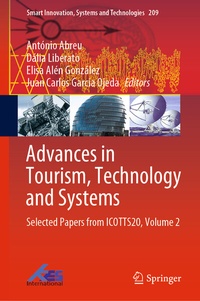
Advances in Tourism, Technology and Systems
Description

More details
Other editions
Additional editions
Persons
António Abreu is Adjunct Professor at the Polytechnic Institute of Accounting and Administration of Porto, Instituto Politécnico do Porto. He completed postdoctorate in Technologies and Information Systems, Department of Informatics Engineering, Faculty of Sciences and Technology, University of Coimbra, Ph.D. in Software Engineering based on reusable components with Human-Machine Interface applications, University of Vigo, and Master in Management Informatics from the University of Minho and Licentiate in Informatics-Mathematics Applied by Universidade Lusíada. He currently works as Lecturer in the Information Systems sciences area of the Polytechnic Institute of Accounting and Administration of Porto/Politécnico do Porto, ISCAP/PPorto. He is an effective member of the CEOS.PP Research Center - Center for Organizational and Social Studies of the Polytechnic of Oporto. Between 2015 and 2018, he was Coordinator of the Advanced Professional Technical Courses (CTeSP) of the Higher Institute of Accounting and Administration of Porto (ISCAP) and Coordinator for Market Development of ISCAP's Center for Training and Services Abroad. 2017/2018 - Coordinator of the ISCAP/ACINNET Business Council. He is Conference Chair of the ICOTTS 2019 - The 2019 International Conference on Tourism, Technology & Systems. He is a scientific committee member of several conferences in the area of Information Systems and Technologies.
Dália Liberato is Professor of Tourism, specializing in tourism destinations management and tourism planning, at the School of Hospitality and Tourism, Polytechnic of Porto. Currently, she coordinates the Tourist Activities Management degree in the same school. Her main research interests are tourism management, tourism planning, cross-border tourism, creative tourism, and e-tourism.
Elisa Alén is Associate Professor of Marketing specializing in tourism marketing at the Faculty of Business Sciences and Tourism, University of Vigo. Elisa's research work lies in tourist behaviour, from motivation to behavioural intentions, focusing on improving satisfaction. In recent years, she has focused on different types of tourism, mainly thermal and senior tourism.
Juan Carlos Garcia Ojeda is Tenure-Track Professor at the Universidad de Cartagena (Colombia). He completed Ph.D. in Science Technology from the University of Pannonia (Hungary), M.Sc. in Computer Science from Kansas State University (USA), M.Sc. in Computer Science from Instituto Tecnológico y de Estudios Superiores de Monterrey (Mexico) in agreement with the Universidad Autónoma de Bucaramanga (Colombia), and B.Sc. from Universidad Autónoma de Bucaramanga (Colombia). He is a member of the Association for Computing Machinery (ACM), State Alumni (US Department of State), Colombia-USA Exchange Alumni Association; also, Regional Promoter, for the Caribbean region, of the Colombian Society of Computation (SCo2). He has published several papers in both national and internationaljournals, book chapters, and a book and participated and presented papers in national and international conferences.
