

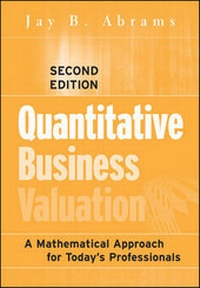
Quantitative Business Valuation
A Mathematical Approach for Today's Professionals
2nd Edition
Published on 19. February 2010
512 pages
978-0-470-59449-0 (ISBN)
Description

Praise for the First Edition of Quantitative BusinessValuation
A Mathematical Approach for Today's Professionals
"Jay Abrams' book is close to the equivalent of several graduatedissertations rolled into one book. For each topic (covered), hepresents a scholarly summary of past research, new empiricalresearch of his own, and his conclusions. It is a well-documentedcontribution to in-depth understanding of important businessvaluation issues, and should not be overlooked by the seriouspractitioner."
--Shannon Pratt, DBAManaging Director, Willamette ManagementAssociatesCoauthor, Valuing a Business
"A must-read for the serious business appraiser."
--Jay E. Fishman, ASA, CBAPresident, Financial Research,Inc.
"The problem of simplified valuation procedures and coherenttheory still remains complex and is ever evolving. Jay Abrams dealsvery effectively with this complexity through the use ofmathematical formulas. Input to his models is explained withclarity and effectiveness, which adds to the overall value of thisadvanced text on business valuation."
--Terry A. Isom, Chairman, National Association of CertifiedValuation Analysts
"Jay Abrams' book strives to provide mathematical modeling forwhat practitioners often do by reasoning alone. This book is amust-read for practitioners who are searching for additionaltechniques for dealing with some of business valuation'simponderables."
--David M. Bishop, FIBA, BVAL, ASA, MCBAPresident, AmericanBusiness Appraisers, Inc.
"Jay Abrams' book will not only challenge the top theoreticiansin the field; his step-by-step explanations will make advancedquantitative techniques available to the many appraisers who arenot capable of independently creating the underlying mathematicalanalysis."
--Kent Osborne, ASAChairman, Editorial Review Board of theAmerican Society of Appraisers
"While a proliferation of business valuation treatises andguides exists in the market, most are very general in nature and donothing more than rehash fundamental concepts. I am unaware of anyauthor who has stepped into the unknown as Jay Abrams has andcompiled and developed a treatise of extremely useful analyticaltools for the serious valuator."
--Robert J. Grossman, CPA/ABV, ASA, CVAPartner, Grossman Yanak& Ford
"Jay Abrams develops unusual approaches which meritconsideration when 'cookie cutter' methodologies are inadequate.This manuscript contributes to the dialogue among practitioners andstrengthens the theoretical foundations of businessvaluation."
--Herbert T. SpiroPresident, American Valuation Group,Inc.
"There is no question about it, the use of rigorous quantitativemethods is the cure for subjective valuation analysis. This booknot only satisfies this need--which has grown considerably inrecent years--but is chock-full of new tools that have beencarefully developed."
--Edward MurrayValuation Partner, Arthur Andersen, LLP
More details
Other editions
Additional editions
Book
04/2010
2nd Edition
Wiley
€138.50
Shipment within 10-20 days
Person
Jay B. Abrams is a leading valuation and litigation economist. He is the principal in Abrams Valuation Group, Inc. and is credited with numerous inventions, including the Abrams Log Size Model for calculating discount rates. He is also a popular finance lecturer and the author of numerous journal articles.
Content
- Quantitative Business Valuation: A Mathematical Approach for Today's Professionals, Second Edition
- Contents
- List of Tables and Figures
- Introduction
- Acknowledgments
- Part I: Forecasting Cash Flow
- Chapter 1: Cash Flow: A Mathematical Derivation
- Introduction
- The Mathematical Model
- Analysis of the Mathematical Model
- Summary
- References
- Chapter 2: Forecasting Cash Flow: Mathematics of the Payout Ratio
- Introduction
- The Mathematics
- Forecasting Gross Cash Flow Is Incorrect
- Conclusion
- References
- Chapter 3: Using Regression Analysis
- Introduction
- Forecasting Costs and Expenses
- Performing Regression Analysis
- Use of Regression Statistics to Test the Robustness of the Relationship
- Problems with Regression Analysis for Forecasting Costs
- Using Regression Analysis to Forecast Sales
- Autocorrelation in Time Series Analysis
- Application of Regression Analysis to the Guideline Company (GC) Methods
- Summary
- References
- Chapter 4: Annuity Discount Factors and the Gordon Model
- Introduction
- ADF with End-of-Year Cash Flows
- Midyear Cash Flows
- Starting Periods Other Than Year 1
- Periodic Perpetuity Factors (PPFs): Perpetuities for Periodic Cash Flows
- ADFs in Loan Mathematics
- Relationship of the Gordon Model to the Price/Earnings and Price/Sales Ratios
- The Bias in Annual (versus Monthly) Discounting Is Immaterial
- Conclusions
- References
- Appendix 4A: Mathematical Appendix
- Introduction
- The ADF with Stub Periods (Fractional Years)
- Table A4.3: Loan Amortization
- Conclusion
- Part II: Calculating Discount Rates
- Chapter 5: Discount Rates as a Function of Log Size
- Research Included in the First Edition
- Table 5.1: Analysis of Historical Stock Returns
- Application of the Log Size Model
- Discussion of Models and Size Effects
- Industry Effects
- The Wedge between Public and Private Firm Valuations
- Satisfying Revenue Ruling 59-60
- Summary and Conclusions
- References
- Appendix 5A: Automating Iteration UsingNewton's Method
- Appendix 5B: Mathematical Appendix
- What Does the Exponential Relationship Mean?
- Appendix 5C: Abbreviated Review and Use
- Introduction
- Regression #1: Return versus Standard Deviation of Returns
- Regression #2: Return versus Log Size
- The Wedge between Public and Private Firm Valuations
- Satisfying Revenue Ruling 59-60
- Summary and Conclusions
- Chapter 6: Arithmetic versus Geometric Means: Empirical Evidence and Theoretical Issues
- Introduction
- Theoretical Superiority of the Arithmetic Mean
- Empirical Evidence of the Superiority of the Arithmetic Mean
- Indro and Lee Article
- References
- Chapter 7: An Iterative Valuation Approach
- Introduction
- Equity Valuation Method
- Invested Capital Approach
- Log Size
- Summary
- References
- Part III: Adjusting for Control and Marketability
- Chapter 8: Adjusting for Levels of Control and Marketability
- Introduction
- The Value of Control and Adjusting for Level of Control
- Discount for Lack of Marketability (DLOM)
- Conclusion
- References
- Appendix 8A: Developing the Discount Formulas
- Mathematical Analysis of the Discount-Calculating Partial Derivatives
- Part IV: Putting It All Together
- Chapter 9: Empirical Testing of Abrams's Valuation Theory
- Introduction
- Table 9.1: Log Size for 1938-1986
- Table 9.2: Reconciliation to the IBA Database
- Calculation of DLOM
- Interpretation of the Error
- Conclusion
- References
- Chapter 10: Measuring Valuation Uncertainty and Error
- Introduction
- Measuring Valuation Uncertainty
- Measuring the Effects of Valuation Error
- Summary and Conclusions
- Reference
- Part V: Litigation
- Chapter 11: Demonstrating Expert Bias
- Introduction
- Market Methods
- A Balanced DCF Valuation
- Summary
- Chapter 12: Lost Inventory and Lost Profits Damage Formulas in Litigation
- Introduction
- Commentary to Table 12.1: Sample Damage Calculations with VM = $95
- Table 12.1B: Lost Profits Formulas Based on EBITDA for Lost Sales on Inventory Never Produced
- When Reality May Vary with Our Assumptions
- Modification of Formulas for Wholesale and Retail Businesses
- Legal Treatment
- Summary
- Reference
- Part VI: Valuing ESOPs and Buyouts of Partners and Shareholders
- Chapter 13: ESOPs: Measuring and Apportioning Dilution
- Introduction
- Definitions of Dilution
- Table 13.1: Calculation of Lifetime ESOP Costs
- The Direct Approach
- The Iterative Approach
- Summary
- References
- Appendix 13A: Mathematical Appendix
- Significance of the Results
- Chapter 14: The Trade-off in Selling to an ESOP versus an Outside Buyer
- Section 1: Introduction
- Section 2: Advantages and Disadvantages of Selling to an ESOP versus a Third Party
- Section 3: The Mathematics
- Section 4: Sample Calculations in the Tables
- Section 5: Conclusion
- References
- Chapter 15: Buyouts of Partners and Shareholders
- Introduction
- Table 15.1: Pre-and Post-Transaction Valuations
- Table 15.2: Dilution in FMV as a Result of the Partner Buyout
- Sharing the Dilution
- Conclusion
- Part VII: Probabilistic Methods
- Chapter 16: Valuing Start-Ups
- Issues Unique to Start-Ups
- Organization of the Chapter
- Part 1: First Chicago Approach
- Venture Capital Valuation Approach
- Part 2: Debt Restructuring Study
- Part 3: Exponentially Declining Sales Growth Model
- References
- Chapter 17: Monte Carlo Risk Simulation
- What Is Monte Carlo Risk Simulation?
- Comparing Simulation with Traditional Analyses
- Running a Monte Carlo Simulation Using Risk Simulator
- Using Forecast Charts and Confidence Intervals
- Tornado and Sensitivity Tools in Simulation
- Sensitivity Analysis
- Distributional Fitting: Single Variable and Multiple Variables
- Getting the Risk Simulator Software
- Chapter 18: Real Options
- Part 1: Introduction to Real Options
- Part 2: Traditional Valuation Approaches
- Part 3: Application: Real Options SLS Software
- Glossary
- About the Author
- Index
