

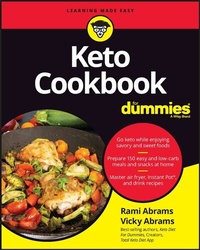
Keto Cookbook For Dummies
Description

Millions of people have already benefited from the low-carb ketogenic diet. They've lost weight, increased their energy levels, got their Type 2 diabetes under control, and so much more. And if you're looking for an easy and fun way to get started with keto, look no further than the Keto Cookbook For Dummies!
In this book, you'll find 150 delicious keto recipes, from cheesy egg casserole to a keto-inspired berry cobbler. You'll also discover expert tips on meal planning and preventing common ailments with simple adjustments to your diet. You'll even learn how to use your Instant Pot and air fryer to make full-flavor, low-carb keto dishes.
The book also shows you how to:
* Swap in tasty keto alternatives for unhealthy ingredients
* Make keto snacks and appetizers that give you a huge, long-lasting energy boost when you need it most
* Prepare yummy keto sauces and staples you can make ahead of time and freeze for easy meal-prep during the week
For everyone trying their best to get a handle on their health, weight, and nutrition, Keto Cookbook For Dummies is a must-have companion for busy families, professionals, and anyone else who just wants to live a healthier, more energetic life.
More details
Other editions
Additional editions
Persons
Content
Part 1: Succeeding with the Keto Lifestyle 5
Chapter 1: Embracing Keto for Your Well-Being 7
Chapter 2: Considering Keto's Numerous Health Benefits 19
Chapter 3: Transforming Your Kitchen into a Keto Kitchen 31
Chapter 4: Choosing Keto-Appropriate Foods and Ingredients 43
Chapter 5: Getting to Know Your Macros 59
Chapter 6: Eating Out on Keto 71
Chapter 7: Maximizing Keto with Intermittent Fasting 83
Chapter 8: Overcoming Obstacles 95
Part 2: Creating Meals with Delicious Keto Recipes 111
Chapter 9: Breakfasts 113
Chapter 10: Appetizers 129
Chapter 11: Soups 141
Chapter 12: Salads 149
Chapter 13: Lunches 159
Chapter 14: Fish Dinners 175
Chapter 15: Meat Dinners 185
Part 3: Exploring Vegetarian Keto 201
Chapter 16: Vegetarian Breakfasts 203
Chapter 17: Vegetarian Appetizers 213
Chapter 18: Vegetarian Lunches 221
Chapter 19: Vegetarian Dinners 231
Part 4: Maximizing Your Meals with Air Fryers, Slow Cookers, and Meal Prep 241
Chapter 20: Air Fryer Recipes 243
Chapter 21: Instant Pot and Slow Cooker Meals 263
Chapter 22: Meal Prep for the Week 273
Part 5: Enjoying Keto Drinks, Snacks, and Desserts 285
Chapter 23: Drinks 287
Chapter 24: Snacks 299
Chapter 25: Desserts 309
Part 6: The Part of Tens 321
Chapter 26: Ten Health Conditions that Can Benefit from Keto 323
Chapter 27: Ten Celebrities Who Swear by Keto 329
Chapter 28: Ten Benefits of Eating Healthy Fats 335
Appendix: Metric Conversion Guide 341
Index 345
Chapter 1
Embracing Keto for Your Well-Being
IN THIS CHAPTER
Examining the different types of keto diets
Setting yourself up for success
Seeing what the keto diet can do for you
Understanding when it's time to stop
The keto diet has exploded in popularity in the last 10 years, but other than it being a great way to lose weight, what do you really know about this popular diet? Is it really a healthy way to lose weight? Is there more to it than eating bacon and eggs? We are here to help you figure out whether the keto diet is right for you and to teach you the basic steps of safely and effectively following a keto lifestyle. In this chapter, we introduce the core concepts of the keto diet.
Exploring the Keto Diet
The ketogenic diet (also known as the keto diet) is a tried-and-true method to improve your health by working with your body through your dietary practices. The keto lifestyle can help you
- Have more energy
- Quickly lose weight
- Improve your heart health
- Improve your ability to focus
Though it has become more popular recently, the keto diet has been used for almost a hundred years to prevent disease and help the body heal. That's an amazing track record for any diet! The benefits of the keto diet are just that good.
So, what exactly is the keto diet? The keto diet involves eating foods that are
- High in fat
- Moderate in protein
- Very low in carbohydrates
Easily digested carbohydrates fuel weight gain and cause unhealthy spikes in blood sugar. Throughout a lifetime, this can really take a toll on your health.
The keto diet puts your body into a metabolic state called ketosis, when your body uses fats, rather than carbs, for fuel. You'll learn everything to know about ketosis in Chapter 2!
There are many misconceptions about nutrition in general, and the keto diet especially. The keto lifestyle is much more than "bacon, eggs, and cheese" - although you can eat bacon and cheese as much as you'd like! It won't clog your arteries or make you fat, nor will it increase your cholesterol levels if you follow a whole-food-based keto lifestyle.
For example, one of the most common misconceptions is that fat is bad for you. Fat is actually very good for you, keeps you feeling fuller longer, helps you lose weight, and improves your health over the long term.
Additionally, you don't need to eat many carbs as part of a healthy lifestyle. For many reasons, your body stores fat - and not carbs - for energy. Fat provides 9 calories (energy) per gram, while carbs only provide 4 calories per gram! Fat is a slow, continuous energy source compared to carbs, which are glucose at the most basic level. Carbs spike blood glucose and require your body to produce insulin to then reduce blood glucose to safe levels.
Eating a whole range of low-carb foods is the key to a healthy lifestyle. The best part is that keto is a flexible diet with multiple variations to fit your lifestyle and goals! It isn't a one-size-fits-all plan.
There are several different variations of the keto diet. Take a look at each one to see which version fits your personal goals and the way you prefer to eat.
Standard ketogenic diet
The standard ketogenic diet is the most basic, straightforward version of the keto diet. It is the most researched and has been around the longest of the various types of keto diets. It clearly breaks down the sources of your daily calorie intake so you can easily start your keto diet. Here is what to eat on the standard keto diet:
- Fat: 70 percent of your daily calories
- Protein: 25 percent of your daily calories
- Carbohydrates: 5 percent of your daily calories
On this diet, you generally eat about 25 to 30 grams of carbohydrates per day; however, this number is flexible. This amount of carbs is about one-fifth to one-tenth of what many Americans eat per day, so you can start to see why making such a radical change from a carb-based diet to a fat-based one has a massive, positive impact on your health and energy levels.
The standard ketogenic diet's ratio is 70:25:5 in terms of calories from fat, protein, and carbs as shown in Figure 1-1. You should aim for up to 30 grams of carbs per day.
FIGURE 1-1: Standard keto diet percentages.
Targeted ketogenic diet
The targeted keto diet is often used by athletes because it's more flexible when it comes to carb intake. This diet allows more carbs when you know you will be especially active. The extra carbs are burned immediately during your intense workouts, allowing you to stay in ketosis but still get a bit of extra energy.
Keep in mind that this is not a free pass to eat as many carbs as you want. About 25 to 30 grams of easily digestible carbs are okay about 30 to 45 minutes before a hard workout like high-intensity interval training (HIIT), 30 minute or longer jogs, hour or longer of weight lifting. After that exercise is over, you go right back to the regular keto diet. Remember to count the total number of calories (including your pre-workout carbs) when coming up with your daily energy intake.
It is important to eat only enough carbs to fuel your workout so your body returns to burning fats after you exercise. It's a good idea to get your body adjusted to the standard keto diet for a few months before switching to a targeted keto diet.
Cyclical ketogenic diet
The cyclical keto diet is another flexible version of keto that caters to athletes. It allows athletes to up their carb intake for a short time to "fuel" themselves for a performance. Once the big event is over, you return to the standard keto diet. Although this may kick you out of ketosis, the intense activity ensures that all those extra carbs are burned.
The cyclical keto diet is also good for people who need cheat days. You can go 5 days on the keto diet and then cheat a little on the weekends. However, it is important to remember that on those cheat days, you still shouldn't binge on carbs. It can be tough on the body to go from no carbs to high carbs. Instead, opt for a low-carb diet on cheat days, ranging from 150 to 200 grams of carbs rather than the lower quantities typically allowed on the keto diet. You won't be in ketosis on the cheat days, but it can sometimes help people who really miss the carbs.
Consider the cyclical keto diet if any of the following applies to you:
- You are an elite bodybuilder or short-distance sprinter who has been training for years. And you've noticed drops in your performance and realize that you need more carbs to fuel your intense level of activity.
- You are otherwise healthy and don't have any metabolic reasons to believe that "carb loading" will affect your health. If you notice an improvement in blood pressure or blood sugar levels, cyclical keto is not for you because you may lose all your gains when you cycle out of ketosis.
- You work out intensely and on a specific schedule. Your high-carb days should coincide with the days that you're at the gym. Also, you need to be able to cycle in and out of ketosis by completely depleting the excess carbs you consume on your workout days and then switch back into a keto diet on non-carb-loading days.
Generally, cyclical keto helps with gains for anaerobic exercises including 100-meter sprints, low-rep maximums (four to six) for weightlifters, or CrossFit circuits.
High-protein ketogenic diet
The high-protein keto diet is just as it sounds - higher in protein! Here is a quick look at the breakdown of a high-protein keto diet:
- Fat: 60 percent of your daily calories
- Protein: 35 percent of your daily calories
- Carbohydrate: 5 percent of your daily calories
This version of the keto diet is great for anyone who is concerned about losing muscle mass or not gaining enough while working out consistently. Adding protein is a great way to help gain muscle and remain in ketosis. Keto is considered a muscle neutral diet, meaning you don't really gain or lose muscle because your body is efficiently utilizing the fat you eat and stored fat even while at a caloric deficit. This is another benefit of keto because on high-carb diets, when in a caloric deficit, your body more readily taps into muscle protein for the remainder energy, so you lose muscle in addition to fat.
Keep in mind, it's difficult, but possible, to get kicked out of ketosis if you go higher than the recommended 35 percent of calories from protein (see Figure 1-2). Remember to eat a range of proteins that are nutritious and filling.
FIGURE 1-2: High-protein keto diet percentages.
Setting Realistic Expectations on Keto
Before you dive into the keto diet, you should be sure that it is the right fit for you. Having realistic expectations is key to your success. While the keto diet can be adapted to fit the needs of almost everyone, you should fully understand the benefits and the few side effects of the diet (which we go over in Chapter 2). Keep reading to really assess whether keto is right for you.
