

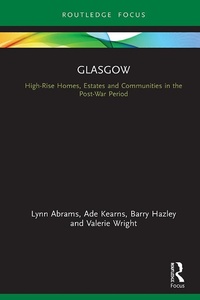
Glasgow
High-Rise Homes, Estates and Communities in the Post-War Period
1st Edition
Published on 13. April 2020
144 pages
978-0-429-84842-1 (ISBN)
Description

In the wake of an unparalleled housing crisis at the end of the Second World War, Glasgow Corporation rehoused the tens of thousands of private tenants who were living in overcrowded and unsanitary conditions in unimproved Victorian slums. Adopting the designs, the materials and the technologies of modernity they built into the sky, developing high-rise estates on vacant sites within the city and on its periphery.
This book uniquely focuses on the people's experience of this modern approach to housing, drawing on oral histories and archival materials to reflect on the long-term narrative and significance of high-rise homes in the cityscape. It positions them as places of identity formation, intimacy and well-being. With discussions on interior design and consumption, gender roles, children, the elderly, privacy, isolation, social networks and nuisance, Glasgow examines the connections between architectural design, planning decisions and housing experience to offer some timely and prescient observations on the success and failure of this very modern housing solution at a moment when high flats are simultaneously denigrated in the social housing sector while being built afresh in the private sector.
Glasgow is aimed at an academic readership, including postgraduate students, scholars and researchers. It will be of interest to social, cultural and urban historians particularly interested in the United Kingdom.
This book uniquely focuses on the people's experience of this modern approach to housing, drawing on oral histories and archival materials to reflect on the long-term narrative and significance of high-rise homes in the cityscape. It positions them as places of identity formation, intimacy and well-being. With discussions on interior design and consumption, gender roles, children, the elderly, privacy, isolation, social networks and nuisance, Glasgow examines the connections between architectural design, planning decisions and housing experience to offer some timely and prescient observations on the success and failure of this very modern housing solution at a moment when high flats are simultaneously denigrated in the social housing sector while being built afresh in the private sector.
Glasgow is aimed at an academic readership, including postgraduate students, scholars and researchers. It will be of interest to social, cultural and urban historians particularly interested in the United Kingdom.
Reviews / Votes
'Glasgow: High-Rise Homes, Estates, and Communities in the Post-War Period succeeds in debunking the design failure paradigm...this is a highly readable book and represents a useful contribution to public housing literature for both American and European readers alike. 'David P. Varady, Journal of Urban Affairs
More details
Series
Edition
1. Auflage
Language
English
Place of publication
London
United Kingdom
Publishing group
Taylor & Francis Ltd
Target group
College/higher education
Illustrations
10 Halftones, black and white; 10 Illustrations, black and white
ISBN-13
978-0-429-84842-1 (9780429848421)
Copyright in bibliographic data and cover images is held by Nielsen Book Services Limited or by the publishers or by their respective licensors: all rights reserved.
Schweitzer Classification
Other editions
Additional editions
Lynn Abrams | Ade Kearns | Barry Hazley
Glasgow
High-Rise Homes, Estates and Communities in the Post-War Period
Book
02/2022
1st Edition
Routledge
€36.00
Shipment within 15-20 days
Lynn Abrams | Ade Kearns | Barry Hazley
Glasgow
High-Rise Homes, Estates and Communities in the Post-War Period
Book
07/2020
1st Edition
Routledge
€76.90
Shipment within 10-20 days
Book
05/2020
Routledge
Unfortunately, price unknown
Available (delivery time upon request)
Persons
Lynn Abrams is Professor of Modern History at the University of Glasgow. Her research focuses on the modern history of gender relations, the practice and theory of oral history and the social and cultural history of modern Scotland.
Ade Kearns is Professor of Urban Studies at the University of Glasgow. He has published widely on housing, neighbourhoods and community cohesion and led the GoWell programme, a long-term study of the impacts of regeneration in Glasgow.
Barry Hazley is Derby Fellow in the Institute of Irish Studies, University of Liverpool and Research Fellow on a project examining Northern Irish migrants during the Troubles in Great Britain. His research focuses on the social and cultural history of modern Britain and Ireland.
Valerie Wright is a historian of modern Britain with expertise in gender, social and political history. She is currently Research Fellow in the Faculty of Social Sciences at the University of Stirling.
Ade Kearns is Professor of Urban Studies at the University of Glasgow. He has published widely on housing, neighbourhoods and community cohesion and led the GoWell programme, a long-term study of the impacts of regeneration in Glasgow.
Barry Hazley is Derby Fellow in the Institute of Irish Studies, University of Liverpool and Research Fellow on a project examining Northern Irish migrants during the Troubles in Great Britain. His research focuses on the social and cultural history of modern Britain and Ireland.
Valerie Wright is a historian of modern Britain with expertise in gender, social and political history. She is currently Research Fellow in the Faculty of Social Sciences at the University of Stirling.
Content
List of Figures
Acknowledgements
Abbreviations
Introduction: The fluctuating fortunes of high rise
Embracing high rise in the post-war period
Retreat from high rise
Removal and return of high rise
A retrospective study of the postwar high rise experience
Inside: making homes - privacy and communality
Modern family homes
Modern interiors
Space and adaptation
Consumption, decor and taste
Privacy versus communality
Maintenance and security
Conclusions
Outside: Surviving and Thriving on Estates
Estate planning, amenity and social life
Life on the periphery: a lack of foresight
Miracle in the Gorbals? City centre living
'You've to go into the city': social facilities
Children and play: 'nae use for the bairns'
Safety and delinquency
Places to play
Conclusions
Communities: Identity, Change and Neighbourly Relations
Eventless places? Neighbourly interactions on high rise estates
Narratives of community loss and decline
New neighbourly relations
Conclusions: retelling the history of community life
Conclusions: plural histories of multi-storey living
Bibliography
Acknowledgements
Abbreviations
Introduction: The fluctuating fortunes of high rise
Embracing high rise in the post-war period
Retreat from high rise
Removal and return of high rise
A retrospective study of the postwar high rise experience
Inside: making homes - privacy and communality
Modern family homes
Modern interiors
Space and adaptation
Consumption, decor and taste
Privacy versus communality
Maintenance and security
Conclusions
Outside: Surviving and Thriving on Estates
Estate planning, amenity and social life
Life on the periphery: a lack of foresight
Miracle in the Gorbals? City centre living
'You've to go into the city': social facilities
Children and play: 'nae use for the bairns'
Safety and delinquency
Places to play
Conclusions
Communities: Identity, Change and Neighbourly Relations
Eventless places? Neighbourly interactions on high rise estates
Narratives of community loss and decline
New neighbourly relations
Conclusions: retelling the history of community life
Conclusions: plural histories of multi-storey living
Bibliography
