

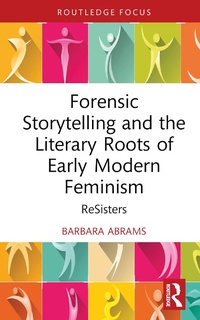
Forensic Storytelling and the Literary Roots of Early Modern Feminism
ReSisters
1st Edition
Published on 1. November 2023
172 pages
978-0-429-67283-5 (ISBN)
Description

The writing of letters and the rise of the novel provided a way for some women to express themselves at a time when the all-male French Academy defined the very parameters of French literary acceptability and tradition. Women who were consigned to convents, workhouses or prisons were in most respects deprived of agency, yet many found ways to respond to the legal documents served against them. The letters and associated materials preserved in their legal files provide evidence that these women did not remain quiet, as they found means to resist authority. The forensic storytelling examined in this book supports the conclusion that the documents written in these constrained circumstances have both historical and literary merit and form the core of an understudied genre of literature.
Reviews / Votes
This important archival study opens up the rich possibilities of what Abrams' calls "forensic storytelling." This strategy of scholarly engagement is the author's new way into the story of early modern women's writing as a literature of resistance in 18th century France....Abrams brings together the history of 18th century French women and the literature by and about these women. As a French literary scholar of the 18th century, she offers a window into the time period. Through careful and insightful close readings, as well as elegant translations of the handwritten archival texts at the heart of this book, she makes these women's lives accessible to scholars and students alike. Not only does she supply readers with the French and the English translations of key texts from these women's case files, but we also see the text in a robust array of photographs of these very documents.--Laura Levitt, Professor of Religion, Jewish Studies, and Gender, Temple University, USA
More details
Series
Edition
1. Auflage
Language
English
Place of publication
London
United Kingdom
Publishing group
Taylor & Francis Ltd
Target group
College/higher education
Illustrations
35 Halftones, black and white; 35 Illustrations, black and white
ISBN-13
978-0-429-67283-5 (9780429672835)
Copyright in bibliographic data and cover images is held by Nielsen Book Services Limited or by the publishers or by their respective licensors: all rights reserved.
Schweitzer Classification
Other editions
Additional editions
Book
05/2025
1st Edition
Routledge
€36.20
Shipment within 10-20 days
Book
11/2023
1st Edition
Routledge
€77.40
Shipment within 15-20 days

Book
01/2010
Routledge
Unfortunately, price unknown
Available (delivery time upon request)
Person
Barbara Abrams is Professor of French and Women's and Gender Studies and is Chair of the Department of History, Language, and Global Culture at Suffolk University, Boston. Her academic work focuses on French literature of the Enlightenment and Women's and Gender Studies. Her recent publications include several articles on women's epistolary writing in eighteenth-century France, the Factum as Fiction, and a new critical focus on the novels of Marie-Madeleine Bonafon. Her previous books include a multigraph project titled Reframing Rousseau's Le Levite d'Ephraim: The Hebrew Bible, Hospitality, and Modern Identity (Oxford University Studies in the Enlightenment) and Le Bizarre and Le Decousu in the Novels and Theoretical Works of Denis Diderot: How the Idea of Marginality Originated in Eighteenth-Century France, which examines the background of our modern concept of marginality by focusing on Diderot's materialist philosophy.
Content
Acknowledgments
Preface
Introduction
Chapter One: Forensic Storytelling and Antimonarchical Epistolarity
Chapter Two: Les Causes Celebres, Factum or Fiction? Or: "That's What He Said!"
Chapter Three: Tanastes est Satan: Authenticity and Audacity in the Writings of Marie-Madeleine Bonafon
Chapter Four:Excess or Success? The Case of Mme Genevieve de Gravelle
Chapter Five: "What's in a Name?": The Case of Angelique Schwab
Conclusion
Index
Preface
Introduction
Chapter One: Forensic Storytelling and Antimonarchical Epistolarity
Chapter Two: Les Causes Celebres, Factum or Fiction? Or: "That's What He Said!"
Chapter Three: Tanastes est Satan: Authenticity and Audacity in the Writings of Marie-Madeleine Bonafon
Chapter Four:Excess or Success? The Case of Mme Genevieve de Gravelle
Chapter Five: "What's in a Name?": The Case of Angelique Schwab
Conclusion
Index
