

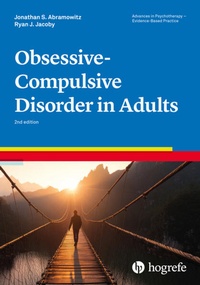
Obsessive-Compulsive Disorder in Adults
2nd Edition
Published on 1. October 2025
XIV, 134 pages
978-1-61676-607-8 (ISBN)
Description

An updated edition of the popular guide to successfully assessing and treating adults with OCD
- Compact and current overview of science and practice
- Details the best treatment approaches
- Includes downloadable tools for clinical use
The new edition of this concise and popular guide delivers up-to-date, hands-on guidance on the assessment and treatment of obsessive-compulsive disorder (OCD), offering a framework for understanding and helping people with this complex and challenging condition. Written by leading experts in the field, this book unpacks the intricacies of diagnosing OCD and explores models that explain the onset, development, and persistence of the disorder as well as its various manifestations.
Using case studies and examples throughout, the authors detail the most evidence-based therapeutic approaches, emphasizing two techniques that have proven most effective in clinical practice: exposure and response prevention. Methods such as optimizing inhibitory learning, using acceptance and commitment therapy, and techniques for working with couples and families affected by OCD are also integrated to address the disorder's core symptoms and collateral effects. Further sections explore multicultural issues, less common forms of OCD (e.g., relationship obsessions), and in-person vs. virtual treatment. Printable tools and worksheets in the appendices provide invaluable resources allowing for immediate use in practice.
This is essential reading for clinical psychologists, therapists, psychiatrists, counselors, and students engaged in treating OCD.
More details
Series
Edition
2nd edition 2026
Language
English
Place of publication
Cambridge
United States
Target group
Professional and scholarly
Clinical psychologists, psychiatrists, psychotherapists, and counselors, as well as students.
File size
5,02 MB
ISBN-13
978-1-61676-607-8 (9781616766078)
DOI
10.1027/00607-000
Schweitzer Classification
Other editions
Additional editions
Jonathan S. Abramowitz | Ryan J. Jacoby
Obsessive-Compulsive Disorder in Adults
E-Book
10/2025
2nd Edition
Hogrefe Publishing
€21.99
Available for download
Jonathan S. Abramowitz | Ryan J. Jacoby
Obsessive-Compulsive Disorder in Adults
Book
09/2025
2nd Edition
Hogrefe Publishing
from
€24.95
Shipment within 3-4 weeks
Persons
Jonathan S. Abramowitz, PhD, Department of Psychology, University of North Carolina, Chapel Hill, NC, USA.
Ryan J. Jacoby, PhD, OCD and Related Disorders Program, Massachusetts General Hospital, Boston, MA, USA.
Ryan J. Jacoby, PhD, OCD and Related Disorders Program, Massachusetts General Hospital, Boston, MA, USA.
Content
- Obsessive-Compulsive Disorder in Adults
- Dedication
- Acknowledgments
- Contents
- Preface
- 1 Description
- 1.1 Terminology
- 1.2 Definition
- 1.2.1 Avoidance
- 1.2.2 Insight
- 1.2.3 Tics
- 1.2.4 OCD From an Interpersonal Perspective
- 1.3 Epidemiology
- 1.4 Course and Prognosis
- 1.5 Differential Diagnoses
- 1.5.1 Generalized Anxiety Disorder
- 1.5.2 Depression
- 1.5.3 Tics and Tourette's Syndrome
- 1.5.4 Psychotic Disorders (e.g., Schizophrenia)
- 1.5.5 Impulsive Behavior and Habit Disorders
- 1.5.6 Obsessive-Compulsive Personality Disorder
- 1.5.7 Illness Anxiety Disorder
- 1.5.8 Body Dysmorphic Disorder
- 1.5.9 Hoarding Disorder
- 1.6 Comorbidity Rates
- 1.7 Diagnostic Procedures and Documentation
- 1.7.1 Screening
- 1.7.2 Structured Diagnostic Interviews
- 1.7.3 Semistructured Symptom Interviews
- 1.7.4 Self-Report Inventories
- 1.7.5 Documenting Changes in Symptom Levels
- 2 Theories and Models
- 2.1 Biological Theories
- 2.1.1 Neurotransmitter Theories
- 2.1.2 Neuroanatomical Theories
- 2.2 Psychological Theories
- 2.2.1 Learning Theory
- 2.2.2 Cognitive Deficit Models
- 2.2.3 Contemporary Cognitive-Behavioral Models
- 3 Diagnosis and Treatment Indications
- 3.1 Form Versus Function
- 3.2 The Diagnostic Assessment
- 3.3 Identifying the Appropriate Treatment
- 3.4 Factors That Influence Treatment Decisions
- 3.4.1 Age
- 3.4.2 Sex and Gender
- 3.4.3 Ethnic and Racial Background
- 3.4.4 Educational Level and Cognitive Impairments
- 3.4.5 Client Preference
- 3.4.6 Clinical Presentation
- 3.4.7 OCD Symptom Theme
- 3.4.8 Interpersonal Factors
- 3.4.9 Insight
- 3.4.10 Comorbidity
- 3.4.11 Treatment History
- 3.5 Presenting the Recommendation for ERP
- 4 Treatment
- 4.1 Methods of Treatment
- 4.1.1 Functional Assessment
- 4.1.2 Self-Monitoring
- 4.1.3 Psychoeducation
- 4.1.4 Using Cognitive Therapy Techniques
- 4.1.5 Using Acceptance-Based Strategies
- 4.1.6 Planning for Exposure and Response Prevention
- 4.1.7 Implementing Exposure and Response Prevention
- 4.1.8 Ending Treatment
- 4.2 Mechanisms of Action
- 4.3 Efficacy and Prognosis
- 4.4 Variations and Combinations of Methods
- 4.4.1 Variants of ERP Treatment Procedures
- 4.4.2 Combining Medication and ERP
- 4.4.3 Involving Significant Others in Treatment
- 4.4.4 In-Person Versus Virtual Treatment Delivery
- 4.5 Problems in Carrying Out the Treatment
- 4.5.1 Negative Reactions to the Cognitive Behavioral Model
- 4.5.2 Nonadherence
- 4.5.3 Arguments
- 4.5.4 Persistent Family Accommodation of OCD Symptoms
- 4.5.5 Therapist's Inclination to Challenge the Obsession
- 4.5.6 Hijacking Psychoeducational and Cognitive Interventions
- 4.5.7 Using Exposure to Control Anxiety
- 4.5.8 Intolerable Anxiety Levels During Exposure
- 4.5.9 Absence of Anxiety During Exposure
- 4.5.10 Therapist Discomfort With Conducting Exposure Exercises
- 4.5.11 Clients Asking Therapists for Reassurance
- 4.5.12 Reluctance to Share Intrusive Thoughts
- 4.5.13 Considering a Higher Level of Care
- 4.6 Multicultural Issues
- 4.6.1 International Presentations of OCD
- 4.6.2 Justice-Based Treatment of OCD
- 5 Case Vignettes
- 6 Further Reading
- 7 References
- 8 Appendix: Tools and Resources
