

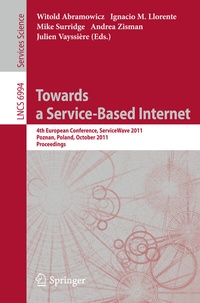
Towards a Service-Based Internet
4th European Conference, ServiceWave 2011, Poznan, Poland, October 26-28, 2011, Proceedings
Published on 1. October 2011
XVII, 338 pages
978-3-642-24755-2 (ISBN)
Description

This volume constitutes the refereed proceedings of the Fourth European Conference, ServiceWave 2011, held in Poznan, Poland, in October 2011.
The 25 revised full papers presented together with 3 invited presentations were carefully reviewed and selected from numerous submissions. They are organized in topical sections on cloud computing, security, privacy and trust, service engineering fundamentals, business services, and FI-PPP. In addition to the scientific track, 14 extended abstracts of demonstrations covering a wide spectrum of technology and application domains were accepted.
The 25 revised full papers presented together with 3 invited presentations were carefully reviewed and selected from numerous submissions. They are organized in topical sections on cloud computing, security, privacy and trust, service engineering fundamentals, business services, and FI-PPP. In addition to the scientific track, 14 extended abstracts of demonstrations covering a wide spectrum of technology and application domains were accepted.
More details
Other editions
Additional editions
Witold Abramowicz | Ignacio M. Llorente | Mike Surridge
Towards a Service-Based Internet
4th European Conference, ServiceWave 2011, Poznan, Poland, October 26-28, 2011, Proceedings
Book
10/2011
1st Edition
Springer
€53.49
Shipment within 7-9 days
Content
- Title page
- Preface
- Organization
- Table of Contents
- Cloud Computing
- Integration of an Event-Based Simulation Framework into a Scientific Workflow Execution Environment for Grids and Clouds
- Introduction
- Background
- GroudSim
- ASKALON
- Architecture
- Evaluation
- Simulation Times
- Sequential Grid Sites
- Parallel Grid Sites
- Simulation versus Execution
- Related Work
- Conclusion
- References
- Large-Scale Multidimensional Data Visualization: A Web Service for Data Mining
- Introduction
- Background of the Web-Based Service for Visualization
- Visualization Methods
- Web Service for Multidimensional Data Visualization
- Conclusions
- References
- Blueprint Template Support for EngineeringCloud-Based Services
- Introduction
- Motivating Scenario
- Evaluation of Related Work
- Blueprint Template for XaaS Offerings
- Basic Properties
- Offering Section
- Implementation Artefacts Section
- Resource Requirements Section
- Virtual Architecture Topology (VAT) Section
- Invariants Section
- Conclusion and Future Work
- References
- Self-management Challenges for Multi-cloud Architectures (Invited Paper)
- Introduction
- Predictive Elasticity Control
- Admission Control for Safe Overbooking
- VM Placement (Scheduling)
- Cloud Governance-High-Level Management
- Live Migration of Large-Scale Virtual Machines
- Concluding Remarks
- References
- Contrail Virtual Execution Platform Challenges in Being Part of a Cloud Federation (Invited Paper)
- Introduction
- Challenges of a Large Federation
- Authenticity of Reported Statistics
- Verification of SLA Adherence
- Scalability of Interface APIs
- Authorization/Authentication Nightmare
- Issue of Trust in the Federation
- Need for VEP in Cloud Computing
- Contrail Virtual Execution Platform
- OVF Deployment Subsystem
- REST APIs for other Contrail Modules
- OCCI Support
- Application Monitoring and Reporting Module
- IaaS Drivers
- Federation Authentication/Authorization Support
- Virtual Organization
- Concluding Remarks
- References
- Portability and Interoperability between Clouds: Challenges and Case Study (Invited Paper)
- Introduction
- Challenges in Interoperability and Portability
- Defining the Cloud Interoperability
- Use Cases of Multiple Clouds
- Types and Targets of Cloud Interoperability
- Cloud Portability
- Interoperability and Portability Requirements
- Approaches to Cloud Interoperability and Portability
- Case Study: Interoperability in mOSAIC
- Final Remarks and Conclusions
- References
- Enhancing Query Support in HBase via an Extended Coprocessors Framework
- Introduction
- Background
- Coprocessor Use Cases
- Endpoint Queries
- Streaming Results from Coprocessor Endpoints
- Experiment Setup
- Datasets
- Sample Queries
- Schema Design
- Cluster Setup
- Experiment and Results
- Evaluation
- Related Work
- Conclusion
- References
- Complex Service Provisioning in Collaborative Cloud Markets
- Introduction
- Problem Statement
- Approach
- System Model and Notation
- Negotiation of Quality of Service
- Partner Selection for Collaboration
- Experimental Results
- Related Work
- Conclusion
- References
- Security, Privacy and Trust
- Network Events Correlation for Federated Networks Protection System
- Introduction
- General Architecture of Federated Networks Protection System (FNPS)
- Decision Module
- Event Correlation Mechanism
- Ontology
- Decisions Enhanced with Semantic Reasoning
- General Decision Rules Distribution
- P2P-Enabled Communication between Domains
- Graphical User Interface and Visualization
- SQLIA Attack Detection Scenario
- Conclusions
- References
- An Autonomic Security Monitor for Distributed Operating Systems (Invited Paper)
- Introduction
- Background
- Monitoring in a Distributed Operating System
- Monitoring Security in XtreemOS
- Security Monitoring and Auditing
- Security Requirements
- Monitoring and Auditing Capabilities
- Autonomic Management of Security Events
- Implementation
- Discussion
- Conclusion and Future Work
- References
- A Novel Systemic Taxonomy of Trust in the Online Environment (Invited Paper)
- Introduction
- Short Survey of the State of the Art in Trust and Reputation
- Reputation Systems through the General Systems Taxonomy
- A Novel Taxonomical Framework for Reputation Mechanisms
- Redefining the Factors of Impact
- Active Entity Behavior (AEB): Considers the D and E Nature of RMs
- Resilience and Evolutionism: Considers the D, C and E Nature of RMs
- Context: Considers the D and E Nature of RMs
- Time: Considers the D and C Nature of RMs
- Privacy: Considers the D, C and E Nature of RMs
- The BarterCast Use-Case through the Taxonomy Framework
- Concluding Remarks and the Way Forward
- References
- Orchestrating Security and System Engineering for Evolving Systems (Invited Paper)
- Introduction
- The Contribution of This Paper
- The Security and System Engineering Orchestrated Process
- Secure Specification and Design
- The Mutual Evolution of Risk and Requirement Analysis
- Managing Evolution during the Design Step
- Security Testing of Evolving Systems
- Security Verification of Evolving Systems
- Conclusions
- References
- FI-WARE Security: Future Internet Security Core (Invited Paper)
- Introduction
- The FI-WARE Approach
- Generic Security Enablers
- Security Monitoring
- Context-Based Security and Compliance (PRRS Framework)
- Optional Security Services
- Context-Based Security and Compliance
- PRRS Framework
- USDL-SEC
- Optional Security Enablers
- Future Works
- References
- A General Method for Assessment of Security in Complex Services
- Introduction
- Contributions
- Decomposition of a Business Process into a Design Graph
- A Mathematical Model
- Security-Aware Selection of a Business Process Implementation
- Semirings for Expressing Security Metrics
- Interoperability of Services
- Related Work
- Conclusion
- References
- Service Engineering Fundamentals
- Adaptive Services and Energy Efficiency (Invited Paper)
- A Performance Comparison of QoS-Driven Service Selection Approaches
- Introduction
- QoS-Driven Service Selection Approaches
- Per-request Approach
- Per-flow Approach
- MOSES System
- Experimental Comparison
- Experimental Setup
- Experimental Results
- Conclusions
- References
- Optimal Admission Control for a QoS-Aware Service-Oriented System
- Introduction
- MOSES System
- An MDP Formulation for MOSES Admission Control
- Model
- Experimental Analysis
- Simulation Model
- Experimental Results
- Conclusions
- References
- Cloud Service Engineering: A Service-Oriented Perspective on Cloud Computing (Invited Paper)
- Introduction
- A Motivating Example
- Cloud Service Engineering: Research Challenges
- Next Steps
- References
- Preventing Performance Violations of Service Compositions Using Assumption-Based Run-Time Verification
- Introduction
- Related Work
- Example SBA
- The SPADE Approach
- Experimental Evaluation
- Conclusions and Future Work
- References
- A Taxonomy of Service Engineering Stakeholder Types
- Introduction
- The S-Cube Service Engineering Lifecycle
- Research Method
- A Taxonomy of Service Engineering Stakeholders
- Coverage of the S-Cube Service Engineering Lifecycle
- Coverage of Lifecycle Phases by the Stakeholder Types
- The Participation of Each Type of Stakeholders
- Comparison between the Evolution and Adaptation Cycles
- Related Work
- Conclusion
- References
- Service Oriented Middleware for the Internet of Things: A Perspective (Invited Paper)
- Introduction
- Challenges
- Related Work
- Blueprints of a Solution
- Discovery Module
- Composition and Estimation Module
- Knowledge Base
- Conclusion
- References
- Future Internet Apps: The Next Wave of Adaptive Service-Oriented Systems?
- Introduction
- The Transport and Logistics Scenario
- Adaptive Characteristics of FI Apps
- Cross-Layer Adaptation
- Cross-Area Adaptation
- Distributed Adaptation
- Context-Aware Adaptation
- Autonomic and Human-in-the-Loop Adaptation
- Reactive and Proactive Adaptation
- Survey Study
- Context
- Design, Execution and Data Collection
- Analysis, Findings and Validity Threats
- Conclusions
- References
- Using Services and Service Compositions to Enable the Distributed Execution of Legacy Simulation Applications
- Introduction
- Related Work
- Use Case: Simulation of Solid Bodies
- Simulation Application
- Service-Based Distributed Simulation Environment
- Using Services and Service Compositions to Improve This Situation
- Simulation Infrastructure
- Simulation Applications
- Resource Manager
- Workflow Engine, Simulation Manager and Simulation Client
- Conclusions
- References
- Business Services
- A Semantic Rule and Event Driven Approach for Agile Decision-Centric Business Process Management (Invited Paper)
- Introduction
- Enhancing Non-semantic BPM to Semantic BPM
- Integration of Rules in Business Processes Execution
- Implementation of the BPEL+ Rules Approach
- Rule-Based Semantic Decision Services
- Prova - A Semantic Rule Engine
- Rule Responder Enterprise Service Bus Middleware
- Conclusion
- References
- Web Services Trustworthiness Model (Invited Paper)
- Introduction
- Related Work
- Web Services Quality
- Web Services Selection
- Problem Statement
- The Vision of Solution
- Further Research
- References
- FI-PPP
- Identification and Specification of Generic and Specific Enablers of the Future Internet - Illustrated by the Geospatial and Environmental Domain (Invited Paper)
- Introduction
- Methodology for Enabler Identification and Specification
- Use Case Modelling
- Use Case Analysis Process
- Reference Model based on ISO RM-ODP
- Life-Cycle Based Enablers
- The Value Chain of Environmental Knowledge Generation
- Overview of Stakeholders
- Requirements for a Next Generation of eEnvironment Services
- Architectural Based Enablers
- Conclusions and Further Work
- References
- Future Internet Technology for the Future of Transport and Logistics (Invited Paper)
- Introduction and Motivation
- FInest High Level Architecture
- Front End Layer
- Back End Layer
- Core Modules Layer
- Usage of Future Internet Technologies
- FInest Platform Core Modules
- FInest Business Collaboration Module (BCM)
- FInest E-Contracting Module (ECM)
- FInest Transport Planning Module (TPM)
- Conclusion
- References
- ICT Enablers for Smart Energy (Invited Paper)
- Introduction
- Smart Energy - Key Drivers and Challenges
- FINSENY's Approach
- Scenario Evaluation
- ICT Requirements
- Functional ICT Architecture
- FINSENY's Scenarios
- Scenario Distribution Network
- Scenario Microgrid
- Scenario Smart Building
- Scenario Electric Mobility
- Scenario Electronic Market Place for Energy
- Smart Grid Stakeholder Group
- Conclusion
- References
- Demonstrations
- SLA Translations with a Model-Driven Business Impact Analyses Framework
- Introduction
- Demo Story
- References
- OFELIA - Pan-European Test Facility for OpenFlow Experimentation
- OpenFlow Test Facility in the FIRE Context
- Description of the Demonstration
- References
- Coverage and Capacity Extensions by Means of Opportunistic Networks in the Future Internet
- Introduction
- Short System Description - Features Demonstrated
- Summary of Novel Characteristics
- References
- REMICS- REuse and Migration of Legacy Applications to Interoperable Cloud Services
- REMICS Approach and Demonstrations1
- Towards Governance of Rule and Policy Driven Components in Distributed Systems
- Introduction
- Anatomy of a Governance Infrastructure for Rule and Policy Driven Components in Distributed Systems
- SLA-enabled Enterprise IT
- Introduction
- SeCMER: A Tool to Gain Control of Security Requirements Evolution
- Introduction
- Demo Scenario
- References
- FIRE OpenLab IP Testbed and Tool Demo
- Description
- Functions and Features Demonstrated
- Example Novel Characteristics
- References
- Distributed Spectrum Sensing in a Cognitive Networking Testbed
- Introduction
- System Description and Novel Characteristics
- DTN Simulation Tool for N4C Integration Support
- Motivation
- Description of the System
- Demonstration
- References
- Testing and Profiling Internet Services in Mobile Devices
- Introduction
- Demonstration of the OPTIMIS Toolkit for Cloud Service Provisioning
- Introduction
- OPTIMIS Innovations
- Demonstration
- Travel eCommerce Experiment - Through TEFIS, a Single Access Point to Different Testbed Resources
- Introduction
- Demonstration Description
- Videos to Show Experiment
- References
- Author Index
