

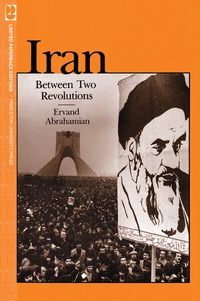
Iran Between Two Revolutions
1st Edition
Published on 20. July 2022
561 pages
978-1-4008-4409-8 (ISBN)
Description

Emphasizing the interaction between political organizations and social forces, Ervand Abrahamian discusses Iranian society and politics during the period between the Constitutional Revolution of 1905-1909 and the Islamic Revolution of 1977-1979. Presented here is a study of the emergence of horizontal divisions, or socio-economic classes, in a country with strong vertical divisions based on ethnicity, religious ideology, and regional particularism. Professor Abrahamian focuses on the class and ethnic roots of the major radical movements in the modem era, particularly the constitutional movement of the 1900s, the communist Tudeh party of the 1940s, the nationalist struggle of the early 1950s, and the Islamic upsurgence of the 1970s.
In this examination of the social bases of Iranian politics, Professor Abrahamian draws on archives of the British Foreign Office and India Office that have only recently been opened; newspaper, memoirs, and biographies published in Tehran between 1906 and 1980; proceedings of the Iranian Majles and Senate; interviews with retired and active politicians; and pamphlets, books, and periodicals distributed by exiled groups in Europe and North America in the period between 1953 and 1980.
Professor Abrahamian explores the impact of socio-economic change on the political structure, especially under the reigns of Reza Shah and Muhammad Reza Shah, and throws fresh light on the significance of the Tudeh party and the failure of the Shah's regime from 1953 to 1978.
In this examination of the social bases of Iranian politics, Professor Abrahamian draws on archives of the British Foreign Office and India Office that have only recently been opened; newspaper, memoirs, and biographies published in Tehran between 1906 and 1980; proceedings of the Iranian Majles and Senate; interviews with retired and active politicians; and pamphlets, books, and periodicals distributed by exiled groups in Europe and North America in the period between 1953 and 1980.
Professor Abrahamian explores the impact of socio-economic change on the political structure, especially under the reigns of Reza Shah and Muhammad Reza Shah, and throws fresh light on the significance of the Tudeh party and the failure of the Shah's regime from 1953 to 1978.
More details
Other editions
Additional editions
Ervand Abrahamian
Iran Between Two Revolutions
Book
07/1982
Princeton University Press
€92.30
Shipment within 10-20 days
Ervand Abrahamian
Iran Between Two Revolutions
Book
07/1982
Princeton University Press
€86.66
Article exhausted; check different version
Person
Ervand Abrahamian is Professor of History at Baruch College, City University of New York.
Content
- Cover Page
- Half-title Page
- Title Page
- Copyright Page
- Dedication Page
- Contents
- List of Tables and Figure
- Preface
- Introduction
- Part I. Historical Background
- One. The Nineteenth Century
- Social Structure
- Communal Organizations
- Communal Conflicts
- Communal Conflicts and Class Consciousness
- The Qajar Dynasty
- Two. The Constitutional Revolution
- The Impact of the West
- The Traditional Middle Class
- The Intelligentsia
- From Protest to Revolution (1800-1905)
- The Revolution Qune 1905-August 1906)
- The Struggle for the Constitution (August 1906- June 1908)
- The Civil War (June 1908-July 1909)
- Three. Reza Shah
- The Period of Disintegration (1909-1921)
- The Rise of Reza Shah (1921-1925)
- The Reign of Reza Shah (1926-1941)
- Reza Shah's State and Iran's Society
- Part II . Politics of Social Conflict
- Four. The Evolving Political System: From Military to Embattled Monarchy
- New Beginnings
- The Thirteenth Majles (November 1941-November 1943)
- The Fourteenth Majles Elections (November 1943-February 1944
- Convening the Fourteenth Majles (February-March 1944)
- The Fourteenth Majles (March 1944-March 1946)
- Five. The Evolving Political System: From Embattled to Military Monarchy
- Qavam as Prime Minister (March 1946-December 1946)
- The Fifteenth Majles Elections (December 1946- June 1947)
- The Fifteenth Majles (June 1947-June 1949)
- The Sixteenth Majles Elections (July 1949-February 1950)
- The Sixteenth Majles (February 1950-May 1951)
- Premier Mossadeq (May 1951-August 1953)
- Six. The Tudeh Party
- Expansion North (November 1942-August 1944)
- Expansion South (August 1944-October 1946)
- Repression (October 1946-February 1950)
- Revival (February 1950-August 1953)
- Seven. Class Bases of the Tudeh
- Class Profile
- Salaried Middle Class
- Urban Working Class
- Propertied Middle Class
- Rural Masses
- Eight. Ethnic Bases of the Tudeh
- Ethnic Profile
- Christians
- Azeris
- Part III. Contemporary Iran
- Nine. The Politics of Uneven Development
- Consolidation of Power (1953-1963)
- Socioeconomic Development (1963-1977)
- Political Underdevelopment (1963-1977)
- Iran on the Verge of Revolution
- Ten. The Opposition
- Political Parties (1953-1977)
- Clerical Opposition (1963-1977)
- Guerrilla Organizations (1971-1977)
- Eleven. The Islamic Revolution
- Middle-Class Protest (May 1977-June 1978)
- Middle- and Working-Class Protests (June 1978-December 1978)
- The Fall of the Shah (January-February 1979)
- Conclusion
- Glossary
- Bibliography
- Index
