

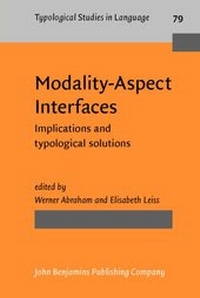
Modality-Aspect Interfaces
Implications and typological solutions
1st Edition
Published on 26. June 2008
XXIV, 422 pages
978-90-272-9019-9 (ISBN)
Description

The main topics pursued in this volume are based on empirical insights derived from Germanic: logical and typological dispositions about aspect-modality links. These are probed in a variety of non-related languages. The logically establishable links are the following: Modal verbs are aspect sensitive in the selection of their infinitival complements - embedded infinitival perfectivity implies root modal reading, whereas embedded infinitival imperfectivity triggers epistemic readings. However, in marked contexts such as negated ones, the aspectual affinities of modal verbs are neutralized or even subject to markedness inversion. All of this suggests that languages that do not, or only partially, bestow upon full modal verb paradigms seek to express modal variations in terms of their aspect oppositions. This typological tenet is investigated in a variety of languages from Indo-European (German, Slavic, Armenian), African, Asian, Amerindian, and Creoles. Seeming deviations and idiosyncrasies in the interaction between aspect and modality turn out to be highly rule-based.
More details
Other editions
Additional editions
Book
06/2008
John Benjamins Publishing Co
€116.60
Shipment within 10-15 days
Persons
Content
- Modality-Aspect Interfaces
- Editorial page
- Title page
- LCC data
- Table of contents
- List of contributors
- Preface
- Introduction
- 1. The logical disposition about the aspect-modality link
- 2. The cross-linguistic extension
- 3. The typological aspect-modality inversion
- 4. Results of the empirical discussions in the present volume
- 4.1 General contingencies
- 4.2 Illocutive category and aspect: Interrelations and pragmatic inferences
- 4.3 Typologically solid confirmation: Synchronic references
- 4.4 Typologically solid confirmation: Diachronic references
- 4.5 Aspect-Modality Interface Generalization/AMIG III
- 4.6 Potential counter examples to the AMIGs I-V
- 5. Typological Aspect-Modality Interface Generalization/AMIG V
- 6. Final view
- References
- General
- On the logic of generalizations about cross-linguistic aspect-modality links
- 1. The undisputed default relations between verb meaning and aspect assignment
- 2. Aspects and tense forms: The logical connections in Russian
- 3. Aspects and forms of modality: The general logical connections
- References
- The silent and aspect-driven patterns of deonticity and epistemicity
- 1. Diachronic typology of modals
- 1.1 Aspect languages are devoid of a class of modal verbs
- 1.2 The aspectual affinity of modals in synchrony and diachrony
- 1.3 The classification of modals in terms of binary opposition
- 1.4 Abraham's generalizations in the light of the terminological fine-tuning of modality
- 2. The rise of modals in the Germanic languages
- 2.1 Deonticity and perfectivity from a historical perspective
- 2.2 Epistemicity, imperfectivity, definiteness, and negation
- 2.3 Epistemicity, imperfectivity, and tense
- 3. Modals in the Slavic languages
- 4. In search of functional equivalents for the modals
- 4.1 The non-equivalence of modal adverbs with epistemic modals
- 4.2 On the functional equivalence of epistemic modals and evidentials: Conclusion
- References
- Primary sources
- Secondary references
- Propositional aspect and the development of modal inferences in English
- 1. Introduction
- 2. Definitions and terminology
- 2.1 Generic modality
- 2.2 Aspectual interactions with modality types
- 2.3 Semantic roles and modality
- 3. Generics and propositional aspect
- 3.1 Generic aspect
- 3.2 Propositional aspect
- 3.3 Evidentiality and epistemic meanings
- 4. Data under investigation
- 5. Discussion
- 5.1 Semantic explanations
- 5.2 Quantitative justification
- 6. Conclusions
- References
- Towards an understanding of the progressive form in English
- 1. The aim and the scope of the study
- 2. The terms
- 3. The starting question
- 4. The current explanations of the incompatibility
- 5. Categorial status of the progressive: Traditional approach
- 6. The discourse function of the progressive
- 6.1 The progressive and future time reference
- 6.2 The progressive aspect and present time reference
- 6.3 Summary of the pragmatic dependency of the progressive
- 7. An explanation of why the progressive cannot be used in the imperative mood
- References
- Epistemic modality and aspect contingencyin Armenian, Russian, and German
- 1. Introduction
- 2. Theoretical framework
- 2.1 Possibility and necessity in German
- 2.2 Expressing possibility in Russian
- 2.3 Modal auxiliaries of possibility in Armenian
- 2.4 Aspect in Russian and Armenian
- 2.5 Necessity in Armenian
- 2.6 Necessity in Russian
- 3. Epistemic functions of possibility
- 3.1 Root modality with wide scope
- 3.2 Is root modality with wide scope distinct from epistemic modality?
- 4. Necessity
- 4.1 Aspect in necessity expressions in Armenian
- 4.2 Aspect in necessity expressions in Russian
- 5. Conclusion
- References
- Primary sources
- Secondary references
- Slavic
- Indefiniteness and imperfectivity as micro-grammatical contexts of epistemicity in German-Slovene translations
- 1. Introduction
- 2. The relevance of micro-grammatical contexts in the sense of the Slovene Model of Natural Syntax (SMNS)
- 3. Hypotheses related to the observed syntactic constructions
- 4. Epistemic and root modality and their markedness
- 5. Modal verbs in Slovene
- 6. Samples and methodology
- 7. Statistical data analysis
- 8. Collocation tendencies of epistemic and root structures with marked parameter variants
- 9. Findings and reflections
- 10. Conclusion and outlook
- References
- Primary sources
- Secondary references
- The connections between modality, aspectuality, and temporality in Modern Russian
- 1. Introduction
- 2. The system of aspectual-temporal forms in Modern Russian
- 3. The preterit forms of the imperfective and perfective aspects
- 3.1 Markedness relations
- 4. The future tense forms of the imperfective and perfective aspects
- 4.1 Markedness relations
- 4.2 Modal meanings
- 5. The present tense forms of the imperfective and perfective aspects
- 5.1 Standard contexts for the forms of the imperfective and the perfective present tense
- 5.2 Non-standard contexts for present tense forms of the perfective and imperfective aspects
- 6. Summary
- References
- Aspectual coercion in Bulgarian negative imperatives
- 1. Introduction
- 2. Aspect in negative imperatives - function and interpretation
- 3. Aspectual coercion in prohibitive negative imperatives
- 4. Coercive processes in preventive negative imperatives
- 5. Summary
- 6. Acknowledgements
- References
- Russian modals mozet ''can'' and dolzen ''must'' selecting the imperfective in negative contexts
- 1. Possibility
- 1.1 Internal possibility (~ ''ability'')
- 1.2 External possibility
- 1.3 Deontic possibility (~ ''permission'')
- 1.4 Epistemic possibility (~ ''lack of knowledge'')
- 2. Necessity
- 2.1 Internal necessity
- 2.2 External necessity
- 2.3 Deontic necessity (= ''moral obligation'')
- 2.4 Epistemic necessity (~ ''probability'')
- 3. Discussion of disputable examples from the national corpus of Russian
- 4. Conclusion
- References
- African
- Tense, mood, and aspect in Gungbe (Kwa)
- 1. Introduction
- 2. The clause structure in Gungbe
- 2.1 Tense, mood, and aspect markers
- 3. The interpretation of modality
- 3.1 Root modality
- 3.2 Epistemic modality
- 3.3 Interaction with aspect
- 4. Conclusion
- References
- The modal system of the Igbo language
- 1. Introduction
- 1.1 A sketch of some relevant Igbo structures
- 1.2 The issue of modality
- 2. From compulsion to possibility
- 2.1 The main verbs -gá "go" and -gá "thread"
- 2.2 The auxiliary verb -gá "shall"
- 2.3 The modal uses of the auxiliary gá and the modal suffixes
- 3. From ability to possibility
- 3.1 -nwé íké "have strength/power
- be able/can"
- 3.2 -p?` "be able/can"
- 3.3 _nwu "able"
- 4. From appropriateness to possibility
- 4.1 -kwésí "be appropriate/suitable"
- 4.2 -tósí "be appropriate/suitable"
- 5. Aspect-modality interaction
- 6. Summary and conclusion
- References
- Asian
- The Aspect-Modality Link in the Japanese verbal complex and beyond
- 1. Introduction
- 2. The balance between aspect and modality (the Leiss question)
- 3. The nature of the deontic-perfective, epistemic-imperfective link
- 4. Aspect in Japanese - a brief orientation
- 5. Empirical study
- 6. Possible counterexamples
- 7. The crucial factor in deontic vs. epistemic interpretation
- 8. Conclusion
- References
- The Aspect-Modality Link in Japanese
- 1. Introduction
- 2. Evaluating sentence (Handan-bun): An expression of the unmarked epistemic modality
- 3. Expressing the speaker's intended modality through the particle?
- 4. Predicate types according to sentence types: The epistemicity-imperfectivity affinity
- 5. Evaluating sentence with a verbal predicate: Emergence of the deontic meaning?
- 6. Discussion
- 6.1 A reversal of grammaticalization: From subjectivity(origo-related) to objectivity (subject-related)?
- 6.2 Emerging epistemicity/deonticity: The discrepancy between form and referent
- 7. A further perspective: Another realization of the modality in Japanese and A-M Link
- 8. Conclusion
- References
- Amerindian
- The Lakota aspect/modality markers -kinica and tkhá
- 1. Introduction
- 2. The Lakota data
- 2.1 -kinica "proximative, intentional"
- 2.2 tkhá ''past tense with various aspectual and/or modal meaning components
- 3. Discussion
- 3.1 -kinica ''proximative, intentional'': From deontic modality to perfective aspect
- 3.2 tkhá ''past + aspectual and/or modal meaning component'': No evidence for diachronic aspect-modality links
- 4. Conclusions
- References
- Creole
- A note on modality and aspect in Saramaccan
- 1. Preliminaries
- 2. TAM in Saramaccan
- 3. The modal system in Saramaccan
- 4. Aspect and modality
- 5. Conclusion
- Acknowledgements
- References
- Diachronic
- Aspects of a reconstruction of form and function of modal verbs in Germanic and other languages
- 1. Introductory remarks
- 2. The reanalysis of preterit presents
- 3. The preterit presents in Old Germanic and their further development
- 3.1 [CAN]
- 3.2 [MAY]
- 4. Modality and aspectuality - and conclusion
- References
- Primary sources
- Secondary references
- The autopsy of a modal - insights from the historical development of German
- 1. Recent proposals - a synopsis
- 2. The emergence of epistemic modals
- 2.1 Modal verbs across centuries
- 2.2 Epistemic modals in Schmid's Neuwe Welt (1567)
- 3. Root modals modifying situations
- 4. Implementing the contrast
- 4.1 A pragmatic solution - Maienborn (2003)
- 4.2 Saving Kratzer (1995)
- 4.3 Event structure and aspectual specification
- 5. Root modals determining temporal reference
- 6. The transparency of epistemic and quotative modals
- 7. New insights about Behaghel's Puzzle
- 8. A short sketch of grammaticalisation
- References
- Index of authors
- Index of subjects
- The series Typological Studies in Language
