

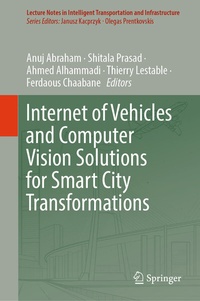
Internet of Vehicles and Computer Vision Solutions for Smart City Transformations
Description

This book compiles recent research endeavors at the intersection of computer vision (CV) and deep learning for Internet of Vehicles (IoV) applications, which are pivotal in shaping the landscape of smart cities. These technologies play instrumental roles in enhancing various facets of urban life, encompassing safety, transportation, infrastructure management, and sustainability. The amalgamation of CV and deep learning within smart cities creates a powerful synergy that fosters safer, more efficient, and sustainable urban environments. By harnessing these cutting-edge technologies to drive data-driven decision-making, cities can elevate the quality of life for their inhabitants, mitigate environmental impact, and optimize overall urban functionality. Additionally, this compilation provides in-depth technical and scientific insights into various facets of artificial intelligence (AI) technologies, including forthcoming trends and innovations that are poised to transform smart cities.
The book also extends its focus to other areas of smart city development. It explores the application of these technologies in the creation of smart parking solutions, discusses the role of surveillance for public safety, and examines how CV and IoV can be utilized for environmental monitoring. The book also delves into urban planning and infrastructure development, emphasizing the importance of a data-driven approach. It sheds light on the social impact of smart cities and the importance of citizen engagement and discusses issues of security and privacy in the context of smart cities. The book concludes with a look at future trends and challenges in the field of smart cities. Targeted at researchers, practitioners, engineers, and scientists, this book is geared toward those engaged in the development of advanced algorithms for future-forward smart city applications in computer vision, vehicular networking, communication technology, sensor devices, IoT communication, vehicular and on-road safety, data security, and services for IoV-related devices.
More details
Other editions
Additional editions
Content
Introduction to Smart Cities.- Understanding Smart City Concepts.- Importance of Technology in Urban Development.- Computer Vision in Smart Cities.- Basics of Computer Vision.- Applications of Computer Vision in Smart Cities.- Challenges and Opportunities.- Internet of Things (IoT) and Smart Cities.- IoT Infrastructure in Urban Environments.- IoT Sensors and Data Collection.- Integration of IoT in Smart Cities.- Internet of Vehicles (IoV) and Intelligent Transportation Systems.- IoV Fundamentals and Traffic Management.- Connectivity, Communication, and Vehicle Safety.- IoV Applications for Urban Mobility and Real-time Data Analytics.- Integration Challenges and Optimal Routing Protocols in IoT and IoV.- Standardization in Safe Autonomous Systems.- Software Infrastructure, Policies & Regulations for Intelligent Vehicles.- Computer Vision for Traffic Management.- Traffic Surveillance and Monitoring.
