

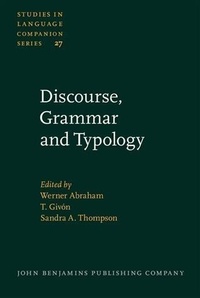
Discourse, Grammar and Typology
Papers in honor of John W.M. Verhaar
1st Edition
Published on 10. February 1995
XX, 352 pages
978-90-272-8573-7 (ISBN)
Description

This volume combines papers selected for their affinity with work on discourse analysis and language typology. The methodological platform is the authors' conviction that all linguistic work needs to be empirical in the sense that (1) generalizations are to be made on the basis of spoken texts in larger contexts, (2) generalizations are correct only as long as pertinent linguistic material does not contradict them, and (3) that linguistic categories and rules are of a temporal nature. In this sense, the contributions represent 'functional typological' comparison, often of languages not frequently investigated.
The papers are arranged in 5 groups: Transitivity and voice; Clausal modality; Typology and discourse categories; Language and Culture; Functionality.
The papers are arranged in 5 groups: Transitivity and voice; Clausal modality; Typology and discourse categories; Language and Culture; Functionality.
More details
Other editions
Additional editions
Werner Abraham | T. Givon | Sandra A. Thompson
Discourse, Grammar and Typology
Papers in honor of John W.M. Verhaar
Book
02/1995
John Benjamins Publishing Co
€127.20
Shipment within 10-15 days
Content
- DISCOURSE GRAMMAR AND TYPOLOGY
- Editorial page
- Title page
- Copyright page
- Table of contents
- Introduction
- Curriculum Vitae
- Bibliography
- SectionI: Transitivity and Voice
- Diathesis: The Middle, Particularly in West-Germanic
- 1. Exposition: The middle as a verbal diathesis
- 2. Research background, thematic delimitation, and goal of this paper
- 3. The middle in English and German: Middle constructions vs. middle verbs
- 4. Generalizations and questions
- 5. The middle and corefence between subject and the direct object
- 5.1 Reflexive sich
- 5.2 The implicit thematic function of the obligatory "middle" adverbial
- 6. The interrelation between medialization and passivization
- 7. Agentive interpretation without surface agents
- 8. The functional and categorial status of es and sich
- 9. Typological differences: Basic valency identification
- 10. The Romance type of middle: The Toscan example
- 10. Conclusion
- Notes
- References
- How Many Transitivisers Are in Kope?
- 1. Introduction
- 2. The semantics of Vm-
- 2.1 Beneficiary
- 2.2 Recipient
- 2.3 Addressee
- 2.4 Undergoer
- 2.5 Multiple Prefixes
- 3. The structural characteristics of Vm-
- 3.1 Syntactic
- 3.2 Morphological
- 4. Comparative evidence for the status of Vm-
- 5. The status of Vm- in Kope
- Notes
- References
- Complement Clauses Versus Relative Clauses: Some Khmer Evidence
- 1. English
- 2. Japanese
- 3. Khmer
- 4. Conclusions
- Notes
- References
- The two Prototypes of Ditransitive Verbs: The Indonesian Evidence
- 1. Introduction
- 2. The DAT/BEN verb-types (prototypes)
- 3. The LOC/INSTR verb-types
- 4. The "partial" DAT verbs
- 5. Summary
- 6. Passivization
- 7. Lexical-passive verbs with -kan
- 8. Interweaving the types of -kan
- 9. Confounding the use and non-use of -kan
- 10. English vs Indonesian: Typological difference
- 11. On Chung (1976)
- 12. On Hopper and Thompson (1980)
- Acknowledgements
- Notes
- References
- Appendix 1
- Appendix 2
- Appendix 3
- Section II: Clausal Modality
- The Assertion of High Subjective Certaintyin Mufian (Papua New Guinea) Oral Narratives
- 1. Introduction
- 2. Mufian background data
- 3. Function of a' 'certainty'
- 3.1 a' with irrealis verbs
- 3.2 a' with realis verbs
- 3.3 Emphatic strong command
- 3.4 Contrastive/emphatic topicalization of an NP
- 4. Conclusion
- Notes
- References
- Appendix 1
- On the German werden future
- 1. Introduction
- 2. Grammaticalization chains
- 3. On the development of future tenses
- 4. The verb-to-future chain
- 5. On conceptual relationship
- 6. On modality
- 7. Conclusions
- Notes
- References
- The Category 'Event' in Natural Discourse and Logic
- Preface
- 1. Eventhood in philosophy and linguistics
- 2. Event reporting in natural language
- 2.1 Simple narrative clauses in texts
- 2.2 Event reporting in vernacular English
- Notes
- References
- Section III: Typology and Discourse Categories
- The Category 'S' in English Conversation
- Introduction
- 1. Methods
- 1.1 Coding difficulties
- 2. Results
- 2.1 Subtypes of 'S'
- 2.2 Animacy
- 2.3 Anaphoric type
- 2.4 Person
- 2.5 Number
- 2.6 Feature clusters
- 3. Conclusions
- Notes
- References
- Appendix A
- A Semantic Basis for Grammatical Typology
- 1. Introduction
- 2. The uniqueness of grammatical and semantic systems
- 3. Typology and semantics
- 4. Reflexiveconstructions
- 5. Transitive constructions
- 6. Conclusion
- Notes
- References
- Section IV: Language and Culture
- Grammatical Signs of the Divided Self A Study of Language and Culture
- 1. Introduction
- 2. The idea of alienation
- 3. Way-stations on the path to alienation
- 3.1 No representation of the self
- 3.2 Self address
- 3.3 Self reference
- 3.4 Stage fright
- 3.5 Affectation
- 4. Mind-body splits: Reflexive pronouns
- 4.1 Developments in English
- 4.2 A case of semantic reversal
- 5. Conclusions
- Notes
- References
- Language and Culture of Inner Asia's Borderland
- Introduction
- 1. Inner Asia's borderlands
- 2. Cultural and linguistic characteristics
- 3. Extant research on the borderland
- 4. The unknown dialects of Baonan
- 5. Conclusion
- Notes
- References
- Appendix. Map of Chinawith the borderland area shaded in a rectangle
- Section V: Functionality
- Multifunctionality and the Realization Problem in Modelling Discourse Production
- 1. Introduction
- 1.1 Data
- 2. Trigger choice in Malay
- 2.1 Trigger choice in primary clauses
- 2.2 Trigger choice in secondary clauses
- 3. Distribution in texts
- 4. Conclusion
- Notes
- References
- Appendix: Glossing Conventions
- Towards an Understanding of Linguistic Evolution and the Notion 'X has a Function Y'
- 1. Introduction
- 2. Discrimination between grammatical functions
- 2.1 Some simpler examples
- 2.2 A complex case: Fore
- 2.3 A more complex case: Acehnese
- 3. On methodology and argumentation
- 4. Conclusion
- Notes
- References
- Lice he no good": On [r] and [l] in Tok Pisin
- Introduction
- 1. Data base
- 2. Tok Pisin phonology
- 3. Variability in [r] and [1]
- 4. Conclusion
- Notes
- References
- Form and Meaning in Morphology
- Problems with compositionality in morphology
- 1. Polyfunctionality in morphology
- 2. Non-linearity in morphology
- 3. Subcategorization in morphology
- 4. Argument structure in morphology
- 5. Argument satisfaction of word-internal verbs
- 6. Argument satisfaction of word-internal prepositions
- 7. Conclusion
- Acknowledgements
- References
- Subject index
- List of Contributors and Editors
- The series Studies in Language Companion Series
