

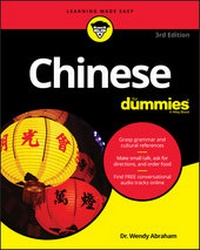
Chinese For Dummies
Description

With more than 1.2 billion speakers across the globe -- and with nearly 3 million in the U.S. alone -- Mandarin Chinese claims the top spot as the world's most common language. If you want to learn this language to get ahead at school or work, or to make your travel to China easier, this is the handy reference you'll want by your side.
Chinese For Dummies teaches basic grammar, as well as the necessary vocabulary to make introductions and greetings, use proper etiquette, make small talk, make transportation arrangements, order food and beverages, ask directions, deal with money, shop, access recreation, and handle an emergency.
* Concentrates on Mandarin Chinese and features new and revised content
* Includes major updates to all the necessary foundational information needed to speak Chinese
* Covers grammar, verb conjugations, and pronunciations
* Offers a refreshed mini-dictionary complete with even more vocabulary
* Find free conversational audio tracks online
As the Chinese economy continues to grow, the importance of Chinese as a trade language will also increase. If you're a student or business professional who has a basic understanding of the language, you'll be poised to surpass your peers when it comes to dealing with international markets. So get started today!
More details
Other editions
Additional editions
Content
- Intro
- Title Page
- Copyright Page
- Table of Contents
- Introduction
- About This Book
- Foolish Assumptions
- Icons Used in This Book
- Beyond the Book
- Where to Go from Here
- Part 1 Getting Started with Chinese
- Chapter 1 Chinese in a Nutshell: The Spoken Word
- Grasping Chinese Dialects
- Pinyin Spelling: Beijing, Not Peking
- Sounding Off: Basic Chinese Sounds
- Starting off with initials
- Ending with finals
- Perfect pitch: Presenting . . . the four tones!
- Adding Idioms and Popular Expressions to Your Repertoire
- Chapter 2 The Written Word: Checking Out Chinese Characters
- Perusing Pictographs, Ideographs, and the Six Scripts
- The Chinese Radical: A Few Clues to a Character's Meaning
- Following the Rules of Stroke Order
- Rule 1
- Rules 2 through 9
- Up, Down, or Sideways? Deciphering the Direction of Characters
- Traditional versus Simplified Characters: When to Use Which
- Using a Chinese Dictionary . . . without an Alphabet!
- Chapter 3 Warming Up with the Basics: Chinese Grammar
- The Basics of Chinese Nouns, Articles, and Adjectives
- Nouns
- Definite versus indefinite articles
- Adjectives
- Getting into Verbs, Adverbs, Negation, and Possession
- Verbs
- Adverbs
- Bù and méiyou: Total negation
- Getting possessive with the particle de
- Asking Questions
- The question particle ma
- Yes/no choice questions using bù between repeating verbs
- Interrogative pronouns
- Chapter 4 Getting Started with Basic Expressions: Ni Hao!
- Making Introductions
- Acquainting yourself
- Introducing your friends and family
- Asking people for their names
- Greeting and Chatting
- Addressing new friends and strangers
- Conversing around the clock
- Talking about the weather
- Finding out where people are from
- Taking (that is, rejecting) compliments
- Saying goodbye
- Chapter 5 Getting Your Numbers, Times, and Measurements Straight
- Counting in Chinese
- Numbers from 1 to 10
- Numbers from 11 to 99
- Numbers from 100 to 9,999
- Numbers from 10,000 to 100,000 and beyond
- How 'bout those halves?
- Ordinal numbers
- Asking how many or how much
- Telling Time
- Asking and stating the time
- Specifying the time of the day
- Save the Date: Using the Calendar and Stating Dates
- Dealing with days of the week
- Naming the months
- Specifying dates
- Celebrating Chinese holidays
- Sizing Up Weights and Measures
- Chapter 6 Speaking Chinese at Home
- Hanging Out at Home
- Hunting for an Apartment
- Decorating Your New Digs
- Appointing Your Rooms, Fengshui Style
- The bedroom
- The bathroom
- The kitchen
- The living room
- The basement
- The attic
- Part 2 Chinese in Action
- Chapter 7 Getting to Know You: Making Small Talk
- Establishing a Connection
- Posing simple introductory questions
- Chatting about family
- Making small talk on the job
- Talking about where you live
- Chapter 8 Dining Out and Shopping for Food
- All about Meals
- Satisfying your hunger
- Sitting down to eat and practicing proper table manners
- Getting to Know Chinese Cuisines
- Dining Out
- Understanding what's on the menu
- Placing an order and chatting with the waitstaff
- Dipping into some dim sum
- Finding the restrooms
- Finishing your meal and paying the bill
- All the Tea in China
- Taking Your Chinese to Go
- Making comparisons
- How much is that thousand-year-old egg?
- Chapter 9 Shopping Made Easy
- Going to Stores
- Getting What You Want at a Department Store
- Just browsing
- Asking for help
- Shopping for Clothes
- What's your size?
- Comparing quality: Good, better, best
- Comparing two items
- What are you wearing? Chuan versus dài
- Asking about the color and material
- Shopping for Other Items
- Hunting for antiques
- Getting a Good Price and Paying
- Negotiating prices at the night market
- Paying for your purchase (or demanding a refund)
- Chapter 10 Exploring the Town
- Attending a Performance
- Exploring different types of music
- Buying a ticket
- Asking whether someone has done something
- Exploring Museums and Galleries
- Visiting Historical Sites
- Going to the Movies
- Hopping Around Bars and Clubs
- Chapter 11 Taking Care of Telecommunications
- Getting Familiar with Telephone Terms
- Going Mobile with a Cellphone
- Making a Phone Call
- Calling your friends
- Ringing hotels and places of business
- Phoning a client
- Sorry, I Can't Take Your Call Right Now . . .
- Listening to messages that people leave you
- Recording and understanding greeting messages
- Leaving messages
- Checking Your Email
- Going Online
- The Great Wall . . . Firewall, That Is
- Chapter 12 Chinese at School and Work
- Going to School
- Schools and supplies
- Teachers and subjects
- Exams and semesters
- Degrees and diplomas
- Settling into Your Office Digs
- Conducting a Meeting
- Scheduling and planning a meeting
- Making the initial greeting
- Starting the meeting
- Making a presentation
- Ending the meeting
- Discussing Business and Industry
- Chapter 13 Recreation and Outdoor Activities
- Naming Your Hobbies
- Exploring Nature
- Tapping into Your Artistic Side
- Striking Up the Band
- Playing on a Team
- Part 3 Chinese on the Go
- Chapter 14 Planning a Trip
- Talking about When You Want to Travel
- Celebrating the Chinese Holidays
- Where To? Deciding on a Destination
- Passports and Visas: Don't Leave Home without 'Em
- Packing for Your Trip
- Enlisting the Help of a Travel Agency
- Chapter 15 Making Cents of Money
- Staying Current with Chinese Currency
- Rénmínbì (RMB) in the PRC
- Xin Táibì in the ROC
- Hong Kong dollars
- Singapore dollars
- Exchanging Money
- Spending Money
- Using cash
- Paying with plastic
- Doing Your Banking
- Making withdrawals and deposits
- Accessing an ATM
- Tips on Tipping
- Chapter 16 Getting Around
- Flying Around the Airport
- Making it past the check-in counter
- Boarding your flight
- Going through customs
- Navigating Around Town
- Hailing a cab
- Hopping on the bus
- Riding the rails
- Chapter 17 Asking for Directions
- Avoiding 20 Questions: Just Ask "Where?"
- Different strokes for different folks: Saying nar versus saying nali
- Getting direction about directions
- Understanding the answers to "where" questions
- Expressing Distances (Time and Space) with Lí
- Using Ordinal Numbers to Clarify Points of Reference
- Specifying Cardinal Points
- Chapter 18 Finding a Place to Stay
- Making a Room Reservation
- Checking In Before You Hit the Pool
- Taking Advantage of Hotel Service
- Counting on convenience
- Getting problems fixed
- Checking Out Before Heading Out
- Chapter 19 Handling Emergencies
- Calling for Help in Times of Need
- Receiving Medical Care
- Deciding whether to see a doctor
- Describing what ails you
- Discussing your medical history
- Making a diagnosis
- Treating yourself to better health
- Calling the Police
- Acquiring Legal Help
- Part 4 The Part of Tens
- Chapter 20 Ten Ways to Learn Chinese Quickly
- Listen to Chinese Being Spoken
- Check Out a Peking Opera Performance
- Cook with a Wok
- Shop for Food in Chinatown
- Search Online
- Watch Kung-Fu Flicks
- Exchange Language Lessons
- Make Chinese Friends
- Study Chinese Calligraphy
- Be Curious and Creative
- Chapter 21 Ten Things Never to Do in China
- Never Accept a Compliment Graciously
- Never Make Someone Lose Face
- Never Get Angry in Public
- Never Address People by Their First Names First
- Never Take Food with the Wrong End of Your Chopsticks
- Never Drink Alcohol Without First Offering a Toast
- Never Let Someone Else Pay the Bill Without Fighting for It
- Never Show Up Empty-Handed
- Never Accept Food, Drinks, or Gifts Without First Refusing a Few Times
- Never Take the First "No, Thank You" Literally
- Part 5 Appendixes
- Appendix A Chinese-English Mini-Dictionary
- Appendix B Appendix B Chinese Verbs
- Appendix C Fun & Games Answer Key
- Index
- EULA
Introduction
Globalization has made familiarity with other people, cultures, and languages not only preferable but also essential in the 21st century. With the help of the Internet and a bevy of social media growing at a dizzying rate, reaching out and touching someone on the other side of the earth has become as easy as clicking a mouse, using a smartphone, or clicking on to RenRen (the Chinese equivalent of Facebook) or Weibo (the Twitter of China). And yet nothing quite beats the excitement of a face-to-face encounter with someone who hails from the other side of the globe in his or her own language. Communication in cyberspace doesn't even come close.
Whether you're an inveterate traveler, going overseas for business, studying abroad, adopting a child, interested in frequenting Chinatown, befriending a Chinese-speaking classmate or co-worker, or just plain curious about China, Chinese For Dummies, 3rd Edition, can help you get acquainted with enough Chinese to carry on a decent conversation on any number of topics. You won't become fluent instantly, of course, but this book helps you greet a stranger, buy a plane ticket, talk to Chinese students, converse with business colleagues, and order some food. It also gives you some invaluable cultural tips so that you not only rattle off those newly acquired words and phrases but also back them up with the right behavior at the right time.
I designed this book to help guide you toward the successful use of one of the most difficult languages on earth. Chinese should also just be plain fun to learn.
About This Book
The good news is that you can use Chinese For Dummies, 3rd Edition, anytime, anywhere. No mandatory class sessions, no exams, and no homework assignments to dread. Need to get to a new city for a business meeting? Just turn to the chapters on travel or business to find out how to buy a plane ticket, get through customs, get to the airport on time, or do some negotiating. Have to make a sudden trip to the doctor? Turn to the chapter on your health and figure out in advance how to tell your caregivers exactly what ails you.
Pay attention to a few conventions that can help you navigate this book's contents:
- Chinese terms are set in boldface to make them stand out.
- Pronunciations and meanings appear in parentheses immediately after the Chinese terms. The English translations are in italics.
- This book uses the pinyin ?? (pin-yin) (Literally: spelling the way it sounds) Romanization system of Chinese words. What does that mean? Well, if you go to China, you see signs in Chinese characters all around, but if you look for something in English, you may be hard-pressed to find it. Whatever signs you see in Roman letters will be of pinyin, the Romanization system developed by the Communists in the 1950s, so seeing pinyin in this book is good practice for you.
-
In this edition of Chinese For Dummies, Chinese characters have been added in many places and appear after the initial transliteration from the pinyin. Chinese characters are fun to try to decipher. The Chinese have been working at precisely that for thousands of years, especially for the more complicated characters that took as many as 20 separate strokes of the writing brush to create traditional Chinese characters.
Lucky for you, many of the more complicated Chinese characters were simplified in the early 20th century to make them easier to read and write, and these are used in mainland China today. (You can read more about Chinese characters in Chapter 2.) The original (or traditional) characters are still used in Taiwan. In this book, simplified characters appear first, followed in parentheses by the traditional characters. Characters that were never simplified don't have any separate notation in parentheses.
- Another thing you should keep in mind as you begin to understand Chinese is that many of the English translations you see in this book aren't exactly literal. Knowing the gist of what you hear or see is more important than knowing what individual words in any given phrase mean. For example, the Chinese phrase meaning so-so literally translates as horse horse tiger tiger even though you're not actually talking about animals. Whenever I give a literal translation, I preface it with "Literally."
The following elements in this book help reinforce the new terms and phrases you're studying:
- Talkin' the Talk dialogues: Nothing beats seeing and hearing an actual conversation to learn Chinese, so I intersperse dialogues throughout the book under the heading "Talkin' the Talk." They show you the Chinese words, the pronunciations, and the English translations, and I often put cultural do's and don'ts into context, which should come in handy. Many of these dialogues appear in the accompanying online audio tracks so you can practice the sentences after you hear how they should sound. With the tonal nature of the Chinese language, this feature is indispensable as you learn Chinese.
- Words to Know: These boxes come after the Talkin' the Talk dialogues and highlight useful additional words beyond the dialogue.
- Fun & Games activities: Working through word games, cracking crossword puzzles, or recalling some phrases to fill in the blanks can be a fun way to review the words and phrases you encounter in each chapter. This element is a great way to gauge your progress and tease your brain at the same time. Look for these activities at the end of each chapter.
The beauty of this book is that it can be all things to all people. You don't have to memorize Chapter 5 before moving on to Chapter 6 if what Chapter 6 deals with is what you really need. Each chapter provides you with different bits of information about the Chinese language and highlights different parts of Chinese grammar. Read as much or as little as you want, as quickly or as slowly as you like. Whatever interests you is what you should focus on. And remember: You're discovering a language that simultaneously represents one of the world's oldest civilizations and one of its fastest-growing economies in the 21st century.
Foolish Assumptions
Some of the foolish assumptions I made about you while writing Chinese For Dummies, 3rd Edition, are that
- You don't know any Chinese, except for maybe a couple of words you picked up from a good kung-fu movie or the word tofu, which you picked up while grocery shopping.
- Your goal in life isn't to become an interpreter of Chinese at the U.N.; you just want to pick up some useful words, phrases, and sentence constructions to make yourself understood in a Chinese-speaking environment.
- You have no intention of spending hours and hours memorizing Chinese vocabulary and grammar patterns.
- You basically want to have fun while speaking a little Chinese.
Icons Used in This Book
Cute little icons occasionally appear in the left-hand margins, next to sidebars, and with the Talkin' the Talk dialogues throughout this book. These beacons shed light on what kind of information you're looking at and can help you locate certain types of information in a hurry. The five icons used in this book are as follows:
The bull's-eye appears wherever I've highlighted a great idea to help make your study of Chinese easier.
This icon, appropriately showing a string around a finger, should serve as a reminder about particularly important information concerning Chinese.
This icon should act as a stop sign in your mind. It warns you about things to avoid saying or doing so that you don't make a fool of yourself overseas or with a new Chinese friend.
This icon clues you in on fascinating bits of information about China and Chinese culture. Knowledge of a culture goes hand in hand with knowledge of a foreign language, so these icons help light the way as you embark on your journey.
This icon highlights various rules of grammar that may be out of the norm. Even though this book doesn't focus primarily on grammar, your successful execution of the language can only be enhanced by paying attention to little grammatical rules as they pop up.
Beyond the Book
This book is full of useful information, but you can find even more online! Check out this book's Cheat Sheet, which contains useful questions, common expressions, phrases used in emergencies, the Chinese calendar, and Chinese numbers all in a handy portable format. Just go to www.dummies.com and search for "Chinese For Dummies Cheat Sheet."
You can also hear all the Talkin' the Talk dialogues provided in the book to get a better handle on correct pronunciation. Just go to www.dummies.com/go/chinesefd.
Where to Go from Here
Chinese is often considered one of the toughest languages in the world to master. Don't worry. The good news is that you're not trying to master it. All you want to do is be understandable when you open your mouth so that you don't ask for the men's room when you really want the ladies' room. All?you have to do now is keep listening to and repeating the words and phrases you find in this book....
