

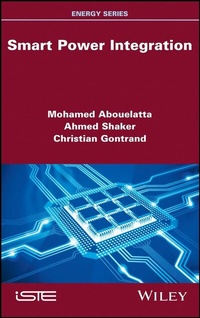
Smart Power Integration
Description

Two types of integration are highlighted: modular or hybrid integration, together with compatible devices such as the insulated gate bipolar transistor (IGBT); and monolithic integration, specifically through the paradigm of functional integration. Smart Power Integration outlines the main MOS devices for high voltage integrated circuits, and explores into the fields of codesign, coupling hardware and software design, including applications to motor control. Studies focusing on heat pipes for electronics cooling are also outlined.
More details
Other editions
Additional editions
Persons
Mohamed Abouelatta is a professor of microelectronics at Ain Shams University, Egypt. His fields of research include power devices, smart power ICs, photovoltaic and 3D heterogeneous integration.
Ahmed Shaker is a professor of engineering physics at Ain Shams University, Egypt. His fields of research include power devices, and photovoltaic and tunneling FETs.
Christian Gontrand is a professor at INL/INSA Lyon, France. He was formerly a head professor in the Smart Power Integration team at AMPERE lab and had the technical charge of the CIMIRLY from 1988 to 1996.
Content
Preface ix
Chapter 1. Overview of Smart Power Integration 1
1.1. Introduction 1
1.2. Smart PIC applications 2
1.2.1. Flat panel displays 4
1.2.2. Computer power supplies and disk drivers 4
1.2.3. Variable speed motor drives 4
1.2.4. Factory automation 4
1.2.5. Telecommunications 5
1.2.6. Appliance controls 5
1.2.7. Consumer electronics 5
1.2.8. Lighting controls 5
1.2.9. Smart homes 6
1.2.10. Aircraft electronics (Avionics) 6
1.2.11. Automotive electronics 6
1.3. Historical view of the MOS power devices 6
1.4. Smart PIC fabrication processes 9
1.4.1. Dedicated processes 9
1.4.2. Compatible processes 10
1.5. Insulation techniques 10
1.5.1. Self-insulation 10
1.5.2. Dielectric insulation 11
1.5.3. Junction insulation 11
1.5.4. Advanced junction insulation techniques 12
1.6. Motivation of the book 13
Chapter 2. Modular or Hybrid Integration 17
2.1. Introduction 17
2.2. IGBT technology evolution 18
2.2.1. IGBT presentation 18
2.2.2. Epitaxial structure with buffer layer and reduction of carrier lifetime 30
2.2.3. Homogeneous structure with control of load injection 36
2.2.4. Silicon direct bonding-IGBT 38
2.2.5. IGBT trench 39
2.2.6. Lateral IGBT 39
2.3. Assembly technology 40
2.4. Thermal aspect 41
2.4.1. Thermal impedance 43
2.5. Applications fields 45
2.5.1. IGBT power modules for electric traction applications 45
2.5.2. IPM for low- and medium-power applications 48
Chapter 3. Monolithic Integration 51
3.1. Functional integration and smart power 51
3.2. Transition from low-voltage technology (CMOS) to high voltage 52
3.2.1. Introduction 52
3.2.2. A typical CMOS technology 62
3.2.3. Breakdown voltage of a microelectronics structure 63
3.2.4. Improved junctions breakdown by guard techniques 68
3.2.5. Improvement using electrical insulation techniques 73
3.2.6. Review of the main MOS devices for high-voltage integrated circuits 75
3.3. Combining analog and digital (mixed) 82
3.3.1. Analog: basic functional blocks in CMOS technology and basic analog structures 82
3.3.2. Reminder on the general structure of the operational amplifier 88
3.3.3. Digital 96
3.3.4. The notion of codesign 96
3.3.5. Assessment 99
Chapter 4. Technology for Simulating Power Integrated Systems 101
4.1. Introduction 101
4.2. Hardware and software design of engine control 102
4.2.1. Functional specification 105
4.2.2. Exploring the space of solutions: the partitioned specification model 106
4.2.3. Mixed synthesis, hardware and software code 107
4.2.4. Model functional testing 110
4.2.5. Synthesis of the approach and related tools of the functional model 111
4.3. Proposed design stream: related tools 112
4.3.1. Accuracy 113
4.3.2. Resources and system architecture 113
4.3.3. Realization 120
4.4. Conclusion 123
Chapter 5. 3D Electrothermal Integration 125
5.1. Introduction 125
5.2. Electrothermal modeling of substrate 126
5.2.1. Brief introduction to mathematical tools 127
5.2.2. Simulation results by using Green/TLM 132
5.2.3. Thermal management in a 3D-integrated figure 146
5.2.4. Thermo-mechanical design 156
5.2.5. Thermal modeling of the connectors 157
5.3. Heat analysis for 3D ICs 157
5.3.1. 3D IC heat transfer compact model without TSVs 157
5.3.2. IC model for analyzing the temperature of the chip of the top layer taking into account the TSVs 159
5.3.3. 3D IC thermal modeling result 161
5.3.4. Electrothermal (ET) modeling of very large scale circuits 166
5.3.5. Electrical modeling of very large scale 167
5.3.6. Thermal modeling of very large scale circuits 170
5.3.7. Electrothermal modeling of very large scale circuits 171
5.4. Conclusion 184
5.5. Heat pipe 185
5.6. Conclusion 203
Chapter 6. Substrate Coupling in Smart Power Integration 205
6.1. Introduction 205
6.2. Part I: smart power integration using the DTI technique 205
6.2.1 DTI technology 205
6.2.2 DTI structure 206
6.2.3. LDMOSFET performance with DTI 207
6.2.4. Parasitic suppression in 2D smart power ICs with deep trench 211
6.2.5. HV dynamic signal impact on CMOS devices 215
6.2.6. Mixed-mode CMOS-substrate coupling simulation 227
6.3. Part II: smart power integration using stacked 3D technology 232
6.3.1. From 2D planar integration to 3D integration 232
6.3.2. 3D smart power integration 234
6.3.3. TSV-CMOS mixed-mode coupling 253
6.3.4. Electromagnetic impact of TSV in RF range 264
Conclusion 271
Appendix: Semiconductor Physical Models 275
References 299
Index 301
1
Overview of Smart Power Integration
1.1. Introduction
Since 1965, integrated circuit (IC) technology has followed Moore's law which states that the number of integrated devices doubles every 18 months. This growth is partly due to an increase in the size of ICs that can be produced. However, the dominant effect is due to the reduction in feature size of component devices that are integrated. The reduction of feature size tends to bring advantages of increased speed and the possibility to operate at lower voltages, allowing reduced power consumption. These advantages make technology shrinkage very attractive for technical performance reasons, as well as cost.
However, there are many applications where voltage cannot be reduced for external reasons. There are three areas where this is the case: power electronics, automotive applications and wide dynamic range circuits. In such applications, system integration of high voltage, analog and digital circuitry on a single IC is attractive in order to gain advantage in terms of miniaturization, reliability, efficiency and cost. However, in order to make these gains, the conflict of reducing voltage due to technology feature size has to be resolved with the requirements for operation at continued relatively high voltage.
The different operation and interface requirements of high voltage, analog and digital require a technology development optimized for these system requirements. Different technologies have been developed to address these applications, such as smart power and various bipolar-CMOS-DMOS (BCD) processes.
Smart power integrated circuits (PICs) that monolithically integrate low-loss power devices and control circuitry have attracted much attention across a wide range of applications. These ICs improve system reliability, reduce volume and weight and increase overall efficiency. Considerable effort has been put into the development of smart power devices for automotive electronics, peripheral computer appliances and portable equipment, such as cell phones, video cameras, and so on.
Commonly used smart power devices are the lateral double diffused MOS Field Effect Transistor (LDMOSFETs) and lateral insulated gate bipolar transistors (LIGBTs) implemented in bulk silicon or silicon on insulator (SOI). The main challenges in the development of these devices are obtaining the best trade-off between specific ON-resistance RON,SP (RON × area) and breakdown voltage (BV), and shrinking feature size without degrading device characteristics.
1.2. Smart PIC applications
Figure 1.1. Applications of power devices
Smart PIC technology is expected to have an impact in all areas in which discrete power semiconductor devices are currently being used. It is anticipated that this technology will open up new applications based upon the added features of smart controls. In Figure 1.1, applications of power devices are shown as a function of operating frequency. Another classification approach of these applications involves current and voltage handling requirements, as shown in Figure 1.2. Some of these applications are listed in the following subsections.
Figure 1.2. System ratings of power devices
1.2.1. Flat panel displays
The popularity of portable electronic products such as cell phones and notebook computers has generated significant demand for flat panel displays. These displays are usually liquid crystal displays (LCD) or electro-luminescence (EL) panels arranged in a matrix with large number of column and row drivers (e.g. 640 × 480 for VGA resolution). Although the required voltage may be high, the current level is low (usually in the mA range). Smart PICs with as many as 80 output channels have been fabricated on a monolithic chip.
1.2.2. Computer power supplies and disk drivers
Computer systems are developing continuously in terms of speed and processing capabilities. This is made possible by using higher density Very Large-Scale Integration (VLSI) technology. However, the increased power requirement has resulted in an increase in the physical size of the power supply. In 1976, the CPU board and power supply each represented one-third of the total physical volume of a computer system. By the 1990s, the power supply had grown to 50% of the physical volume while the CPU board had shrunk to about 20%. To reverse this trend, it is necessary to develop smart PIC technology to improve the density and hence the volume of the power supplies.
1.2.3. Variable speed motor drives
Variable-speed motor drives are being developed to reduce power loss in all applications. The improvement in performance requires smart power technology that can operate at relatively high frequencies with low power losses. This translates to a low ON-state voltage drop at high current levels, fast switching speed and rugged operation. For smart PIC implementation, additional consideration, such as level shifting to and from high voltages, over-temperature, over-current, over-voltage and short-circuit protection are more critical.
1.2.4. Factory automation
Advanced numerical control and robotic systems require efficient smart PIC technology to create a distributed power control network under the management of a central computer. The smart PICs for this application must be capable of providing AC or DC power to various loads, such as motors, solenoids, arc welders, and so on. They are also required to perform diagnostic, protection and feedback functions.
1.2.5. Telecommunications
One of the high-volume markets for smart power technology is in telecommunications. The technology required for these applications must be capable of integrating multiple high-voltage, high-current devices on a single chip. At present, this has been achieved using MOS devices fabricated using dielectric insulation. Improvements are required to reduce the cost of the dielectric insulation fabrication process. Ongoing development on direct wafer bonding has been promising in terms of providing a cost-effective process.
1.2.6. Appliance controls
The main benefit of using smart PICs in appliance control is to provide improvements in performance and efficiency. Onboard sensors can also provide more precise controls (e.g. temperature settings). Simple domestic appliances, such as toasters, washing machines and irons, are appearing with smart PICs for this reason.
1.2.7. Consumer electronics
Smart PICs are required for a large variety of entertainment systems such as CD players, tape recorders, VCRs, etc. For example, a monolithic motor control IC that regulates the speed of the motor, while minimizing power losses, is essential to all battery-operated consumer entertainment systems. Development of improved lateral power devices with greater power density is necessary to increase the efficiency of this technology.
1.2.8. Lighting controls
Traditional fluorescent lights use a mechanical ballast (transformer) for start-up. The electrical characteristics of fluorescent lights vary drastically from start-up to normal operation. In order to improve the efficiency and overall lifetime of a lighting system, more precise control is needed. The cost of electronic fluorescent light ballasts implemented using smart PICs can easily be justified by the resulting savings in energy and maintenance. In addition, incorporating smart PIC technology enables lighting to be controlled by a central computer, further enhancing energy savings in commercial buildings.
1.2.9. Smart homes
The concept of smart homes is attracting increased attention as a result of advances in smart power technology that are driving down the cost of the control module. A smart home system requires the development of a multiplexed network with smart power modules to control loads such as ovens, furnaces, air conditioners, lights and small appliances.
1.2.10. Aircraft electronics (Avionics)
The concept of fly-by-wire, where the hydraulic actuators in an aircraft are replaced by electromechanical actuators, is gaining acceptance among manufacturers. Success in development will depend on the availability of smart PIC technology to perform the control that is small in both size and weight. The power switches must be extremely reliable and capable of operating at high voltage and current levels with low ON-state voltage drop. In this regard, MOS-gated devices are essential for compact PICs.
1.2.11. Automotive electronics
One of the biggest anticipated markets for smart PICs is automotive electronics. Between the 1960s and 1970s, there was a slow uptake of discrete devices and analog ICs for automotive applications. In the 1980s, digital ICs and microprocessors were incorporated. In the 1990s, smart PICs were already being used to create a multiplexed control network in cars to reduce the size and weight of the wiring harness. The smart PIC modules control loads such as lights and motors, while providing protection functions. This has greatly enhanced fault management and diagnostic capability.
1.3. Historical view of the MOS power devices
The basic operation of the MOSFET involves the formation of a conductive channel at the surface of the semiconductor, below an insulator, by the...
