

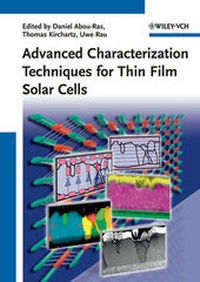
Advanced Characterization Techniques for Thin Film Solar Cells
1st Edition
Published on 12. May 2011
XXXVIII, 547 pages
978-3-527-63630-3 (ISBN)
Description

Written by scientists from leading institutes in Germany, USA and Spain who use these techniques as the core of their scientific work and who have a precise idea of what is relevant for photovoltaic devices, this text contains concise and comprehensive lecture-like chapters on specific research methods.
They focus on emerging, specialized techniques that are new to the field of photovoltaics yet have a proven relevance. However, since new methods need to be judged according to their implications for photovoltaic devices, a clear introductory chapter describes the basic physics of thin-film solar cells and modules, providing a guide to the specific advantages that are offered by each individual method.
The choice of subjects is a representative cross-section of those methods enjoying a high degree of visibility in recent scientific literature. Furthermore, they deal with specific device-related topics and include a selection of material and surface/interface analysis methods that have recently proven their relevance. Finally, simulation techniques are presented that are used for ab-initio calculations of relevant semiconductors and for device simulations in 1D and 2D.
For students in physics, solid state physicists, materials scientists, PhD students in material sciences, materials institutes, semiconductor physicists, and those working in the semiconductor industry, as well as being suitable as supplementary reading in related courses.
They focus on emerging, specialized techniques that are new to the field of photovoltaics yet have a proven relevance. However, since new methods need to be judged according to their implications for photovoltaic devices, a clear introductory chapter describes the basic physics of thin-film solar cells and modules, providing a guide to the specific advantages that are offered by each individual method.
The choice of subjects is a representative cross-section of those methods enjoying a high degree of visibility in recent scientific literature. Furthermore, they deal with specific device-related topics and include a selection of material and surface/interface analysis methods that have recently proven their relevance. Finally, simulation techniques are presented that are used for ab-initio calculations of relevant semiconductors and for device simulations in 1D and 2D.
For students in physics, solid state physicists, materials scientists, PhD students in material sciences, materials institutes, semiconductor physicists, and those working in the semiconductor industry, as well as being suitable as supplementary reading in related courses.
More details
Other editions
Additional editions
Daniel Abou-Ras | Thomas Kirchartz | Uwe Rau
Advanced Characterization Techniques for Thin Film Solar Cells
Book
03/2011
1st Edition
Wiley-VCH
€122.00
Article exhausted; check for reprint
Persons
- Uwe Rau is full professor at RWTH Aachen (Faculty Electrical Engineering and Computer Science, chair of photovoltaics) since 2007 and is head of the energy research IEF-55 photovoltaic institute at the research center in Jülich. He obtained his PhD 1991 from Physical Institute of the University Tübingen (Prof. Huebener) and was scientific group leader from 1995-2007 at the University Bayreuth and Stuttgart.
- Daniel Abou-Ras is senior scientist at the Helmholtz Center Berlin for Materials and Energy. He obtained his PhD at ETH Zurich, Switzerland. In 2005, he earned the MRS Graduate Student Gold Award at the MRS Spring Meeting. His research interests are scanning as well as transmission electron microscopy techniques applied on thin-film solar cells. Dr. Abou-Ras has organized various Young Scientist Tutorials on characterization techniques for thin film solar cells held at MRS and E-MRS Meetings.
- Thomas Kirchartz is a scientist at the Institute of Energy at the research center in Jülich. He obtained his Dipl. Ing. degree from the University of Stuttgart for work on the electroluminescence of solar cells in 2006 and his Dr. Ing. from the RWTH Aachen in 2009 for work on a detailed balance theory of solar cells. Dr. Kirchartz participated as instructor in two Young Scientist Tutorials on characterization techniques for thin film solar cells and was awarded a Graduate Student Award of the European Material Research Society.
- Daniel Abou-Ras is senior scientist at the Helmholtz Center Berlin for Materials and Energy. He obtained his PhD at ETH Zurich, Switzerland. In 2005, he earned the MRS Graduate Student Gold Award at the MRS Spring Meeting. His research interests are scanning as well as transmission electron microscopy techniques applied on thin-film solar cells. Dr. Abou-Ras has organized various Young Scientist Tutorials on characterization techniques for thin film solar cells held at MRS and E-MRS Meetings.
- Thomas Kirchartz is a scientist at the Institute of Energy at the research center in Jülich. He obtained his Dipl. Ing. degree from the University of Stuttgart for work on the electroluminescence of solar cells in 2006 and his Dr. Ing. from the RWTH Aachen in 2009 for work on a detailed balance theory of solar cells. Dr. Kirchartz participated as instructor in two Young Scientist Tutorials on characterization techniques for thin film solar cells and was awarded a Graduate Student Award of the European Material Research Society.
Content
I Introduction
1. Introduction to thin-film photovoltaics
II Device characterization
2. Fundamental electrical characterization of thin-film solar cells
3. Electroluminescence analysis of thin-film solar modules
4. Capacitance spectroscopy of thin-film solar cells
III Materials characterization
5. Characterizing the light trapping properties of textured surfaces with scanning near-field optical microscopy
6. Ellipsometry
7. Photoluminescence analysis of Si and chalcopyrite-type thin films for solar cells
8. Steady state photocarrier grating method
9. Time-of-flight analysis
10. Electron Spin Resonance on Si thin films for solar cells
11. Scanning probe microscopy on thin films for solar cells
12. Electron microscopy on thin films for solar cells
13. X-ray and neutron diffraction of materials for thin film solar cells
14. Raman Spectroscopy on thin films for solar cells
15. Soft x-ray and electron spectroscopy: a unique "tool chest" to characterize the chemical and electronic properties of surfaces and interfaces
16. Elemental distribution profiling of thin films for solar cells
17. Hydrogen effusion experiments
IV Materials and device modelling
18. Ab-initio modelling of semiconductors
19. One-dimensional electro-optical simulations of thin film solar cells
20. Two-dimensional electrical simulations of thin film solar cells
1. Introduction to thin-film photovoltaics
II Device characterization
2. Fundamental electrical characterization of thin-film solar cells
3. Electroluminescence analysis of thin-film solar modules
4. Capacitance spectroscopy of thin-film solar cells
III Materials characterization
5. Characterizing the light trapping properties of textured surfaces with scanning near-field optical microscopy
6. Ellipsometry
7. Photoluminescence analysis of Si and chalcopyrite-type thin films for solar cells
8. Steady state photocarrier grating method
9. Time-of-flight analysis
10. Electron Spin Resonance on Si thin films for solar cells
11. Scanning probe microscopy on thin films for solar cells
12. Electron microscopy on thin films for solar cells
13. X-ray and neutron diffraction of materials for thin film solar cells
14. Raman Spectroscopy on thin films for solar cells
15. Soft x-ray and electron spectroscopy: a unique "tool chest" to characterize the chemical and electronic properties of surfaces and interfaces
16. Elemental distribution profiling of thin films for solar cells
17. Hydrogen effusion experiments
IV Materials and device modelling
18. Ab-initio modelling of semiconductors
19. One-dimensional electro-optical simulations of thin film solar cells
20. Two-dimensional electrical simulations of thin film solar cells
