

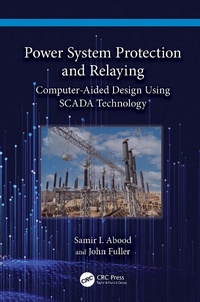
Power System Protection and Relaying
Computer-Aided Design Using SCADA Technology
1st Edition
Published on 29. September 2023
404 pages
978-1-000-95405-0 (ISBN)
Description

This textbook provides an excellent focus on the advanced topics of the power system protection philosophy and gives exciting analysis methods and a cover of the important applications in the power systems relaying. Each chapter opens with a historical profile or career talk, followed by an introduction that states the chapter objectives and links the chapter to the previous ones, and then the introduction for each chapter. All principles are presented in a lucid, logical, step-by-step approach. As much as possible, the authors avoid wordiness and detail overload that could hide concepts and impede understanding. In each chapter, the authors present some of the solved examples and applications using a computer program.
Toward the end of each chapter, the authors discuss some application aspects of the concepts covered in the chapter using a computer program.
In recognition of requirements by the Accreditation Board for Engineering and Technology (ABET) on integrating computer tools, the use of SCADA technology is encouraged in a student-friendly manner. SCADA technology using the Lucas-Nulle GmbH system is introduced and applied gradually throughout the book.
Practice problems immediately follow each illustrative example. Students can follow the example step by step to solve the practice problems without flipping pages or looking at the book's end for answers. These practice problems test students' comprehension and reinforce key concepts before moving on to the next section.
Power System Protection and Relaying: Computer-Aided Design Using SCADA Technology is intended as a textbook for a senior-level undergraduate student in electrical and computer engineering departments and is appropriate for graduate students, industry professionals, researchers, and academics.
The book has more than ten categories and millions of power readers. It can be used in more than 400 electrical engineering departments at top universities worldwide.
Based on this information, targeted lists of the engineers from specific disciplines including electrical, computer, power control, technical power system, protection, design, and distribution engineers.
Designed for a three-hours semester course on "power system protection and relaying," the prerequisite for a course based on this book are knowledge of standard mathematics, including calculus and complex numbers.
Toward the end of each chapter, the authors discuss some application aspects of the concepts covered in the chapter using a computer program.
In recognition of requirements by the Accreditation Board for Engineering and Technology (ABET) on integrating computer tools, the use of SCADA technology is encouraged in a student-friendly manner. SCADA technology using the Lucas-Nulle GmbH system is introduced and applied gradually throughout the book.
Practice problems immediately follow each illustrative example. Students can follow the example step by step to solve the practice problems without flipping pages or looking at the book's end for answers. These practice problems test students' comprehension and reinforce key concepts before moving on to the next section.
Power System Protection and Relaying: Computer-Aided Design Using SCADA Technology is intended as a textbook for a senior-level undergraduate student in electrical and computer engineering departments and is appropriate for graduate students, industry professionals, researchers, and academics.
The book has more than ten categories and millions of power readers. It can be used in more than 400 electrical engineering departments at top universities worldwide.
Based on this information, targeted lists of the engineers from specific disciplines including electrical, computer, power control, technical power system, protection, design, and distribution engineers.
Designed for a three-hours semester course on "power system protection and relaying," the prerequisite for a course based on this book are knowledge of standard mathematics, including calculus and complex numbers.
More details
Edition
1. Auflage
Language
English
Place of publication
London
United Kingdom
Publishing group
Taylor & Francis Ltd
Target group
College/higher education
Product notice
Reflowable
Illustrations
61 Tables, black and white; 282 Line drawings, black and white; 39 Halftones, black and white; 321 Illustrations, black and white
ISBN-13
978-1-000-95405-0 (9781000954050)
Copyright in bibliographic data and cover images is held by Nielsen Book Services Limited or by the publishers or by their respective licensors: all rights reserved.
Schweitzer Classification
Other editions
Additional editions
Samir I. Abood | John Fuller
Power System Protection and Relaying
Computer-Aided Design Using SCADA Technology
Book
07/2025
1st Edition
CRC Press
€77.60
Shipment within 10-20 days
Samir I. Abood | John Fuller
Power System Protection and Relaying
Computer-Aided Design Using SCADA Technology
Book
09/2023
1st Edition
CRC Press
€141.70
Shipment within 10-20 days
Persons
Samir I. Abood received his BS and MS from the University of Technology, Baghdad, Iraq, in 1996 and 2001, respectively. He earned his PhD in the Electrical and Computer Engineering from Prairie View A&M University. From 1997 to 2001, he worked as an engineer at the University of Technology. From 2001 to 2003, he was a professor at the University of Baghdad and Al-Nahrain University. From 2003 to 2016, he was a Middle Technical University/Baghdad-Iraq professor. He is an electrical and computer engineering professor at Prairie View A&M University in Prairie View. He is the author of 30 papers and 12 books. His main research interests are sustainable power and energy systems, microgrids, power electronics and motor drives, digital PID controllers, digital methods for electrical measurements, digital signal processing, and control systems.
John Fuller is an electrical and computer engineering professor at Prairie View A&M University in Prairie View, Texas. He received a BSEE degree from Prairie View A&M University and a master's degree and a PhD degree from the University of Missouri, Columbia. He has researched some funded projects over a 48-year teaching career in higher education. Some of the major projects of his research efforts are hybrid energy systems, stepper motor control, the design and building of a solar-powered car, nuclear survivability and characterization on non-volatile memory devices, nuclear detector/sensor evaluation, and some other electrical and computer-related projects. Dr. Fuller is presently the coordinator of Title III funding to the Department of Electrical and Computer Engineering in developing a solar-powered home. He is also the Center for Big Data Management associate director in the Department of Electrical and Computer Engineering. In addition to teaching and research duties with college-level students, he is also active in the PVAMU summer programs for middle and high school students. Dr. Fuller has also held administrative positions as Head of the Department of Electrical Engineering and as interim dean of the College of Engineering at Prairie View A&M University. In 2018, he was recognized as the Texas A&M System Regents Professor.
John Fuller is an electrical and computer engineering professor at Prairie View A&M University in Prairie View, Texas. He received a BSEE degree from Prairie View A&M University and a master's degree and a PhD degree from the University of Missouri, Columbia. He has researched some funded projects over a 48-year teaching career in higher education. Some of the major projects of his research efforts are hybrid energy systems, stepper motor control, the design and building of a solar-powered car, nuclear survivability and characterization on non-volatile memory devices, nuclear detector/sensor evaluation, and some other electrical and computer-related projects. Dr. Fuller is presently the coordinator of Title III funding to the Department of Electrical and Computer Engineering in developing a solar-powered home. He is also the Center for Big Data Management associate director in the Department of Electrical and Computer Engineering. In addition to teaching and research duties with college-level students, he is also active in the PVAMU summer programs for middle and high school students. Dr. Fuller has also held administrative positions as Head of the Department of Electrical Engineering and as interim dean of the College of Engineering at Prairie View A&M University. In 2018, he was recognized as the Texas A&M System Regents Professor.
Content
1. Introduction to Power Protection Systems. 2. Protective Relays. 3. Protection Systems with SCADA Technology 4. Faults Analysis. 5. Fuses and Circuit Breakers. 6. Overcurrent Relay. 7. Transmission Line Protection. 8. Transformer Protection. 9. Generator, Motor, and Busbar Protection. 10. High-Impedance Faults. 11. Grounding of Power System.
