

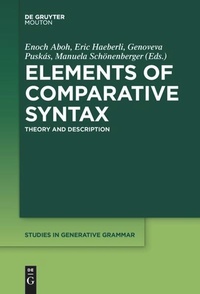
Elements of Comparative Syntax
Theory and Description
1st Edition
Published on 11. September 2017
VIII, 533 pages
978-1-5015-0403-7 (ISBN)
Description

This volume brings together a selection of articles illustrating the multifaceted nature of current research in generative syntax. The authors, including some of the leading figures in the field, present analyses of typologically diverse languages, with some studies drawing on dialectal, acquisitional and diachronic evidence. Set against this rich empirical background, the contributions address an equally wide range of theoretical issues.
More details
Other editions
Additional editions
Book
07/2019
1st Edition
De Gruyter Mouton
€44.95
Article not available at the moment
Book
09/2017
1st Edition
De Gruyter Mouton
€149.95
Article not available at the moment
E-Book
09/2017
1st Edition
De Gruyter Mouton
€149.95
Available for download
Persons
E. Aboh, University of Amsterdam, The Netherlands; E. Haeberli, G. Puskas, and M. Schönenberger, University of Geneva, Switzerland.
Content
- Intro
- Contents
- Introduction
- Part I: Comparative syntax: Focus on one language
- Labeling (Romance) causatives
- Quantifier float and predicate inversion
- Beyond narrative: On the syntax and semantics of ly-Adverbs
- Ellipsis, polarity, and the cartography of verb-initial orders in Irish
- Negation and modality: On negative purposive and "avertive" complementizers
- Are doubly-filled comps governed by prosody in Swiss German? The chameleonic nature of dass 'that'
- Presentatives and the syntactic encoding of contextual information
- Part II: Comparative syntax: Cross-linguistic studies
- On reflexives with an object in French, German, and Gungbe
- A micro-parameter for allocutive agreement
- Apposition in English and French
- Locality and the functional sequence in the left periphery
- Wh in situ and criterial freezing
- Germanic verb particle variation
- Part III: Comparative syntax: Language acquisition and change
- The loss of Latin OV: Steps towards an analysis
- Medial NP-adjuncts in English: A diachronic perspective
- Gothic sai and the Proto-Germanic verb-based discourse particle *se
- The 3SGS morpheme in child and adult English: A formal analysis
- Index
