

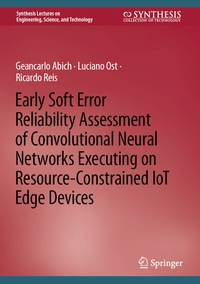
Early Soft Error Reliability Assessment of Convolutional Neural Networks Executing on Resource-Constrained IoT Edge Devices
Description

This book describes an extensive and consistent soft error assessment of convolutional neural network (CNN) models from different domains through more than 14.8 million fault injections, considering different precision bit-width configurations, optimization parameters, and processor models. The authors also evaluate the relative performance, memory utilization, and soft error reliability trade-offs analysis of different CNN models considering a compiler-based technique w.r.t. traditional redundancy approaches.
More details
Other editions
Additional editions
Persons
Geancarlo Abich is currently an Assistant Professor at the University of Santa Cruz do Sul (UNISC) - Brazil. He received a bachelor's degree in computer engineering from the UNISC in 2014, the MSc in Computer Science at Federal University of Rio Grande do Sul (UFRGS) in 2017, and concluded his Ph.D. in Microelectronics (PGMICRO) at the same institution in 2022. For the past seven years, he has been researching and developing tools involving the implementation and evaluation of reliable embedded systems based on resource constrained devices. His research activity focuses on modelling and simulation of robust MPSoCs and deep learning approaches targeting resource constrained devices.
Luciano Ost is currently a Faculty Member with Loughborough University's Wolfson School - UK. He received his Ph.D. in Computer Science from PUCRS, Brazil in 2010. During his Ph.D., Dr Ost worked as an invited researcher at the Microelectronic Systems Institute of the Technische Universitaet Darmstadt (from 2007 to 2008) and at the University of York (October 2009). After completing his doctorate, he worked as a research assistant (2 years) and then as an assistant professor (2 years) at the University of Montpellier II in France. He has authored more than 90 papers, and his research is devoted to advancing hardware and software architectures to improve the performance, security, and reliability of machine learning and life-critical embedded systems.
Ricardo Reis received the Electrical Engineering degree from the Federal University of Rio Grande do Sul (UFRGS), Brazil, in 1978, and the Ph.D. degree in informatics, option microelectronics from the Institut National Polytechnique de Grenoble, France, in 1983. He received the Doctor Honoris Causa from University of Montpellier, France, in 2016. He has been a Full Professor with UFRGS since 1981. He is at research level 1A of the CNPq (Brazilian National Science Foundation), and the head of several research projects supported by government agencies and industry. He has published over 750 papers in journals and conference proceedings and authored or co-authored several books. His current research interests include physical design, physical design automation, design methodologies, digital design, EDA, circuits tolerant to radiation, and microelectronics education. Prof. Reis was a recipient of the IEEE Circuits and Systems Society (CASS) Meritorious Service Award 2015. He was the Vice President of the IEEE CASS and president of the Brazilian Computer Society (SBC) for two terms. Member of the IEEE IoT Initiative Activity Board. Chair of the IEEE CASS SiG on IoT. Ricardo received the IFIP Fellow Award in 2021 and the ACM/ISPD Lifetime Achievement Award in 2022.
Content
Introduction.- Background in ML Models and Radiation Effects.- Related Works.- Soft Error Assessment Methodology.- Early Soft Error Consistency Assessment.- Soft Error Reliability Assessment of ML Inference Models executing on resource-constrained IoT edge devices.- Conclusions and Future Work.
