

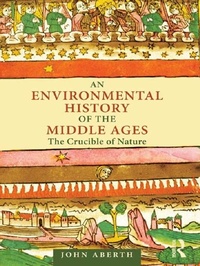
An Environmental History of the Middle Ages
The Crucible of Nature
1st Edition
Published on 20. December 2012
344 pages
978-1-136-26303-3 (ISBN)
Description

The Middle Ages was a critical and formative time for Western approaches to our natural surroundings. An Environmental History of the Middle Ages is a unique and unprecedented cultural survey of attitudes towards the environment during this period. Humankind's relationship with the environment shifted gradually over time from a predominantly adversarial approach to something more overtly collaborative, until a series of ecological crises in the late Middle Ages. With the advent of shattering events such as the Great Famine and the Black Death, considered efflorescences of the climate downturn known as the Little Ice Age that is comparable to our present global warming predicament, medieval people began to think of and relate to their natural environment in new and more nuanced ways. They now were made to be acutely aware of the consequences of human impacts upon the environment, anticipating the cyclical, "new ecology" approach of the modern world.
Exploring the entire medieval period from 500 to 1500, and ranging across the whole of Europe, from England and Spain to the Baltic and Eastern Europe, John Aberth focuses his study on three key areas: the natural elements of air, water, and earth; the forest; and wild and domestic animals. Through this multi-faceted lens, An Environmental History of the Middle Ages sheds fascinating new light on the medieval environmental mindset. It will be essential reading for students, scholars and all those interested in the Middle Ages
Exploring the entire medieval period from 500 to 1500, and ranging across the whole of Europe, from England and Spain to the Baltic and Eastern Europe, John Aberth focuses his study on three key areas: the natural elements of air, water, and earth; the forest; and wild and domestic animals. Through this multi-faceted lens, An Environmental History of the Middle Ages sheds fascinating new light on the medieval environmental mindset. It will be essential reading for students, scholars and all those interested in the Middle Ages
Reviews / Votes
"This environmental history shows that our struggles with climate change, environmental pollution, deforestation, pandemics, and many other aspects of nature are not new. Thanks to this timely book, our future decisions can be informed by what people learned over 1000 years ago." - Joyce E. Salisbury, University of Wisconsin Green Bay, USA"Independent scholar Aberth is a Vermont farmer with a doctorate in medieval history, and he provides information that would enrich any survey course on the European Middle Ages... Recommended. All levels/libraries." - A.C. Reeves, emeritus, Ohio University, CHOICE magazine
"Anyone interested in medieval Europe's environmental history must cheer the publication of John Aberth's newest book... It is as tool for historical understanding of environments and particularly their impact on medieval written culture." -Paola Squatriti, University of Michigan, The Historian Independent scholar Aberth is a Vermont farmer with a doctorate in medieval history, and he provides information that would enrich any survey course on the European Middle Ages. He writes about academic theories of disease, and thus provides insight into medieval science based on both theory and an experiential understanding of nature. Medieval thinkers wanted explanations for such events as the great famine of 1315-22 and the cycle of plague that began with the Black Death. Most of the examples Aberth provides come from England, supplemented by research from the Continent. The author writes of medieval thinking about the ecology of air, water, the earth, forests, and animals. The subtitle is truly appropriate. The book demonstrates that the medieval approach to nature was not merely a battle for conquest and domination, as with, for example, the systems developed for managing woodlands. The text is supported by endnotes and illustrations. Summing Up: Recommended. All levels/libraries.
CHOICE by A. C. Reeves, emeritus, Ohio University
More details
Language
English
Place of publication
London
United Kingdom
Publishing group
Taylor & Francis Ltd
Target group
College/higher education
Illustrations
25 s/w Photographien bzw. Rasterbilder
25 Halftones, black and white
File size
5,40 MB
ISBN-13
978-1-136-26303-3 (9781136263033)
Copyright in bibliographic data and cover images is held by Nielsen Book Services Limited or by the publishers or by their respective licensors: all rights reserved.
Schweitzer Classification
Other editions
Additional editions
Book
09/2012
1st Edition
Routledge
€207.10
Shipment within 15-20 days
Book
09/2012
1st Edition
Routledge
€63.80
Shipment within 15-20 days
Person
Aberth, John
Content
Acknowledgements. Illustrations. Preface. Introduction. Part 1: Air, Water, Earth Part 2: Forest Part 3: Beast. Afterword.
