

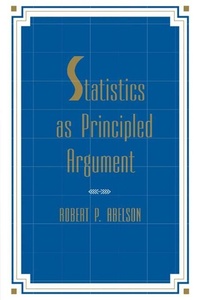
Statistics As Principled Argument
1st Edition
Published on 10. September 2012
240 pages
978-1-135-69442-5 (ISBN)
Description

In this illuminating volume, Robert P. Abelson delves into the too-often dismissed problems of interpreting quantitative data and then presenting them in the context of a coherent story about one's research. Unlike too many books on statistics, this is a remarkably engaging read, filled with fascinating real-life (and real-research) examples rather than with recipes for analysis. It will be of true interest and lasting value to beginning graduate students and seasoned researchers alike.
The focus of the book is that the purpose of statistics is to organize a useful argument from quantitative evidence, using a form of principled rhetoric. Five criteria, described by the acronym MAGIC (magnitude, articulation, generality, interestingness, and credibility) are proposed as crucial features of a persuasive, principled argument.
Particular statistical methods are discussed, with minimum use of formulas and heavy data sets. The ideas throughout the book revolve around elementary probability theory, t tests, and simple issues of research design. It is therefore assumed that the reader has already had some access to elementary statistics. Many examples are included to explain the connection of statistics to substantive claims about real phenomena.
The focus of the book is that the purpose of statistics is to organize a useful argument from quantitative evidence, using a form of principled rhetoric. Five criteria, described by the acronym MAGIC (magnitude, articulation, generality, interestingness, and credibility) are proposed as crucial features of a persuasive, principled argument.
Particular statistical methods are discussed, with minimum use of formulas and heavy data sets. The ideas throughout the book revolve around elementary probability theory, t tests, and simple issues of research design. It is therefore assumed that the reader has already had some access to elementary statistics. Many examples are included to explain the connection of statistics to substantive claims about real phenomena.
Reviews / Votes
"Everyone doing research or planning to do research should read this book. You will be surprised at how much you will learn." - Psychological Science"The book itself is the best demonstration of the validity of Abelson's thesis. It proves that statistical issues can be addressed in an articulate, interesting, entertaining and persuasive way." - British Journal of Mathematical & Statistical Psychology
"Abelson has, in brief, produced a thought-provoking synthesis of the woes and promises of much modern sychological statistics." - British Journal of Psychology "This book helps the advanced reader to think more capably about statistics and research. The reader will benefit from Abelson's expertise."
-Association for Psychological Studies
"The book itself is the best demonstration of the validity of Abelson's thesis. It proves that statistical issues can be addressed in an articulate, interesting, entertaining and persuasive way."
-British Journal of Mathematical & Statistical Psychology
"Abelson has, in brief, produced a thought-provoking synthesis of the woes and promises of much modern psychological statistics..."
-British Journal of Psychology
"This volume is filled with the things that one is never taught but, one hopes, learns later....provides a useful capstone for anyone who concludes his/her formal training in statistics and is now simply a user....a pleasure."
-Chance
"It is frequently of interest to hear about the statistical approaches and (sometimes) mistakes that investigators fall prey to in the field of psychology. The delightful book under review gives insights and cogent discussions of both approaches and mistakes."
-Journal of Quality Technology
"Have you ever considered taking a statistics book to read at the beach or pool? Probably not. This delightful book may change all that....Instead of discussing the various statistical techniques and how to compute them, the author focuses on an overall perspective on what the investigator who uses statistical method is doing. His central theme is that statistical analysis is a tool for presenting a principled argument, meaning a credible argument that is truly based on data. ...Everyone doing research or planning to do research should read this book. You will be surprised at how much you will learn."
-Psychological Science
"This is a refreshing exposition of the real story of how to use statistics, a story generally neglected in standard texts. Apart from its wisdom and technical competence, it is a sheer pleasure to read--graceful, witty, and informal. I recommend it highly for advanced undergraduate and graduate students in the social and biological sciences, their teachers, and practicing researchers in all fields who use statistics."
-Jacob Cohen
New York University; Author, Applied Multiple Regression/Correlation Analysis
More details
Language
English
Place of publication
London
United Kingdom
Publishing group
Taylor & Francis Ltd
Target group
Professional and scholarly
File size
4,05 MB
ISBN-13
978-1-135-69442-5 (9781135694425)
Copyright in bibliographic data and cover images is held by Nielsen Book Services Limited or by the publishers or by their respective licensors: all rights reserved.
Schweitzer Classification
Other editions
Additional editions
Robert P. Abelson
Statistics As Principled Argument
Book
02/1995
1st Edition
Psychology Press
€60.20
Shipment within 10-20 days

Robert P. Abelson
Statistics As Principled Argument
Book
02/1995
Lawrence Erlbaum Associates Inc
€61.48
Article exhausted; check different version
Person
Abelson, Robert P.
Content
Contents: Preface. Abelson's Laws. Making Claims With Statistics. Elementary Arguments and the Role of Chance. Magnitude of Effects. Styles of Rhetoric. On Suspecting Fishiness. Articulation of Results: Ticks and Buts. Generality of Effects. Interestingness of Argument. Credibility of Argument.
