

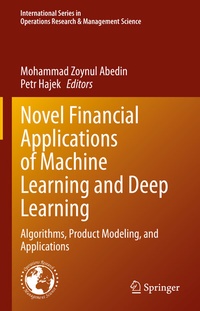
Novel Financial Applications of Machine Learning and Deep Learning
Description

This book presents the state-of-the-art applications of machine learning in the finance domain with a focus on financial product modeling, which aims to advance the model performance and minimize risk and uncertainty. It provides both practical and managerial implications of financial and managerial decision support systems which capture a broad range of financial data traits. It also serves as a guide for the implementation of risk-adjusted financial product pricing systems, while adding a significant supplement to the financial literacy of the investigated study.
The book covers advanced machine learning techniques, such as Support Vector Machine, Neural Networks, Random Forest, K -Nearest Neighbors, Extreme Learning Machine, Deep Learning Approaches, and their application to finance datasets. It also leverages real-world financial instances to practice business product modeling and data analysis. Software code, such as MATLAB, Python and/or R including datasets within a broad range of financial domain are included for more rigorous practice.
The book primarily aims at providing graduate students and researchers with a roadmap for financial data analysis. It is also intended for a broad audience, including academics, professional financial analysts, and policy-makers who are involved in forecasting, modeling, trading, risk management, economics, credit risk, and portfolio management.
More details
Other editions
Additional editions
Persons
Mohammad Zoynul Abedin is a Senior Lecturer in Fintech and Financial Innovation at Teesside University International Business School, Teesside University, UK. He received his B.B.A. and M.B.A. degrees in finance from the University of Chittagong, Bangladesh, and his D.Phil. degree in investment theory from the Dalian University of Technology, China. Dr. Abedin published more than 70 papers, including peer reviewed full length articles, conference papers, and book chapters. His work appears on the Annals of Operations Research , International Journal of Production Research , IEEE Transactions on Industrial Informatics , to mention a few. His current research interests include business data analytics, fintech, and computational finance. He is a fellow of the Financial Management Association (FMA), and British Accounting and Finance Association (BAFA).
Petr Hajek is a Professor at the Science and Research Centre, University of Pardubice, Czech Republic. He holds a Ph.D. degree in system engineering and informatics. Professor Hajek is the author or coauthor of 5 books and more than 70 articles in leading journals such as Information Sciences , Decision Support Systems , and Knowledge-Based Systems. His current research interests include business decision-making, soft computing, text mining, and knowledge-based systems. He is a fellow of the Association for Computing Machinery (ACM), KES International, and Association for Information Systems (AIS).
