

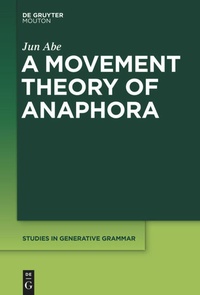
A Movement Theory of Anaphora
Movement Theory of Anaphora
1st Edition
Published on 9. October 2014
VIII, 215 pages
978-1-61451-699-6 (ISBN)
Available for download
Description

Under the tenet shared by Hornstein and Kayne that rules of construal need to be recaptured by the operation Move, this book aims to construct a movement theory of anaphora according to which anaphoric relations are established through movement of pro. This theory has significant theoretical implications for reconstruction effects and pro-drop phenomena. It has brought binding theory into the realm of the Minimalist Program.
More details
Other editions
Additional editions
E-Book
10/2014
1st Edition
De Gruyter Mouton
€149.95
Available for download
Jun Abe
A Movement Theory of Anaphora
Book
08/2014
1st Edition
De Gruyter Mouton
€149.95
Article not available at the moment
Person
Jun Abe, Tohoku Gakuin University, Japan
Content
- Intro
- Contents
- Preface
- 1 Introduction
- 2 Basic Architecture of Deriving Anaphoric Relations via Move
- 2.1 Pro-Movement
- 2.2 Restrictions on Dependency
- 2.2.1 Upward Movement: Deriving Condition C Effects
- 2.2.2 Sideward Movement: Deriving Non-C-Commanding Anaphora
- 2.2.3 Across-the-Board Movement: Deriving Weakest Crossover
- 2.2.4 Standard Weak Crossover Revisited
- 2.2.5 Minimality: Deriving Strong Crossover
- 3 Deriving Cases of Barss's (1986) Chain Obviation Condition
- 3.1 Advantages of Barss's (1986) Chain Obviation Condition
- 3.2 Deriving the Cases of the COC by the Movement Theory
- 4 Do A- and A'-Movement Reconstruct?
- 4.1 An Apparent Paradox Regarding A-Movement Reconstruction
- 4.2 Reconstruction regarding Negative Conditions
- 5 Locality of Empty Pronouns in Japanese
- 5.1 Locality of Empty Pronouns
- 5.2 A-Pro as a Bound Variable
- 5.3 Deriving the SSC Effect from A-Movement
- 5.4 Implications for the Pro-Drop Parameter
- 6 Evidence for Operator Movement of Pro
- 6.1 Multiple Occurrences of Generic Pro
- 6.2 A Unification of Anaphoric and Generic Pro in Operator Movement
- 6.3 Operator Movement of Pro and the Locality with Its Antecedent
- 7 An Extension to the NOC Cases of PRO
- 7.1 Lebeaux's (1984) Theory of PRO
- 7.2 Incorporating the NOC Cases of PRO into the Movement Theory
- 7.3 An Overall Picture of the Theory of Pro/PRO
- 8 A Movement Theory of Reflexives
- 8.1 Lexical Ambiguity of Zibun: Pure Anaphor or Logophor
- 8.2 A Movement Theory of Zibun
- 8.3 Multiple Occurrences of Zibun
- 8.4 Multiple Occurrences of Generic Zibun
- 9 Conclusions
- References
- Index

