

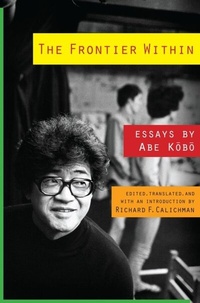
The Frontier Within
Essays by Abe Kobo
1st Edition
Published on 31. August 2015
224 pages
978-0-231-53509-0 (ISBN)
Description

Abe Kobo (1924-1993) was one of Japan's greatest postwar writers, widely recognized for his imaginative science fiction and plays of the absurd. However, he also wrote theoretical criticism for which he is lesser known, merging literary, historical, and philosophical perspectives into keen reflections on the nature of creativity, the evolution of the human species, and an impressive range of other subjects.
Abe Kobo tackled contemporary social issues and literary theory with the depth and facility of a visionary thinker. Featuring twelve essays from his prolific career-including "Poetry and Poets (Consciousness and the Unconscious)," written in 1944, and "The Frontier Within, Part II," written in 1969-this anthology introduces English-speaking readers to Abe Kobo as critic and intellectual for the first time. Demonstrating the importance of his theoretical work to a broader understanding of his fiction-and a richer portrait of Japan's postwar imagination-Richard F. Calichman provides an incisive introduction to Abe Kobo's achievements and situates his essays historically and intellectually.
Abe Kobo tackled contemporary social issues and literary theory with the depth and facility of a visionary thinker. Featuring twelve essays from his prolific career-including "Poetry and Poets (Consciousness and the Unconscious)," written in 1944, and "The Frontier Within, Part II," written in 1969-this anthology introduces English-speaking readers to Abe Kobo as critic and intellectual for the first time. Demonstrating the importance of his theoretical work to a broader understanding of his fiction-and a richer portrait of Japan's postwar imagination-Richard F. Calichman provides an incisive introduction to Abe Kobo's achievements and situates his essays historically and intellectually.
All prices
More details
Other editions
Additional editions
Book
06/2013
Columbia University Press
€76.82
Article not available at the moment
Persons
Richard F. Calichman is professor of Japanese studies at the City College of New York, CUNY. His Columbia University Press books include Overcoming Modernity: Cultural Identity in Wartime Japan (2008); Contemporary Japanese Thought (2005); and What is Modernity? Writings of Takeuchi Yoshimi (2005).
Content
Acknowledgments
Introduction
"Poetry and Poets (Consciousness and the Unconscious)" (Shi to shijin [Ishiki to muishiki]) (1944)
"Theory and Practice in Literature" (Bungaku ni okeru riron to jissen) (1954)
"The Hand of a Calculator with the Heart of a Beast: What Is Literature?" (Moju no kokoro ni keisanki no te wo: Bungaku to ha nanika) (1955)
"Discovering America" (Amerika hakken) (1957)
"Does the Visual Image Destroy the Walls of Language?" (Eizo ha gengo no kabe wo hakai suru ka) (1960)
"Artistic Revolution: Theory of the Art Movement" (Geijutsu no kakumei: Geijutsu undo no riron) (1960)
"Possibilities for Education Today: On the Essence of Human Existence" (Gendai ni okeru kyoiku no kanosei: Ningen sonzai no honshitsu ni furete) (1965)
"Beyond the Neighbor" (Rinjin wo koeru mono) (1966)
"The Military Look" (Miritari rukku) (1968)
"Passport of Heresy" (Itan no pasupoto) (1968)
"The Frontier Within" (Uchi naru henkyo) (1968)
"The Frontier Within, Part II" (Zoku: Uchi naru henkyo) (1969)
Notes
Glossary
Index of Names
Introduction
"Poetry and Poets (Consciousness and the Unconscious)" (Shi to shijin [Ishiki to muishiki]) (1944)
"Theory and Practice in Literature" (Bungaku ni okeru riron to jissen) (1954)
"The Hand of a Calculator with the Heart of a Beast: What Is Literature?" (Moju no kokoro ni keisanki no te wo: Bungaku to ha nanika) (1955)
"Discovering America" (Amerika hakken) (1957)
"Does the Visual Image Destroy the Walls of Language?" (Eizo ha gengo no kabe wo hakai suru ka) (1960)
"Artistic Revolution: Theory of the Art Movement" (Geijutsu no kakumei: Geijutsu undo no riron) (1960)
"Possibilities for Education Today: On the Essence of Human Existence" (Gendai ni okeru kyoiku no kanosei: Ningen sonzai no honshitsu ni furete) (1965)
"Beyond the Neighbor" (Rinjin wo koeru mono) (1966)
"The Military Look" (Miritari rukku) (1968)
"Passport of Heresy" (Itan no pasupoto) (1968)
"The Frontier Within" (Uchi naru henkyo) (1968)
"The Frontier Within, Part II" (Zoku: Uchi naru henkyo) (1969)
Notes
Glossary
Index of Names

