

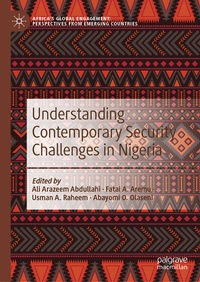
Understanding Contemporary Security Challenges in Nigeria
Description

This book explores how the Nigerian state grapples with both internal and external forces that are fueling insecurity in the country. For more than a decade, Nigeria has been viciously attacked by different clusters of non-state armed actors, ranging from religious extremists, terrorists, kidnappers, herders, bandits, secessionists, and unknown gunmen. While insurgency-related deaths have dropped, the north-east remains the epicenter of insurgency and terrorism.
This book unpacks the contemporary security challenges in Nigeria. Instead of a monolithic analysis of Boko-Haram, it discusses other armed groups, secessionist agitations, maritime security, the social context of insecurity, the nexus between the proliferation of small arms and light weapons and insecurity, the mental health outcomes of insecurity, substance abuse and security, as well as migration and national security. The book is a policy-driven research work that speaks directly to policymakers, students, and other important stakeholders in the security sector in Nigeria and beyond.
More details
Other editions
Additional editions
Persons
Ali Arazeem Abdullahi is Professor of Sociology at the University of Ilorin, Nigeria, and Senior Research Associate at the Department of Sociology, Faculty of Humanities, University of Johannesburg, South Africa. He currently heads the Department of Criminology and Security Studies at the University of Ilorin, Nigeria.
Fatai A. Aremu is Professor of Political Science, University of Ilorin, Nigeria. He is Visiting Research Fellow at the Africa Institute of South Africa (AISA), Human Sciences Research Council (HSRC), South Africa.
Usman A. Raheem is Professor of Geography in the Department of Geography and Environmental Management at the University of Ilorin, Nigeria. He is, currently, Director of Technical and Entrepreneurship Centre (TEC) at the University.
Abayomi O. Olaseni is Clinical Psychologist, who bagged an NPA accredited doctoral and master's degree in Clinical Psychology from the University of Ibadan, Nigeria.
Content
Part I: Some Security Threats in Nigeria.- 1. Unpacking Contemporary Security Challenges in Nigeria.- 2. Secessionist Agitations and National Security in Nigeria.- 3. Kidnapping and Human Security in Nigeria.- 4. Maritime Security in Nigeria: Perspectives for a Comprehensive Approach.- Part II: Drivers of Insecurity in Nigeria.- 5. The Social Context of Insecurity in Nigeria.- 6. Proliferation of Small Arms and Light Weapons and Security Challenges in Nigeria.- 7. Substance Abuse and Human Security in Nigeria.- 8. Migration and National Security in Nigeria.- 9. 'Get Rich Syndrome' and the Challenges of Insecurity in Nigeria.- Part III: Violent Conflicts and Human Security.- 10. Living through Terrorism and Insecurity: Construction of Mental Health Outcomes among Nigerians.- 11. Insecurity and the Nigerian Economy.- 12. Insecurity and Education in Nigeria.- 13. The Impact of Armed-Conflicts on Women and Children in Nigeria.- 14. Terrorism and Food Security in Nigeria: An Appraisal.- 15. Human Rights and Internal Security Operations in Nigeria: An Appraisal.
