

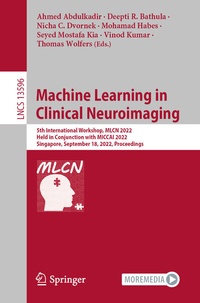
Machine Learning in Clinical Neuroimaging
Description

The book includes 17 papers which were carefully reviewed and selected from 23 full-length submissions.
The 5th international workshop on Machine Learning in Clinical Neuroimaging (MLCN2022) aims to bring together the top researchers in both machine learning and clinical neuroscience as well as tech-savvy clinicians to address two main challenges: 1) development of methodological approaches for analyzing complex and heterogeneous neuroimaging data (machine learning track); and 2) filling the translational gap in applying existing machine learning methods in clinical practices (clinical neuroimaging track).
The papers are categorzied into topical sub-headings: Morphometry; Diagnostics, and Aging, and Neurodegeneration.
More details
Other editions
Additional editions
Content
Morphometry.- Joint Reconstruction and Parcellation of Cortical Surfaces.- A Study of Demographic Bias in CNN-based Brain MR Segmentation.- Volume is All You Need: Improving Multi-task Multiple Instance Learning for WMH Segmentation and Severity Estimation.- Self-Supervised Test-Time Adaptation for Medical Image Segmentation.- Accurate Hippocampus Segmentation Based on Self-Supervised Learning with Fewer Labeled Data.- Concurrent Ischemic Lesion Age Estimation and Segmentation of CT Brain Using a Transformer-based Network.- Weakly Supervised Intracranial Hemorrhage Segmentation using Hierarchical Combination of Attention Maps from a Swin Transformer.- Boundary Distance Loss for Intra-/Extra-meatal Segmentation of Vestibular Schwannoma.- Neuroimaging Harmonization Using cGANs: Image Similarity Metrics Poorly Predict Cross-protocol Volumetric Consistency.- Diagnostics, Aging, and Neurodegeneration.- Non-parametric ODE-based Disease Progression Model of Brain Biomarkers in Alzheimer's Disease.- Lifestyle Factors that Promote Brain Structural Resilience in Individuals with Genetic Risk Factors for Dementia.- Learning Interpretable Regularized Ordinal Models from 3D Mesh Data for Neurodegenerative Disease Staging.- Augmenting Magnetic Resonance Imaging with Tabular Features for Enhanced and Interpretable Medial Temporal Lobe Atrophy Prediction.- Automatic Lesion Analysis for Increased Efficiency in Outcome Prediction of Traumatic Brain Injury.- Autism Spectrum Disorder Classification Based on Interpersonal Neural Synchrony: Can Classification be Improved by Dyadic Neural Biomarkers Using Unsupervised Graph Representation Learning?.- fMRI-S4: Learning Short- and Long-range Dynamic fMRI Dependencies Using 1D Convolutions and State Space Models.- Data Augmentation via Partial Nonlinear Registration for Brain-age Prediction.
