

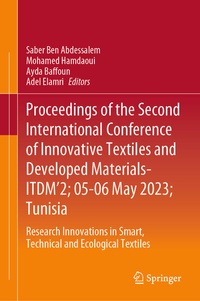
Proceedings of the Second International Conference of Innovative Textiles and Developed Materials-ITDM'2; 05-06 May 2023; Tunisia
Description

This book includes selected articles from the 2nd International Conference on Innovative Textiles and Developed Materials (ITDM'2) held in Monastir, Tunisia, on May 5 and 6, 2023. The articles present latest scientific concepts and technological advances in innovative and sustainable textile materials and processes worldwide. The conference promotes exchange of ideas and emerging technologies to foster collaboration between academia and industry.
More details
Other editions
Additional editions
Persons
Saber Ben Abdessalem received his M.Sc. and Ph.D. degrees in Textile Engineering in 1996 and 1999, respectively, from the University of Haute Alsace, France. Currently, he is a professor in the Textile Department at the National Engineering School of Monastir (ENIM), Tunisia. He is also the director of Materials and Textile Processes research unit (MPTex) at ENIM, Tunisia. His current research area includes technical textiles processes and medical textiles materials.
Mohamed Hamdaoui obtained his Ph.D. in 2008 from the University of Monastir, Tunisia. He is now a professor at the National Engineering School of Monastir, Tunisia. His research work is focused on textile, polymeric materials, composites, and nanocomposites. A particular focus is given for biomass and particularly industrial residues and wastes.
Ayda Baffoun received her Ph.D. from the University of Haute Alsace (France) in 2006. She is an associate professor in the Textile Department at the National Engineering School of Monastir, Tunisia. Her research interests are in textile materials and processes, with particular focus on textile dyeing and finishing.
Adel Elamri received his Ph.D. from the University of Haute Alsace (France) in 2007. He is currently an assistant professor in the Textile Department at the National Engineering School of Monastir, Tunisia. His research interests are polymeric materials, recycling, and biomass valorization.
Content
- Intro
- Organization
- Preface
- Contents
- Ecological Textiles Dyeing & Finishing
- Multiple Reuse of Residual Dyebaths for Cotton Dyeing with Reactive Dyestuffs: A Promising Technique for Environmental Sustainability
- 1 Introduction
- 2 Material and Methods
- 2.1 Material
- 2.2 Dyebath Reuse Procedure
- 2.3 Determination of Dyebath Exhaustion
- 2.4 Color Measurement
- 3 Results and Discussion
- 3.1 Dyeing with a Single Reactive Dye
- 3.2 Dyeing with a Binary Mixture of Reactive Dyes
- 4 Conclusions
- References
- Effect of Polyester Structure on Drying Behavior
- 1 Introduction
- 2 Materials and Methods
- 2.1 Yarn's Structural Characteristics
- 2.2 Fabric's Structural Characteristics
- 2.3 The Drying Behavior
- 3 Results and Discussions
- 4 Conclusion
- References
- A Comparative Study of Environmental Sustainability Initiatives of Two Major Jeanswear Brands
- 1 Introduction
- 2 Methodology
- 2.1 Selection of Brands
- 2.2 Collection of Data
- 2.3 Analysis Method
- 3 Environmental Sustainability Initiatives
- 3.1 GHG Emission and Energy Use
- 3.2 Water Use
- 3.3 Chemicals Use and Wastewater Discharge
- 3.4 Waste Management
- 3.5 Circularity
- 3.6 Materials Sourcing
- 4 Discussion
- 5 Conclusion
- References
- Investigation and Optimization of a New Bleaching Process for Sulfur-Dyed Denim Fabric
- 1 Introduction
- 2 Materials and Methods
- 2.1 Materials
- 2.2 Methods
- 3 Results and Discussion
- 3.1 Study of the Experimental Parameters Effect on the Bleach Treatment
- 3.2 Optimization of the Bleach Treatment Recipe
- 4 Conclusion
- References
- Investigation of an Eco-Friendly Acid Dyeing Process of Cotton Fabric
- 1 Introduction
- 2 Materials and Methods
- 2.1 Fabric
- 2.2 Cotton Cationization and Dyeing
- 2.3 Color Strength and Dye Exhaustion Measurement
- 2.4 Dye Optimization and Prediction Models
- 2.5 Scanning Electron Microscopic Analysis
- 2.6 Compression and Thermal Properties Analysis
- 3 Results and Discussion
- 3.1 Dyeing Optimization and Modelization
- 3.2 Surface Morphological Analysis
- 3.3 KES Characterization
- 4 Conclusion
- References
- Dyeing of the Polyester Fabric with the Fluorescein Molecule
- 1 Introduction
- 2 Materials and Methods
- 2.1 Polyester and Fluorescein Dye
- 2.2 Dyeing Procedure
- 3 Results and Discussions
- 3.1 pH Quenching of Fluorescein Absorbance
- 3.2 Effect of pH and Temperature on Dye Exhaustion
- 3.3 Effect of pH and Fluorescein Concentration on the Reflectance
- 4 Conclusion
- References
- Study of a New Dyeing Process Based on the Capillary Rise Technique
- 1 Introduction
- 2 Materials and Methods
- 2.1 Materials
- 2.2 Methods
- 3 Results and Discussion
- 3.1 Physicochemical Study of the Dyeing Process Based on the Capillary Rise Technique
- 3.2 Study of the Capillary Rise in a Knitted Fabric
- 3.3 Study of the Salt Effect on the Capillary Rise Process
- 3.4 Behavior of the Color Strength with the Increase of Height
- 4 Conclusion
- References
- Innovative Materials & Polymers
- Ballistic Impact Response of Multi-Layers Armors Against Piercing Projectile: Finite Element Modeling
- 1 Introduction
- 2 Finite Element Modeling
- 2.1 Description of the Finite Element Model
- 2.2 Material Properties
- 3 Results and Discussion
- 3.1 Validation of the Finite Element
- 3.2 Effect of Impact Velocity
- 3.3 Comparison Between Two- and Three-Layer Targets
- 3.4 Effect of the Design Parameters
- 4 Conclusion
- References
- Effect of the Cultivar on the Development Hemp Stem and Textile Fiber in the East of France
- 1 Introduction
- 2 Material and Methods
- 2.1 Raw Material
- 2.2 Stem Characterization
- 2.3 Fiber Characterization
- 2.4 Statistical Analysis
- 3 Results and Discussion
- 3.1 Weather
- 3.2 Stem Characterization
- 3.3 Fiber Characterization
- 4 Conclusion
- References
- Energetic Valorization of Cutting Textile Waste by Transforming It into Thermal Insulation Products
- 1 Introduction
- 2 Chemical Characterization of Textile
- 3 Sample Design
- 4 Thermal Characterization
- 4.1 Conductivity
- 4.2 Diffusivity
- 5 Results
- 5.1 Textile Characterization
- 5.2 Conductivity
- 5.3 Diffusivity
- 6 Conclusion
- References
- Functionalization of a Textile Surface by N2 Jet Technology to Improve Its Roughness for Medical Applications
- 1 Introduction
- 2 Material and Methods
- 3 Results and Discussion
- 3.1 Influence of the Pressure on the Hairiness Level
- 3.2 Bending Stiffness
- 4 Conclusion
- References
- The Living Design: The Soul of Regenerative Design and the Key to an Ecological Transition
- 1 How Has Sustainable Design Served the Natural Ecosystem State?
- 1.1 Regenerative Design: A Solution for the Future
- 1.2 The Pillars of Regenerative Design
- 2 How Can Living Design Contribute to Creating a More Sustainable Future?
- 2.1 Biofabrication: A Process of Reversal
- 2.2 Synthetic Biology is the Soul of Biomaterials
- 2.3 The Hybrid Nature: Restoration Process
- 3 "Futures Hybrids" by Carole Collet: An Example of Using Living Design to Preserve Biodiversity
- 4 Conclusion: Living Design: A Promising Path for Regenerative Design
- References
- Using Fabric Warping in Architecture: A Contemporary Conception for Technical Use
- 1 The Textile Envelope in Architecture
- 1.1 The Building Envelope
- 1.2 The Tent, the Origin of Textile Envelope
- 2 The Properties of the Textile Envelope for Contemporary Design
- 3 Cases of Study
- 4 Conclusion
- References
- Use of Date Palm Waste to Produce Bio-Composite Material
- 1 Introduction
- 2 Material and Method
- 2.1 Reinforcement (Leaflets Fibers)
- 2.2 Matrix (White Glue-PVA)
- 2.3 Specimens Preparation
- 3 Results
- 4 Conclusion
- References
- Application of Biopolymers in Medical Textiles: Myriad of Opportunities
- 1 Introduction
- 2 Biopolymers Used in Medical Textile Applications
- 2.1 Polysaccharide Materials
- 2.2 Proteins
- 3 Electrospinning of Biomaterials for Medical Purposes
- 4 Wound Healing Application
- 5 Tissue Engineering and Regeneration
- 6 Drug Delivery
- 7 Conclusions
- References
- Smart & Technical Textiles
- Study of the Weight Loss of Abrasive Non-wovens from Industrial Waste
- 1 Introduction
- 2 Experimental
- 2.1 Fibers Preparation
- 2.2 Producing Non-woven Components
- 2.3 Preparation of Abrasive Particles
- 2.4 Abrasives Manufacturing
- 2.5 Abrasion Test
- 2.6 Choice of Factors and Field of Study
- 2.7 Scanning Electron Microscopy Characterization
- 3 Results and Discussion
- 3.1 Surface Morphology
- 3.2 Box-Behnken Analysis of Loss in Mass of Abrasives
- 3.3 Analysis of Main Effects Plots
- 4 Conclusion
- References
- Numerical Investigations of the Tribological Behavior of G1151 Fabric Through Frictional Sensitivity Study During Drawing Using a Hybrid Elastic Discrete Model
- 1 Introduction
- 2 Material
- 3 Presentation of Hybrid Elastic Discrete Model
- 4 Results and Discussion of the Study on the Sensitivity of Friction
- 5 Conclusion
- References
- Effect of the Twist and Composite Process on the Tensile Behavior of Carbon Multifilament Rovings. An Experimental Investigation Toward the Identification of Constituents' Behaviors
- 1 Introduction
- 2 Material and Methods
- 3 Results and Discussions
- 4 Conclusion
- References
- Investigation of the Properties of Developed Abrasives After Abrasion Test
- 1 Introduction
- 2 Experimental
- 2.1 Fibers Preparation
- 2.2 Nonwoven Manufacturing
- 2.3 Abrasive Grains Preparation
- 2.4 Abrasives Manufacturing
- 2.5 Abrasion Test
- 2.6 Techniques of Characterization
- 2.7 Choice of Factors and Field of Study
- 3 Results and Discussion
- 3.1 EDX Analysis
- 3.2 Box-Behnken Analysis of Loss in Mass of Abrasives
- 3.3 Analysis of the Interaction Diagrams
- 4 Conclusion
- References
- Contribution to the Improvement of Certain Comfort Characteristics of Baby Diapers
- 1 Introduction
- 2 Materials and Methods
- 2.1 Separation Methods of Diaper Components
- 2.2 Methods of Characterization of Disposable Baby Diapers
- 3 Results and Discussions
- 3.1 Analysis of Characteristics of Composition
- 3.2 Analysis of the Fabrication Characteristics: Mass, Thickness and Density of the Baby Diapers
- 3.3 Analysis of Comfort Characteristics
- 4 Conclusion
- References
- DMAIC Approach to Optimize the Production Capacities of a Tunisian Clothing Manufacture: A Case Study
- 1 Introduction
- 2 Research Methodology
- 3 Case Study
- 3.1 Define
- 3.2 Measure
- 3.3 Analyze
- 3.4 Improve
- 3.5 Control
- 4 Conclusion
- References
- The Impact of Acid Blue Dye Concentration on Color Strength and the Chromaticity Coordinates of Raw and Tannery Wool: A Comparative Study
- 1 Introduction
- 2 Experimental
- 2.1 A Wool Sample
- 2.2 SEM Analysis
- 2.3 Methods
- 3 Results and Discussion
- 3.1 Morphological Study
- 3.2 Color Strength (K/SAVG)
- 3.3 Color Parameters (L* a* b* C* h°)
- 4 Conclusion
- References
- Smart Textile Industry: Threats and Opportunities
- 1 Introduction
- 2 Smart Textile Enabling Technologies
- 2.1 Sensors Used in Smart Textiles
- 2.2 Conductive Materials Used in Smart Textile
- 2.3 Actuators for Smart Textiles
- 2.4 Power Sources Used in Smart Textile
- 3 Smart Textile Applications
- 4 Cybersecurity in the Smart Textile Context
- 4.1 Cyber Threats
- 4.2 Privacy Versus Security
- 4.3 Impact on Health
- 4.4 Designing Adequate Security Solutions
- 4.5 Life Cycle of a Thing
- 5 Smart Textiles Standards
- 5.1 Mainstream Standards for Smart Textiles
- 5.2 Regulation of Smart Textiles
- 5.3 Risk Assessment
- 5.4 The 9S Design Paradigm
- 6 Conclusion
- References
- 4.0 Industry & Textile Processes
- Fabric Texture Reconstruction Via Multilayer Dictionary Learning
- 1 Introduction
- 2 Experiments Details
- 3 Methods
- 3.1 Multilayer Dictionary Learning-Based Encoding
- 3.2 Variational Autoencoder-Based Texture Generation
- 3.3 Regularization Terms
- 4 Results
- 5 Discussion
- 6 Conclusion
- References
- Application of the Desirability Function for Optimizing the Use of Calcium Carbonate Used in the Production Process of PVC-Coated Textile
- 1 Introduction
- 2 Materials and Methods
- 2.1 Raw Materials
- 2.2 Synthesis of PVC Synthetic Leather
- 2.3 Desirability Approach
- 3 Results and Discussions
- 3.1 Quality Assessment
- 3.2 Choice of the Tolerance Interval
- 3.3 Optimization of the Production Process of Coated Textiles Used in Furniture Manufacture
- 4 Conclusion
- References
- Ergonomic Study on Ironing Stations in Tunisian Clothing Companies
- 1 Introduction
- 2 Methods of Work and Materials Used
- 3 Results
- 3.1 Discomfort Quiz and MSD Risk Factors
- 3.2 Monitoring of Leaning Posture and Measurement of Arduousness
- 4 Discussion on the Results
- 5 Recommendation
- 6 Conclusion and Perspectives
- References
- An Algorithm at Incoming Quality Control of Raw Woven Fabrics-Cottonade Jacquard
- 1 Introduction
- 2 Theoretical Prerequisites
- 3 Experimental Work
- 3.1 Experimental Set
- 3.2 Description of Experimental Tests
- 3.3 Experimental Results
- 4 Analysis and Discussion
- 5 Conclusion
- References
- Application of Multi-objective Ant Colony Algorithm to Resolve Textile Color Matching Problem
- 1 Introduction
- 2 Experimental
- 2.1 Materials
- 2.2 Dyeing
- 2.3 Color Evaluation
- 2.4 Multi-objective Ant Colony Algorithm
- 3 Results and Discussion
- 4 Conclusion
- References
- Deep Learning for DENIM Defects Detection
- 1 Introduction
- 2 Materials and Methods
- 3 Results and Discussion
- 4 Conclusion
- References
- Modeling of Textile Materials and Structures: Some Numerical and Experimental Aspects
- 1 Introduction
- 2 Modeling of Textile Materials and Structures
- 2.1 Textile Materials and Structures
- 2.2 Fabric Modeling: Main Historical Milestones, Typology, and Finalities
- 3 Continuous Models Formulation and Numerical Solving
- 3.1 General Formulation
- 3.2 Experimental Identification of Constitutive Equations
- 3.3 Numerical Solving
- 4 Conclusions
- References
