Colonial Ideologies, Indigeneity, Anti-Racist Discourses
Description

Contemporary sociolinguistic theorizing is concerned with the study of social solidarity in differential contexts of power, so it must engage with protesting discourses and practices. In two volumes, Sociolinguistics of Protesting addresses the socio-discursivity of protesting from different geopolitical perspectives and illustrates how protests are socio-semiotically organized and narrated.
Volume 1 critically rethinks protest as a central sociolinguistic practice rather than an exception to an imagined social order. Drawing on transdisciplinary and various case studies - from the Arab revolutions to Hong Kong's Lennon Walls and South Africa's student uprisings - this volume explores how language, embodiment, and space intersect in acts of resistance. It is the first of a two-volume set that reshapes the field's understanding of language in times of crisis and uprising.
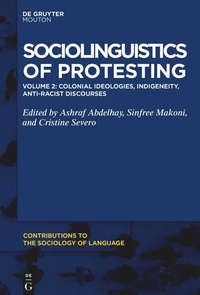
In Volume 2 (the current volume), scholars explore the complex intersections between protest, language, and decolonial thought. It challenges dominant linguistic ideologies by uncovering how language is wielded, contested, and reimagined in protests against racial, gendered, and colonial violence. From Black feminist activism in the U.S. to anti-mining movements in South Africa and pandemic protests in Chile, the chapters examine how diverse (embodied) linguistic practices resist dominant power structures and give voice to marginalized communities.
More details
Other editions
Additional editions