

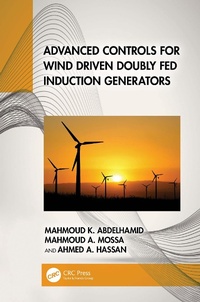
Advanced Controls for Wind Driven Doubly Fed Induction Generators
1st Edition
Published on 22. December 2023
188 pages
978-1-003-83215-7 (ISBN)
Description

Advanced Controls for Wind Driven Doubly Fed Induction Generators discusses the most advanced control algorithms used for enhancing the dynamics of a doubly fed induction generator (DFIG) operating at fixed and variable speeds, and which are used for different utilization purposes (standalone and grid connection). Extensive generator performance analysis has been introduced using various control topologies.
Features:
Presents modeling of wind energy conversion systems (WECS), including a wind turbine as a prime mover, a DFIG as a generation unit for electrical energy, and a three-phase induction motor as an isolated load
Explores a detailed description for the presented control algorithms in order to visualize the base principle of each method
Introduces a comprehensive performance analysis for the DFIG using the formulated predictive voltage control scheme and other control techniques under different operating conditions
Examines the formulation of new control approaches which overcome the shortages present in previous DFIG control schemes
Presents a detailed comparison between different control topologies for the DFIG to outline the most effective procedure in terms of dynamic response, structure simplicity, ripples, total harmonic distortion, and computational burdens
The book is written for researchers and academics working on advanced control systems and those interested in areas such as machine drives, renewable energy systems, 'adaptive control', modeling of WECS, and optimization theory.
Features:
Presents modeling of wind energy conversion systems (WECS), including a wind turbine as a prime mover, a DFIG as a generation unit for electrical energy, and a three-phase induction motor as an isolated load
Explores a detailed description for the presented control algorithms in order to visualize the base principle of each method
Introduces a comprehensive performance analysis for the DFIG using the formulated predictive voltage control scheme and other control techniques under different operating conditions
Examines the formulation of new control approaches which overcome the shortages present in previous DFIG control schemes
Presents a detailed comparison between different control topologies for the DFIG to outline the most effective procedure in terms of dynamic response, structure simplicity, ripples, total harmonic distortion, and computational burdens
The book is written for researchers and academics working on advanced control systems and those interested in areas such as machine drives, renewable energy systems, 'adaptive control', modeling of WECS, and optimization theory.
More details
Edition
1. Auflage
Language
English
Place of publication
London
United Kingdom
Publishing group
Taylor & Francis Ebooks
Target group
Professional and scholarly
Product notice
Reflowable
Illustrations
21 Tables, black and white; 401 Line drawings, black and white; 401 Illustrations, black and white
ISBN-13
978-1-003-83215-7 (9781003832157)
Copyright in bibliographic data and cover images is held by Nielsen Book Services Limited or by the publishers or by their respective licensors: all rights reserved.
Schweitzer Classification
Other editions
Additional editions
Mahmoud K. Abdelhamid | Mahmoud A. Mossa | Ahmed A. Hassan
Advanced Controls for Wind Driven Doubly Fed Induction Generators
Book
06/2025
1st Edition
CRC Press
€76.10
Shipment within 10-20 days
Mahmoud K. Abdelhamid | Mahmoud A. Mossa | Ahmed A. Hassan
Advanced Controls for Wind Driven Doubly Fed Induction Generators
Book
12/2023
1st Edition
CRC Press
€185.80
Shipment within 10-20 days
Persons
Mahmoud K. Abdelhamid received the B.Sc. degree in Electrical Engineering in 2019 from the Electrical Engineering Department, Faculty of Engineering, Minia University, Egypt. Then, he was nominated as a Teaching Assistant in the same department. Further, he also received the MSc degree in Electrical Engineering from the Electrical Engineering Department, Minia University in 2023. Recently, he has been working as an Assistant Lecturer in the same department. His research interests focus on renewable energy systems, electric machine drives, and control systems.
Mahmoud A. Mossa received the bachelor's and master's degrees in electrical engineering from the Faculty of Engineering, Minia University, Egypt, in 2008 and 2013, respectively, and a PhD degree in electrical engineering, in April 2018. Since January 2010, he has been working as an Assistant Lecturer at the Electrical Engineering Department, Minia University. In November 2014, he joined the Electric Drives Laboratory (EDLAB), University of Padova, Italy, for his PhD research activities. Since May 2018, he has been working as an Assistant Professor at the Electrical Engineering Department, Minia University. He occupied a Postdoctoral Fellow position at the Department of Industrial Engineering, University of Padova for six months during the academic year 2021/2022. He is an Associate Editor in International Journal of Robotics and Control Systems. His research interests include renewable energy systems, power management, control systems, electric machine drives, power electronics, optimization, and load frequency control.
Ahmed A. Hassan received the BSc and MSc, degrees from Assiut University, Egypt, and the PhD degree from Minia University, Egypt, all in electrical engineering, in 1976, 1982 and 1988 respectively. Since 2001, he has been a Professor with the Electrical Engineering Department, Minia University. He was also the Dean of the faculty of Computer Science and Information in the same university. His current interests include the application of advanced control techniques to electrical machine drives.
Mahmoud A. Mossa received the bachelor's and master's degrees in electrical engineering from the Faculty of Engineering, Minia University, Egypt, in 2008 and 2013, respectively, and a PhD degree in electrical engineering, in April 2018. Since January 2010, he has been working as an Assistant Lecturer at the Electrical Engineering Department, Minia University. In November 2014, he joined the Electric Drives Laboratory (EDLAB), University of Padova, Italy, for his PhD research activities. Since May 2018, he has been working as an Assistant Professor at the Electrical Engineering Department, Minia University. He occupied a Postdoctoral Fellow position at the Department of Industrial Engineering, University of Padova for six months during the academic year 2021/2022. He is an Associate Editor in International Journal of Robotics and Control Systems. His research interests include renewable energy systems, power management, control systems, electric machine drives, power electronics, optimization, and load frequency control.
Ahmed A. Hassan received the BSc and MSc, degrees from Assiut University, Egypt, and the PhD degree from Minia University, Egypt, all in electrical engineering, in 1976, 1982 and 1988 respectively. Since 2001, he has been a Professor with the Electrical Engineering Department, Minia University. He was also the Dean of the faculty of Computer Science and Information in the same university. His current interests include the application of advanced control techniques to electrical machine drives.
Content
Introduction. Chapter 1. Literature Review. 1.1. Introduction. 1.2. Wind Driven SG. 1.3. Wind Driven IG. 1.4. Field Orientation Control (FOC) of DFIG. 1.5. Model Predictive Control (MPC) of DFIG. Chapter 2. Modeling of the Wind Energy Conversion System Components. 2.1. Mathematical Model of DFIG. 2.2. Modeling of the Wind Turbine. 2.3. Mathematical Model of the Isolated Load under Study. 2.4. Modeling of Rotor Side Converter (VSI). Chapter 3. Analyzing and Enhancing the Performance of a Standalone Variable Speed DFIG. 3.1. Control Schemes Adopted for the Standalone DFIG. 3.2. Adopted Control Scheme for the Load. 3.3. Computation Results. Chapter 4. Dynamic Performance Analysis of an Alternative Operating Regime of DFIG (Grid Connected Case). 4.1. Adopted Control Schemes for the Grid Connected DFIG. 4.2. Computation Results. Chapter 5. Conclusions and Recommendations for Future Work. 5.1. Conclusions. 5.2. Recommendations for Future Work. Appendix. References.
