

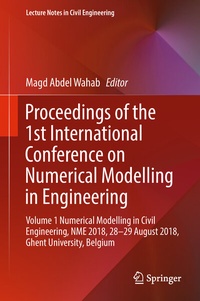
Proceedings of the 1st International Conference on Numerical Modelling in Engineering
Volume 1 Numerical Modelling in Civil Engineering, NME 2018, 28-29 August 2018, Ghent University, Belgium
1st Edition
Published on 25. August 2018
XI, 292 pages
978-981-13-2405-5 (ISBN)
Description

This book contains manuscripts of topics related to numerical modeling in Civil Engineering (Volume 1) as part of the proceedings of the 1st International Conference on Numerical Modeling in Engineering (NME 2018), which was held in the city of Ghent, Belgium. The overall objective of the conference is to bring together international scientists and engineers in academia and industry in fields related to advanced numerical techniques, such as FEM, BEM, IGA, etc., and their applications to a wide range of engineering disciplines. This volume covers industrial engineering applications of numerical simulations to Civil Engineering, including: Bridges and dams, Cyclic loading, Fluid dynamics, Structural mechanics, Geotechnical engineering, Thermal analysis, Reinforced concrete structures, Steel structures, Composite structures.
More details
Series
Language
English
Place of publication
Singapore
Singapore
Publishing group
Springer Singapore
Target group
Professional and scholarly
Product notice
Reflowable
Illustrations
XI, 292 p. 215 illus.
File size
49,84 MB
ISBN-13
978-981-13-2405-5 (9789811324055)
DOI
10.1007/978-981-13-2405-5
Schweitzer Classification
Other editions
Additional editions
Magd Abdel Wahab
Proceedings of the 1st International Conference on Numerical Modelling in Engineering
Volume 1 Numerical Modelling in Civil Engineering, NME 2018, 28-29 August 2018, Ghent University, Belgium
Book
08/2018
Springer
€160.49
Shipment within 15-20 days
Person
Prof Magd Abdel Wahab is a full time Professor of Applied Mechanics in the Faculty of Engineering and Architecture at Ghent University, Belgium and an adjunct professor of computational mechanics at Ton Duc Thang University, Vietnam. He received his B.Sc., 1988, in Civil Engineering and his M.Sc., 1991, in Structural Mechanics, both from Cairo University. Prof. Wahab completed his Ph.D. in Fracture Mechanics in 1995 at KU Leuven, Belgium. He was awarded the degree of Doctor of Science from the University of Surrey in 2008. He has published more than 320 scientific papers in solid mechanics and dynamics of structures and edited more than 12 books and proceedings. His research interests include fracture mechanics, damage mechanics, fatigue of materials, durability, and dynamics and vibration of structures.
Content
- Intro
- Preface
- Organization
- Organising Committee
- Chairman
- International Scientific Committee
- Contents
- Numerical Geometry Optimization and Modelling of Insulation Filled Masonry Blocks
- Abstract
- 1 Introduction
- 2 Hygrothermal Modelling and Optimization
- 2.1 Optimized Insulation Filled Masonry Block Model
- 2.2 Conjugated Heat and Moisture Transfer
- 2.3 Boundary Conditions and Material Properties
- 2.4 Derivative-Free Optimization
- 3 Results
- 3.1 Hygrothermal Results with the Initial Geometry
- 3.2 Results of the Optimized Cases
- 4 Conclusions
- References
- Stochastic Finite Element Analysis of Nonlinear Beam on Winkler-Pasternack Foundation
- Abstract
- 1 Introduction
- 2 Finite Element Theory for Deterministic Analysis
- 2.1 Geometric Nonlinear Beam
- 2.2 Nonlinear Winkler-Pasternack Foundation
- 3 Spatial Variability Modelling
- 4 Numerical Study
- 4.1 Effect of the Shear Deformation Beam
- 4.2 Effect of the Variation of the Slenderness Ratio and Foundation Type on Timoshenko Beam Response
- 4.3 Probabilistic Analysis for Nonlinear Beam Behavior
- 4.4 Influence of the Coefficient of Variation and Foundation Type on the Beam Response
- 5 Conclusion
- References
- Thermal-Mechanical Coupled Behavior of Sliding Bearings for Seismic Isolation
- Abstract
- 1 Introduction
- 2 Bearing Tests
- 2.1 Concept of Sliding Bearing
- 2.2 Specimen
- 2.3 Test Program
- 2.4 Test Results
- 3 Numerical Analysis
- 3.1 Analysis Flow
- 3.2 Simulation Analysis
- 4 Seismic Response Analysis
- 4.1 Structure Model
- 4.2 Ground Motions
- 4.3 Analysis Results
- 5 Conclusion
- Acknowledgements
- References
- Behaviour of Adjacent Ground and Existing Tunnel According to Locations of Pile Loading
- Abstract
- 1 Introduction
- 2 Numerical Analysis
- 3 Results
- 4 Conclusions
- Acknowledgments
- References
- A Numerical Approach to an Interface Damage Model Under Cyclic Loading
- 1 Introduction
- 2 Description of the Model
- 3 Numerical Solution and Computer Implementation
- 4 A Beam Under a Cyclic Load
- 5 Conclusion
- References
- Numerical Simulations of Precast Thin-Walled Concrete Blocks Forming Coastal Structure
- Abstract
- 1 Introduction
- 2 Computation-Related Details
- 2.1 Model of Novel Thin-Walled Concrete Seawall Block
- 2.2 Loads Exerted on Seawall Consideration
- 2.2.1 Wave Pressure
- 2.2.2 Lateral Earth Pressure
- 2.3 Elastic Foundation
- 3 Results and Discussions
- 3.1 Single Block Analysis
- 3.2 Assemble Blocks Analysis
- 4 Conclusions
- Acknowledgements
- References
- Numerical Study of Heat and Moisture Transfers for Validation on Bio-Based Building Materials and Walls
- Abstract
- 1 Introduction
- 2 Mathematical Models
- 2.1 Formulation of the Problem
- 2.2 Boundary Conditions
- 3 Material Properties
- 4 Numerical Resolution and Validation
- 4.1 Simulation Conditions
- 4.2 Results
- 5 Conclusion
- Acknowledgements
- References
- Modelling Load-Transmission Mechanisms in Axially Loaded RC Columns Retrofitted with Steel Jackets
- Abstract
- 1 Introduction
- 2 Elastic Analysis
- 3 Application to RC Members: Assumptions and Constitutive Relationships
- 4 Calculus Procedure and Practical Examples
- 5 Experimental Comparison
- 6 Conclusions
- References
- Three-Dimensional Analysis of an Innovative Hollow Concrete Block of Interlocking Revetment
- Abstract
- 1 Introduction
- 2 Studied Models
- 2.1 Theoretical Analysis
- 2.2 ANSYS Model
- 3 Results and Discussing
- 3.1 Results of the Full Model
- 3.2 Results of the Specific Edge
- 4 Conclusion
- Acknowledgements
- References
- Effects of Construction Sequence on Reinforced Concrete Building Analysis
- Abstract
- 1 Introduction
- 2 Structural Modelling of Construction Sequence and Time-Dependent Behavior
- 3 Numerical Analysis of a Reinforced Concrete Building
- 3.1 Assessment of Column Displacements Considering Construction Sequence
- 3.2 Estimation of Time-Dependent Effects
- 3.3 Evaluation of Standard and Codes for Time-Dependent Behavior
- 4 Conclusion
- References
- A Six-Variable Quasi-3D Model for Static Analysis of Laminated Composite Plates Using Isogeometric Analysis
- Abstract
- 1 Introduction
- 2 The Plate Formulation Based on Quasi-3D Model in Conjunction with Isogeometric Analysis
- 2.1 Quasi-3D Model for Laminate Composite Plate Formulation
- 2.2 Isogeometric Finite Element for Plate Formulation
- 3 Numerical Results
- 3.1 Plate Under Mechanical Load
- 3.2 Plate Under Sinusoidally Distributed Temperature
- 4 Conclusions
- References
- The Rock Failure Behavior Analysis in Rock Cutting Using Finite Element Analysis
- Abstract
- 1 Introduction
- 2 FE Model of Rock Cutting
- 3 Results and Discussion
- 4 Conclusions
- Acknowledgement
- References
- Coupled Thermal and Mechanical Analysis of Composite Cross Sections During Concrete Hydration Using Mathematical Optimization Strategies
- 1 Introduction
- 2 Thermal Analysis
- 2.1 Heat Transfer in Incompressible Materials
- 2.2 Developement of the Optimization Task
- 2.3 Applying Time Integration Methods of Dynamics to the Thermal Analysis
- 2.4 Thermal Effect Due to the Concrete Hardening Process
- 2.5 Evolution of the Thermal Material Parameter
- 3 Coupling of Thermal and Mechanical Analysis
- 3.1 Coupling Method Employed
- 3.2 Mechanical Analysis
- 3.3 Evolution of the Mechanical Material Parameter
- 4 Application
- 5 Conclusions
- References
- Topology Optimization of an Interlocking Revetment Block
- Abstract
- 1 Introduction
- 2 Concrete Block Model
- 2.1 Theoretical Background
- 2.2 Topology Optimization Model in ANSYS
- 3 Results and Discussion
- 4 Proposed Concrete Block and FEM Analysis
- 5 Conclusion
- Acknowledgements
- References
- Damage Detection in Simply Supported Beam Using Transmissibility and Auto-Associative Neural Network
- Abstract
- 1 Introduction
- 2 Theoretical Derivation
- 2.1 Transmissibility of Motion
- 2.2 Auto-Associative Neural Network
- 3 Numerical Example
- 3.1 Input for AANN
- 3.2 Target for AANN
- 3.3 Damage Detection Procedure
- 3.4 Result Discussion
- 3.4.1 Intact Beam
- 3.4.2 Damaged Beam
- 4 Conclusion
- Acknowledgements
- References
- A Coupled SPH-FEM for Fluid-Structures Interaction Problem with Free-Surface and Revetment Slope Thin-Walled Structures
- Abstract
- 1 Introduction
- 2 Computational Methodology
- 2.1 Fluid Domain
- 2.1.1 SPH Method
- 2.1.2 Governing Equations
- 2.2 Structure Domain
- 2.3 Coupled SPH-FEM
- 3 Validation of the Coupled SPH-FEM Model
- 3.1 Numerical Simulation Set-up
- 3.2 Results and Discussion
- 4 Thin-Walled Revetment Slope Structure
- 4.1 Numerical Model
- 4.2 Numerical Results
- 5 Conclusion
- Acknowledgements
- References
- Incompressible Fluid Computation Based on Polygonal Finite Element
- Abstract
- 1 Introduction
- 2 Stoke Equation Systems
- 3 Approximation Using Finite Elements
- 4 MINI Polygonal Finite Element
- 5 Shape Functions on Convex Polygonal Elements
- 5.1 Wachspress Shape Functions
- 5.2 Bubble Wachspress Shape Functions
- 6 Numerical Test
- 7 Conclusions
- Acknowledgement
- References
- Investigation of Inclined Wellbore Stability Using Numerical Analysis
- Abstract
- 1 Introduction
- 2 Numerical Analysis
- 3 Results and Analysis
- 3.1 The Effects of Temperature and Consolidation Time on Pore Pressure
- 3.2 The Effects of Deviation Angle on Pore Pressure
- 3.3 The Effects of Deviation Angle on Wellbore Stress
- 3.4 The Effects of Consolidation Time on Wellbore Stability
- 3.5 The Effects of Temperature Gradients on Wellbore Stability
- 4 Conclusions
- Acknowledgement
- References
- Size-Dependent Analysis for FG-CNTRC Nanoplates Based on Refined Plate Theory and Modified Couple Stress
- Abstract
- 1 Introduction
- 2 Main Theories
- 2.1 Refined Plated Theory
- 2.2 Modified Couple Stress Theory
- 2.3 Functionally Graded Carbon Nanotube-Reinforced Composites Plates
- 2.4 Weak Form of the Static Bending
- 2.5 A Novel NURBS Formulation Based on Modified Couple Stress Theory
- 3 Numerical Examples
- 3.1 Example 1
- 3.2 Example 2
- 4 Conclusions
- Acknowledgement
- References
- Numerical Modelling of the Thermo-Mechanical Behavior of Concrete Arch Dams During the First Filling of the Reservoir
- Abstract
- 1 Introduction
- 2 Model Definition
- 2.1 Structural and Geotechnical Modelling Issues
- 2.2 Meshing
- 2.3 Contraction Joints
- 2.4 Dam-Foundation Interface
- 3 Loads
- 3.1 Dead Load
- 3.2 Hydrostatic Load
- 3.3 Seepage and Uplift Load
- 3.4 Thermal Load
- 4 Example
- 4.1 Finite Element Model
- 4.2 Thermal Analysis
- 4.3 Mechanical Analysis
- 5 Conclusions
- Acknowledgments
- References
- System Identification Based on Vibration Testing of a Steel I-Beam
- Abstract
- 1 Introduction
- 2 System Identification and Modal Parameters Estimation Techniques
- 2.1 System Identification Methods
- 2.2 Modal Parameters Estimation Techniques
- 3 Experimental Set-Up
- 3.1 Sensor Placement
- 3.2 Collecting Vibration Data
- 3.3 Data Processing
- 4 Experimental Results
- 5 Numerical Model
- 5.1 Data Input
- 5.2 Numerical Results and Comparison
- 6 Conclusions
- Acknowledgements
- References
- Numerical Calibration of a Simplified Model for FRP Confinement of Columns
- Abstract
- 1 Introduction
- 2 Simplified Expressions for Assessing the Effect of FRP Confinement on the Compressive Behaviour of Concrete Columns
- 3 Non-linear FE Analyses
- 3.1 Numerical Models
- 3.2 FE Analysis and Numerical Database
- 4 New Calibration of the Simplified Analytical Models [25]
- 5 Comparisons with Literature Models
- 6 Conclusions
- References
- Correction to: Damage Detection in Simply Supported Beam Using Transmissibility and Auto-Associative Neural Network
- Correction to: Chapter "Damage Detection in Simply Supported Beam Using Transmissibility and Auto-Associative Neutral Network" in: M. Abdel Wahab (Ed.): Proceedings of the 1st International Conference on Numerical Modelling in Engineering, LNCE 20, https://doi.org/10.1007/978-981-13-2405-5_15
- Author Index
