

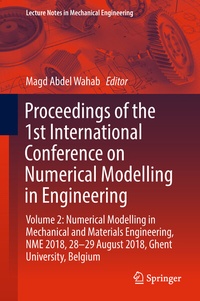
Proceedings of the 1st International Conference on Numerical Modelling in Engineering
Description

This book gathers outstanding papers on numerical modeling in Mechanical Engineering (Volume 2) as part of the proceedings of the 1st International Conference on Numerical Modeling in Engineering (NME 2018), which was held in Ghent, Belgium. The overall objective of the conference was to bring together international scientists and engineers in academia and industry from fields related to advanced numerical techniques, such as the finite element method (FEM), boundary element method (BEM), isogeometric analysis (IGA), etc., and their applications to a wide range of engineering disciplines. This book addresses various industrial engineering applications of numerical simulations to Mechanical and Materials Engineering, including: Aerospace applications, Acoustic analysis, Biomechanical applications, Contact problems and wear, Heat transfer analysis, Vibration and dynamics, Transient analysis, Nonlinear analysis, Composite materials, Polymers, Metal alloys, Fracture mechanics, Fatigue of materials, Creep behavior, Phase transformation, and Crystal plasticity.
More details
Other editions
Additional editions

Person
Content
- Intro
- Preface
- Organization
- Organising Committee
- Chairman
- International Scientific Committee
- Contents
- Flexible IC Interconnection and Electrical Continuity Verification
- Abstract
- 1 Introduction
- 2 Connector Structure
- 2.1 A Subsection Sample
- 3 Electronic Conductive Adhesive
- 4 Testing Board Design Electronic
- 5 Assembly of Testing Board
- 5.1 Assembly of Reflow Testing Circuit Board
- 5.2 Conductive Rubber Structure Assembly
- 6 Testing Board Test Results
- 7 Function Validation
- 8 Conclusions
- Acknowledgment
- References
- Numerical Calculation of Electric and Elastic Properties of Porous Rocks as a Function of Fluid Saturation
- Abstract
- 1 Introduction
- 2 Calculation of Physical Properties
- 3 Result and Discussion
- 3.1 Electrical Properties
- 3.2 Calculation of Elastic Properties
- 4 Conclusion
- References
- A Simple Metal-Semiconductor Substructure Model for the Thermal Induced Fatigue Simulation in Power Integrated Circuits
- Abstract
- 1 Introduction
- 2 Thermo-Mechanical Simulation Method
- 3 Test Structure
- 4 Material Properties and Boundary Conditions
- 5 Mesh
- 6 Results
- 7 Conclusions
- Acknowledgements
- References
- Multi-contacts Interface: Electrical Properties of Dynamical Interface
- Abstract
- 1 Introduction
- 2 Electrical Modeling
- 3 Numerical Results
- 3.1 Static Interface
- 3.2 Rolling Interface
- 3.3 Sliding Interface
- 4 Discussion
- 5 Conclusion and Perspectives
- References
- On the Volume-Diffusion Governed Termination-Migration Assisted Globularization in Two-Phase Solid-State Systems: Insights from Phase-Field Simulations
- 1 Introduction
- 2 Simulation Set-Up
- 2.1 Framework
- 2.2 Grand-Potential Multiphase-Field Model
- 2.3 Domain Set-Up
- 3 Results and Discussion
- 3.1 Temporal Evolution of the Elliptical Structure
- 3.2 Comparison with the Existing Theoretical Studies
- 3.3 Influence of the Aspect Ratio on the Spheroidization Time (/)
- 4 Conclusion
- References
- Experimental and Numerical Study for High Energy Impact Absorption with a Composite Material in Aeronautics
- Abstract
- 1 Introduction
- 2 Program of the Study
- 2.1 State of the Art
- 2.2 Experimental Study
- 2.3 Experimental Test Plan
- 3 Numerical Simulation Methodology by Finite Element Analysis
- 3.1 Different Aspect of Avian Impact
- 3.2 Mathematical and Numerical Model
- 4 Numerical Simulation Model and Virtual Testing
- 5 Conclusion and Perspectives
- 5.1 Conclusions
- 5.2 Perspectives
- References
- A Multiscale Numerical Model for Structures with Internal Frictional Contacts
- 1 Introduction
- 2 Frictional Contact Model Formulation
- 2.1 Mechanical Contact Problem
- 2.2 Friction-Induced Heat Generation
- 3 Numerical Thermo-mechanical Model for Frictional Contacts
- 4 Example: Ultrasonic Wave-Crack Interaction
- 4.1 Model Specifications
- 4.2 Normal and Tangential Stress-Displacement Relations
- 4.3 Generation and Diffusion of Nonlinear Features
- 4.4 Generation and Diffusion of Heat
- 5 Conclusion
- References
- Investigation of Contact Pressure Oscillations with Different Segment-to-Segment Based Isogeometric Contact Formulations
- 1 Introduction
- 2 Formulation
- 2.1 Weak Formulation for Frictionless Contact Problem
- 2.2 NURBS Based Discretization of Contact Problem
- 2.3 Formulation Using the GPTSE Based Contact Algorithm
- 2.4 Formulation Using the Mortar Based Contact Algorithm
- 3 Results and Discussion
- 4 Concluding Remarks
- References
- Modeling 1-D Isothermal Shape Memory Alloy Microstructure via Legendre Wavelets Collocation Method
- Abstract
- 1 Introduction
- 2 Mathematical Model for SMA
- 3 Numerical Algorithm via Legendre Wavelets
- 3.1 Operational Matrix of Derivative
- 3.2 Numerical Algorithm
- 4 Numerical Simulation
- 4.1 Dimensionless Form of the Governing Equations
- 4.2 Simulation Results of the Static Equation
- 4.3 Simulation Results of the Dynamic Equation
- 5 Convergence Analysis
- 6 Conclusion
- Acknowledgements
- References
- Multiscale Statistical Model of Progressive Failure in Random Heterogeneous Media
- Abstract
- 1 Introduction
- 2 Calculation of Failure Probability Using Statistical Metrics
- 3 Damage Evolution Based on the Statistical Model
- 4 Numerical Example and Discussion
- 5 Conclusions
- Acknowledgements
- References
- Numerical Investigation of Two-Phase Flow Induced Local Fluctuations and Interactions of Flow Properties Through Elbow
- 1 Introduction
- 2 Numerical Modelling
- 2.1 Two-Phase Flow Model
- 2.2 Turbulence Model
- 3 Solution Approach
- 4 Results and Discussion
- 4.1 Boundary and Initial Condition
- 4.2 Phase Distribution and Velocity Variation
- 4.3 Pressure
- 5 Conclusion and Recommendation
- References
- Instability of Shock Waves in Bent Channels of Rectangular Cross Section
- Abstract
- 1 Introduction
- 2 Formulation of the Problem
- 3 Numerical Method
- 4 Shock Position Versus M8 at Zero Angle of Attack
- 5 Shock Position Versus the Angle of Attack at a Given M8
- 6 Conclusion
- Acknowledgements
- References
- The Effect of Magnetic Fluid Together with Transverse Roughness Pattern Parameters on the Performance of a Plane Slider Bearing
- 1 List of Symbols (SI Units)
- 2 Introduction
- 3 Analysis
- 4 Results and Discussion
- 5 Conclusion
- References
- Metamodel-Based Analysis of Cross-Flow-Induced Vibrations
- 1 Introduction
- 2 CFD Simulations
- 2.1 Implementation
- 2.2 Computational Domain
- 2.3 Static Case
- 3 Metamodeling Approach
- 3.1 Sampling Plan
- 3.2 Approximation
- 3.3 Model Fitting and Validation
- 4 Results and Discussion
- 4.1 Calculations of Response Values
- 4.2 Analysis of Input Value Impact
- 5 Conclusions
- References
- The Theoretical Investigation of Several Probability Density Function Associated with the Roughness Characteristics for the Performance of Rough Slider Bearing
- 1 List of Symbols (SI Units)
- 2 Introduction
- 3 Analysis
- 4 Results and Discussion
- 5 Conclusion
- References
- Effect of Slip Velocity on the Performance of an Infinitely Short Rough Porous Journal Bearing
- Abstract
- 1 List of Symbols (SI Units)
- 2 Introduction
- 3 Analysis
- 4 Result and Discussion
- 5 Conclusion
- References
- Axisymmetric Modelling of Stretch Blow Moulding Using a Galerkin Mesh-Free Method
- 1 Introduction
- 2 Mesh-Free Approximation Methods
- 3 Lagrangian Mesh-Free Formulation
- 3.1 Boundary Conditions
- 3.2 Domain Integration
- 4 Simulation
- 4.1 Material Model
- 4.2 Loading
- 4.3 Geometry
- 5 Results
- 6 Conclusion
- 7 Future Work
- References
- A Solution Method for the Generalised Linear Systems of Equations Arising in Direct Boundary Element Methods Applied to Problems with Robin Boundary Conditions
- Abstract
- 1 Introduction
- 2 The Linear Systems Arising from the Boundary Element Method with a General Robin Boundary Condition
- 2.1 Direct Boundary Element Method
- 2.2 Indirect Boundary Element Method
- 3 Algorithm for Solving the General Linear System
- 4 Test Problems and Results
- 4.1 Demonstration of the GLS Method
- 4.2 Tests with the Direct Boundary Element Method
- 5 Conclusion
- References
- Constrained Polynomial Approximation for Inverse Problems in Engineering
- 1 Introduction
- 2 Notation and Definition of Constraint Types
- 3 Polynomial Approximation with Constraining Roots
- 3.1 Algebraic Formulation
- 3.2 Algorithmic Implementation
- 3.3 Example and Interpretation
- 4 Polynomial Approximation with Constraining Values
- 4.1 Algebraic Formulation
- 4.2 Numerical Example
- 5 Polynomial Approximation with Generalized Constraints
- 5.1 Algebraic Formulation
- 5.2 Algorithmic Implementation
- 5.3 Numerical Example
- 5.4 Extensions of This Work
- 6 Coefficient Constrained Polynomial Approximation
- 6.1 Example Coefficient Constraints
- 7 Conclusions
- References
- Structural Modelling of Curved Wires
- Abstract
- 1 Introduction
- 2 Curved Wire: Cubic Function Modelling
- 3 Stiffness Matrix Derivation
- 4 Structural Solution
- 5 Test Cases
- 6 Conclusions
- References
- The Simulation Study on the Welding Smoke Control of Tall Workshop by Inducement Type Ventilation
- Abstract
- 1 Introduction
- 2 Calculation of the Divergence of Harmful Substances
- 3 Control Method
- 3.1 Induction Comprehensive Ventilation
- 3.2 Induction Ventilation Principle
- 3.3 Flow Calculation of Induced Jet Flow
- 4 PHOENICS Simulation
- 4.1 Calculation Model
- 4.2 Calculation Results
- 4.3 Air Volume
- 4.4 Air Speed
- 4.5 Air Outlet Height
- 5 Conclusion
- References
- CFD Modelling of Pipe Erosion Due to Sand Transport
- Abstract
- 1 Introduction
- 2 Numerical Modelling
- 2.1 Governing Equations
- 2.2 Flow Domain
- 2.3 Mesh/Grid Generation
- 2.4 Flow Conditions
- 3 Results and Discussion
- 3.1 Mesh Sensitivity Study
- 3.2 Time Series of Average Void Fraction and Contour Plots
- 3.3 Mean Void Fraction
- 3.4 Probability Density Function
- 3.5 Preliminary Erosion Analysis in Multiphase Flow
- 4 Conclusions
- References
- Understanding the Influence of Neighbours on the Spheroidization of Finite 3-Dimensional Rods in a Lamellar Arrangement: Insights from Phase-Field Simulations
- 1 Introduction
- 2 Simulation Set-Up
- 2.1 Phase-Field Model
- 2.2 Domain Set-Up
- 3 Result and Discussion
- 3.1 Spheroidization and Ovulation
- 4 Summary and Outlook
- References
- Modelling Multiphase Flow in Vertical Pipe Using CFD Method
- Abstract
- 1 Introduction
- 2 Simulation Case
- 2.1 Geometry and Mesh
- 3 Methodology
- 4 Mathematical Model
- 4.1 Mass Balance Equation
- 4.2 Momentum Balance Equation
- 4.3 Closure Laws for Stress and Pressure
- 4.4 Closure Laws for Interface Exchange Momentum
- 4.5 Interfacial Transport Equation
- 5 Results and Discussion
- 5.1 Flow Structure Visualization
- 5.2 Time Series Void Fraction Analysis
- 5.2.1 Superficial Gas Velocity of 0.1 m/s
- 5.2.2 Superficial Gas Velocity of 0.21 m/s
- 5.2.3 Superficial Gas Velocity of 1 m/s
- 5.2.4 Superficial Gas Velocity of 4 m/s
- 5.3 Probability Density Function (PDF) Analysis
- 5.3.1 Superficial Gas Velocity of 0.1 m/s
- 5.3.2 Superficial Gas Velocity of 0.21 m/s
- 5.3.3 Superficial Gas Velocity of 1 m/s
- 5.3.4 Superficial Gas Velocity of 4 m/s
- 5.4 Three Phase Gas-Liquid-Solid Flow Simulation with CFD
- 5.4.1 Interment (Churn Turbulent) Case
- 5.4.2 Sand Deposition Analysis-Sand Void Fraction
- 5.4.2 Sand Deposition Analysis-Sand Void Fraction
- 5.4.3 Mass Flux Effect
- 6 Conclusion
- References
- An Analytical Solution for Large Displacements of End-Loaded Beams
- Abstract
- 1 Introduction
- 2 Mathematical Model Formulation
- 3 Analytical Solutions
- 3.1 Initial Constant Curvature Cantilever Beam Bended and Compressed
- 3.2 Initial Constant Curvature Cantilever Beam Bended and Tensioned
- 4 Numerical Applications and Experimental Evidence
- 4.1 Straight Cantilever Beam Subject to a Vertical Load
- 4.2 Straight Cantilever Beam Subjected to Buckling
- 4.3 Hinge - Roller Supporting a Curved Beam Loaded in the Middle
- 5 Conclusions
- 6 Mathematical Appendix
- 6.1 Generalized Binomial Expansion
- 6.2 Gaussian Hypergeometric Function
- 6.3 Special Integral of Eq. (11)
- 6.4 Special Integral of Eq. (13)
- 6.5 Special Integral of Eq. (14)
- 6.6 Special Integral of Eq. (15)
- References
- Diesel Pool Fire Incident Inside an Urban Street Canyon
- Abstract
- 1 Introduction
- 2 Computational Domain
- 2.1 Flow Field Description
- 2.2 Boundary Conditions
- 2.3 Mesh Type
- 2.4 Numerical Schemes
- 3 Results and Discussion
- 3.1 Flow Field Results
- 3.2 Safety Limits
- 4 Conclusion
- References
- Hierarchical Decomposition and Approximation of Sensor Data
- 1 Introduction
- 2 Methodology and Algebraic Framework
- 2.1 Weighted Local Polynomial Approximation - Hierarchy Level 1
- 2.2 Hermite Approximation - Hierarchy Level 2 and Above
- 2.3 Data Reconstruction
- 3 Numerical Testing
- 4 Conclusion
- References
- The Influence of Microstructure Heterogeneity on Crack Propagation in Welds Using XFEM
- Abstract
- 1 Introduction
- 2 Formulation of XFEM
- 3 Numerical Model
- 3.1 Thermal Analysis
- 3.2 Metallurgical Analysis
- 3.3 XFEM Implementation
- 4 Results and Discussion
- 5 Conclusion
- Acknowledgement
- References
- Optimization of IGA Parameters Based on Beam Structure Using Cuckoo Search Algorithm
- Abstract
- 1 Introduction
- 2 Numerical Modeling of IGA Timoshenko Beam
- 2.1 B-Spline Basis Function
- 2.2 B-Spline Curve Function
- 2.3 B-Spline Surface Function
- 2.4 Refinements
- 2.5 Overview of IGA for Modal Analysis
- 3 IGA Model
- 4 Cuckoo Search Algorithm
- 5 Experimental Tests
- 6 Conclusion
- References
- Structural Health Monitoring of Beam-Like and Truss Structures Using Frequency Response and Particle Swarm Optimization
- Abstract
- 1 Introduction
- 2 Frequency Response (FR)
- 3 Particle Swarm Optimization (PSO)
- 3.1 Previous Work
- 3.2 Brief Description of PSO
- 3.3 The Objective Function Based on Frequency Response
- 4 Numerical Examples
- 4.1 Beam-like Structure
- 4.2 Truss Structure
- 5 Conclusion
- References
- Simulation of the Flow Field over the Coastal Terrain
- 1 Introduction
- 2 Description of Analysed Terrain
- 3 Solution Method
- 3.1 Numerical Implementation
- 3.2 Computational Domain and Boundary Conditions
- 3.3 Mesh Development
- 4 Results
- 4.1 Turbulence Models
- 4.2 Domain Studies
- 4.3 Analysis of Mesh Sensitivity
- 5 Conclusions
- References
- Characterization of Honeycomb Sandwich Composite Panel Using Numerical Methods and Experimental Modal Analysis Validation
- Abstract
- 1 Introduction
- 2 Numerical Parameters Homogenized of Honeycomb
- 3 Modal Analysis of Honeycomb Sandwich Panels
- 3.1 Computational Modal Analysis
- 3.2 Experimental Modal Analysis
- 4 Comparative Studies
- 5 Conclusion
- References
- Correction to: An Analytical Solution for Large Displacements of End-Loaded Beams
- Correction to: Chapter "An Analytical Solution for Large Displacements of End-Loaded Beams" in: M. Abdel Wahab (Ed.): Proceedings of the 1st International Conference on Numerical Modelling in Engineering, LNME, https://doi.org/10.1007/978-981-13-2273-0_25
- Author Index
