

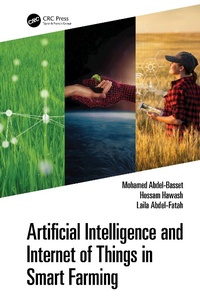
Artificial Intelligence and Internet of Things in Smart Farming
1st Edition
Published on 1. April 2024
314 pages
978-1-003-86185-0 (ISBN)
Description

This book provides a broad overview of the areas of artificial intelligence (AI) that can be used for smart farming applications, through either successful engineering or ground-breaking research. Among them, the highlighted tactics are soil management, water management, crop management, livestock management, harvesting, and the integration of Internet of Things (IoT) in smart farming.
Artificial Intelligence and Internet of Things in Smart Farming explores different types of smart framing systems for achieving sustainability goals in the real environment. The authors discuss the benefits of smart harvesting systems over traditional harvesting methods, including decreased labor requirements, increased crop yields, increased probabilities of successful harvests, enhanced visibility into crop health, and lower overall harvest and production costs. It explains and describes big data in terms of its potential five dimensions-volume, velocity, variety, veracity, and valuation-within the framework of smart farming. The authors also discuss the recent IoT technologies, such as fifth-generation networks, blockchain, and digital twining, to improve the sustainability and productivity of smart farming systems. The book identifies numerous issues that call for conceptual innovation and has the potential to progress machine learning (ML), resulting in significant impacts. As an illustration, the authors point out how smart farming offers an intriguing field for interpretable ML. The book then delves into the function of AI techniques, such as AI in accelerating the development of nano-enabled agriculture, thereby facilitating safe-by-design nanomaterials for various consumer products and medical applications.
This book is for undergraduate students, graduate students, researchers, and AI engineers who pursue a strong understanding of the practical methods of machine learning in the agriculture domain. Practitioners and stakeholders would be able to follow this book to understand the potential of ML in their farming projects and agricultural solutions.
Features:
* Explores different types of smart framing systems for achieving sustainability goals in the real environment
* Explores ML-based analytics such as generative adversarial networks (GAN), autoencoders, computational imaging, and quantum computing
* Examines the development of intelligent machines to provide solutions to real-world problems, emphasizing smart farming applications, which are not modeled or are extremely difficult to model mathematically
* Emphasizes methods for better managing crops, soils, water, and livestock, urging investors and businesspeople to occupy the existing vacant market area
* Discusses AI-empowered Nanotechnology for smart farming
Artificial Intelligence and Internet of Things in Smart Farming explores different types of smart framing systems for achieving sustainability goals in the real environment. The authors discuss the benefits of smart harvesting systems over traditional harvesting methods, including decreased labor requirements, increased crop yields, increased probabilities of successful harvests, enhanced visibility into crop health, and lower overall harvest and production costs. It explains and describes big data in terms of its potential five dimensions-volume, velocity, variety, veracity, and valuation-within the framework of smart farming. The authors also discuss the recent IoT technologies, such as fifth-generation networks, blockchain, and digital twining, to improve the sustainability and productivity of smart farming systems. The book identifies numerous issues that call for conceptual innovation and has the potential to progress machine learning (ML), resulting in significant impacts. As an illustration, the authors point out how smart farming offers an intriguing field for interpretable ML. The book then delves into the function of AI techniques, such as AI in accelerating the development of nano-enabled agriculture, thereby facilitating safe-by-design nanomaterials for various consumer products and medical applications.
This book is for undergraduate students, graduate students, researchers, and AI engineers who pursue a strong understanding of the practical methods of machine learning in the agriculture domain. Practitioners and stakeholders would be able to follow this book to understand the potential of ML in their farming projects and agricultural solutions.
Features:
* Explores different types of smart framing systems for achieving sustainability goals in the real environment
* Explores ML-based analytics such as generative adversarial networks (GAN), autoencoders, computational imaging, and quantum computing
* Examines the development of intelligent machines to provide solutions to real-world problems, emphasizing smart farming applications, which are not modeled or are extremely difficult to model mathematically
* Emphasizes methods for better managing crops, soils, water, and livestock, urging investors and businesspeople to occupy the existing vacant market area
* Discusses AI-empowered Nanotechnology for smart farming
More details
Edition
1. Auflage
Language
English
Place of publication
London
United Kingdom
Publishing group
Taylor & Francis Ebooks
Target group
College/higher education
Illustrations
11 Tables, black and white; 28 Line drawings, black and white; 4 Halftones, black and white; 32 Illustrations, black and white
ISBN-13
978-1-003-86185-0 (9781003861850)
Copyright in bibliographic data and cover images is held by Nielsen Book Services Limited or by the publishers or by their respective licensors: all rights reserved.
Schweitzer Classification
Other editions
Additional editions
Mohamed Abdel-Basset | Hossam Hawash | Laila Abdel-Fatah
Artificial Intelligence and Internet of Things in Smart Farming
Book
approx. 06/2026
1st Edition
CRC Press
€66.00
Not yet published
Mohamed Abdel-Basset | Hossam Hawash | Laila Abdel-Fatah
Artificial Intelligence and Internet of Things in Smart Farming
Book
04/2024
1st Edition
CRC Press
€176.50
Shipment within 10-20 days
Persons
Dr. Mohamed Abdel-Basset is an IEEE Senior Member. He received the B.Sc., M.Sc., and PhD degrees in operations research from the Faculty of Computers and Informatics, Zagazig University, Egypt. He is currently an Associate Professor, Head of department of computer science with the Faculty of Computers and Informatics, Zagazig University. He has published more than 400 articles in international journals and conference proceedings. He is working on the application of multi-objective and robust metaheuristic optimization techniques. His current research interests include optimization, machine learning, deep learning, artificial intelligence, operations research, data mining, computational intelligence, applied statistics, decision support systems, robust optimization, engineering optimization, multi-objective optimization, swarm intelligence, evolutionary algorithms, and artificial neural networks.
Dr. Laila Abdel-Fatah received her B.S. M.Sc. and PhD. degrees in information systems and decision support from the Faculty of Computers and Informatics, Zagazig University, Egypt. She is currently a Lecturer with the Faculty of Computers and Informatics at Zagazig University. Her research interests include computation intelligence (CI), fuzzy logic, artificial intelligence (AI), the Internet of Things (IoT), metaheuristic algorithms, geographic information systems (GIS), and spatial optimization.
Dr. Hossam Hawash is a senior researcher at Zagazig University, Faculty of Computers and Informatics, Department of Computer Science, Egypt. He obtained his bachelor's and master's degrees in computer science in 2012 and 2016, respectively, from the Faculty of Computers and Informatics, Department of Computer Science, Egypt. His area of interest includes computation intelligence, Optimization, machine learning, deep learning, artificial intelligence, fuzzy learning, explainable artificial intelligence, and the Internet of things.
Dr. Laila Abdel-Fatah received her B.S. M.Sc. and PhD. degrees in information systems and decision support from the Faculty of Computers and Informatics, Zagazig University, Egypt. She is currently a Lecturer with the Faculty of Computers and Informatics at Zagazig University. Her research interests include computation intelligence (CI), fuzzy logic, artificial intelligence (AI), the Internet of Things (IoT), metaheuristic algorithms, geographic information systems (GIS), and spatial optimization.
Dr. Hossam Hawash is a senior researcher at Zagazig University, Faculty of Computers and Informatics, Department of Computer Science, Egypt. He obtained his bachelor's and master's degrees in computer science in 2012 and 2016, respectively, from the Faculty of Computers and Informatics, Department of Computer Science, Egypt. His area of interest includes computation intelligence, Optimization, machine learning, deep learning, artificial intelligence, fuzzy learning, explainable artificial intelligence, and the Internet of things.
Content
1. Introduction to Smart Farming. 2. Big Data in Smart Farming. 3. Conceptualization of Machine Learning for Smart Farming. 4. From Field to Database: Sensors, Data Collection, and Efficient Management in Smart Farming. 5. Maximizing Yield, Minimizing Water: Machine Intelligence for Precision Irrigation and Water Management. 6. Innovations in Livestock Monitoring: A Machine Learning Journey. 7. Enhancing Crop Health with Machine Learning: Disease and Weed Identification Strategies. 8. Automated Harvesting and Robotics in Agriculture. 9. The Convergence of AI and IoT in Smart Farming. 10. Toward Agriculture 5.0: The Convergence of Machine Learning and Nanotechnology for Next-Generation Farming.
