

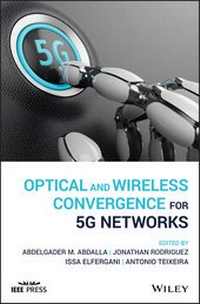
Optical and Wireless Convergence for 5G Networks
Description

The mobile market has experienced unprecedented growth over the last few decades. Consumer trends have shifted towards mobile internet services supported by 3G and 4G networks worldwide. Inherent to existing networks are problems such as lack of spectrum, high energy consumption, and inter-cell interference. These limitations have led to the emergence of 5G technology. It is clear that any 5G system will integrate optical communications, which is already a mainstay of wide area networks. Using an optical core to route 5G data raises significant questions of how wireless and optical can coexist in synergy to provide smooth, end-to-end communication pathways. Optical and Wireless Convergence for 5G Networks explores new emerging technologies, concepts, and approaches for seamlessly integrating optical-wireless for 5G and beyond.
Considering both fronthaul and backhaul perspectives, this timely book provides insights on managing an ecosystem of mixed and multiple access network communications focused on optical-wireless convergence. Topics include Fiber-Wireless (FiWi), Hybrid Fiber-Wireless (HFW), Visible Light Communication (VLC), 5G optical sensing technologies, approaches to real-time IoT applications, Tactile Internet, Fog Computing (FC), Network Functions Virtualization (NFV), Software-De¿ned Networking (SDN), and many others. This book aims to provide an inclusive survey of 5G optical-wireless requirements, architecture developments, and technological solutions.
More details
Other editions
Additional editions

Persons
ABDELGADER M. ABDALLA, PHD, is a Senior Researcher at the Instituto de Telecomunicações, Aveiro, Portugal. He is acting as a work package leader/task leader for two ECSEL Innovation Actions European projects. He is also playing a leading international role on optical-wireless convergence research.
JONATHAN RODRIGUEZ, PHD, is a Principal Investigator and founder of the Mobile Systems Research Lab at the Instituto de Telecomunicações, Aveiro, Portugal. He is also a full Professor at the University of South Wales, UK.
ISSA ELFERGANI, PHD, is a Senior Researcher at the Instituto de Telecomunicações, Aveiro, Portugal, working as technical manager and work package leader on several national and international projects. He is an expert on Radio Communication.
ANTONIO TEIXEIRA, PHD, is a Professor at the University of Aveiro and Principal Investigator at the Instituto de Telecomunicações, Portugal. He was with Nokia Siemens Networks and Coriant as a standardization expert in the field of optical access. He holds an EC in management and leadership from MIT Sloan School.
Content
About the Editors xiii
List of Contributors xvii
Preface xxxi
Acknowledgments xxxiii
Introduction xxxv
1 Towards a Converged Optical-Wireless Fronthaul/Backhaul Solution for 5G Networks and Beyond 1
Isiaka Ajewale Alimi, Nelson Jesus Muga, Abdelgader M. Abdalla, Cátia Pinho, Jonathan Rodriguez, Paulo Pereira Monteiro, and Antonio Luís Teixeira
1.1 Introduction 1
1.2 Cellular Network Interface and Solution 2
1.2.1 MBH/MFH Architecture 2
1.2.1.1 Mobile Backhaul (MBH) 2
1.2.1.2 Mobile Fronthaul (MFH) 3
1.2.2 Integrated MBH/MFH Transport Network 3
1.3 5G Enabling Technologies 4
1.3.1 Ultra-Densification 4
1.3.2 C-RAN and RAN Virtualization 4
1.3.3 Advanced Radio Coordination 6
1.3.4 Millimeter-Wave Small Cells 7
1.3.5 Massive MIMO 8
1.3.6 New Multicarrier Modulations for 5G 8
1.4 Fiber-Wireless Network Convergence 9
1.5 Radio-Over-Fiber Transmission Scheme 10
1.5.1 Digital Radio-Over-Fiber (D-RoF) Transmission 10
1.5.2 Analog Radio-Over-Fiber (A-RoF) Transmission 10
1.6 Optical MBH/MFH Transport Network Multiplexing Schemes 11
1.6.1 Wavelength-Division Multiplexing (WDM) Based Schemes 11
1.6.2 Spatial-Division Multiplexing (SDM) Based Schemes 12
1.6.2.1 State-of-the-Art of SDM in 5G Infrastructure 12
1.6.2.2 Spatial Division Multiplexing Enabling Tools 13
1.7 Wireless based MFH/MBH 16
1.7.1 FSO Communication Systems 17
1.7.1.1 Log-Normal Distribution (LN) 17
1.7.1.2 Gamma-Gamma (GG) Distribution 19
1.7.2 Hybrid RF/FSO Technology 20
1.7.3 Relay-Assisted FSO Transmission 20
1.8 Experimental Channel Measurement and Characterization 21
1.9 Results and Discussions 23
1.10 Conclusion 24
Acknowledgments 24
Bibliography 25
2 Hybrid Fiber Wireless (HFW) Extension for GPON Toward 5G 31
Rattana Chuenchom, Andreas Steffan, Robert G. Walker, Stephen J. Clements, Yigal Leiba, Andrzej Banach, Mateusz Lech, and Andreas Stöhr
2.1 Introduction 31
2.2 Passive Optical Network 32
2.2.1 GPON and EPON Standards 32
2.3 Transparent Wireless Extension of Optical Links 33
2.3.1 Transparent Wireless Extension of Optical Links Using Coherent RoF (CRoF) 33
2.4 Key Enabling Photonic and Electronic Technologies 36
2.4.1 Coherent Photonic Mixer 36
2.4.2 Single Side Band Mach-Zehnder Modulator 39
2.4.3 High Power Amplifier in the E-band for GPON Extension 42
2.4.4 Integrated Radio Access Units 44
2.5 Field Trial for a 2.5 Gbit s-1 GPON over Wireless 46
2.5.1 RX Throughput and Packet Loss 50
2.5.2 Latency 52
2.5.3 Jitter 53
2.6 Conclusions 53
Bibliography 54
3 Software Defined Networking and Network Function Virtualization for Converged Access-Metro Networks 57
Marco Ruffini and Frank Slyne
3.1 Introduction 57
3.2 The 5G Requirements Driving Network Convergence and Virtualization 58
3.3 Access and Metro Convergence 61
3.3.1 Long-Reach Passive Optical Network 62
3.3.2 New Architectures in Support of 5G Networks, Network Virtualization and Mobile Functional Split 63
3.4 Functional Convergence and Virtualization of the COs 66
3.4.1 Infrastructure 67
3.4.1.1 Disaggregated Hardware 67
3.4.1.2 I/O Abstraction and Data Path 68
3.4.1.3 Data Centre Switching Fabric 70
3.4.1.4 Optimized Infrastructure Projects 70
3.4.2 Management and Control 70
3.4.2.1 Network Control 70
3.4.2.2 Cloud and Virtual Management 71
3.4.2.3 Orchestration, Management and Policy 72
3.4.3 Cross-Layer Components 73
3.5 Conclusions 73
Bibliography 74
4 Multicore Fibres for 5G Fronthaul Evolution 79
Ivana Gasulla and José Capmany
4.1 Why 5G Communications Demand Optical Space-Division Multiplexing 79
4.2 Multicore Fibre Transmission Review 81
4.2.1 Homogeneous MCFs 82
4.2.2 Heterogeneous MCFs 83
4.3 Radio Access Networks Using Multicore Fibre Links 84
4.3.1 Basic MCF Link Between the Central Office and Base Station 86
4.3.2 MCF Based RoF C-RAN 87
4.3.3 MCF Based DRoF C-RAN 89
4.4 Microwave Signal Processing Enabled by Multicore Fibers 90
4.4.1 Signal Processing Over a Heterogeneous MCF Link 93
4.4.2 RF Signal Processing Over a Homogeneous MCF Multi-Cavity Device 94
4.5 Final Remarks 97
Bibliography 97
5 Enabling VLC and WiFi Network Technologies and Architectures Toward 5G 101
Isiaka Ajewale Alimi, Abdelgader M. Abdalla, Jonathan Rodriguez, Paulo Pereira Monteiro, Antonio Luís Teixeira, Stanislav Zvánovec, and Zabih Ghassemlooy
5.1 Introduction 101
5.2 Optical Wireless Systems 103
5.3 Visible Light Communication (VLC) System Fundamentals 105
5.4 VLC Current and Anticipated Future Applications 107
5.4.1 Underwater Wireless Communications 109
5.4.2 Airline and Aviation 112
5.4.3 Hospitals 112
5.4.4 Vehicular Communication Systems 113
5.4.5 Sensitive Areas 114
5.4.6 Manufacturing and Industrial Applications 114
5.4.7 Retail Stores 114
5.4.8 Consumer Electronics 114
5.4.9 Internet of Things 115
5.4.10 Other Application Areas 115
5.5 Hybrid VLC and RF Networks 116
5.6 Challenges and Open-Ended Issues 117
5.6.1 Flicker and Dimming 117
5.6.2 Data Rate Improvement 117
5.7 Conclusions 118
Acknowledgments 118
Bibliography 118
6 5G RAN: Key Radio Technologies and Hardware Implementation Challenges 123
Hassan Hamdoun, Mohamed Hamid, Shoaib Amin, and Hind Dafallah
6.1 Introduction 123
6.2 5G NR Enabled Use Cases 124
6.2.1 eMBB and uRLLC 124
6.2.1.1 mMTC 125
6.2.2 Migration to 5G 125
6.3 5G RAN Radio Enabling Technologies 126
6.3.1 Massive MIMO (M-MIMO) 126
6.3.1.1 M-MIMO in mmWave 128
6.3.1.2 M-MIMO in sub 6 GHz 128
6.3.1.3 Distributed MIMO (D-MIMO) 128
6.3.2 Carrier Aggregation and Licensed Assisted Access to an Unlicensed Spectrum 129
6.3.3 Dual Connectivity 130
6.3.4 Device-to-Device (D2D) Communication 130
6.4 Hardware Impairments 131
6.4.1 Hardware Impairments - Transmitters 132
6.4.2 Hardware Impairments - Receivers 133
6.4.3 Hardware Impairments - Transceivers 133
6.5 Technology and Fabrication Challenges 135
6.6 Conclusion 135
Bibliography 136
7 Millimeter Wave Antenna Design for 5G Applications 139
Issa Elfergani, Abubakar Sadiq Hussaini, Abdelgader M. Abdalla, Jonathan Rodriguez, and Raed Abd-Alhameed
7.1 Introduction 139
7.2 Antenna Design and Procedure 142
7.3 Antenna Optimization and Analysis 143
7.3.1 The Influence of Ground Plane Length (G L) 143
7.3.2 The Effect of Feeding Strip Position (F P) 144
7.3.3 The Influences of the Substrate Type 145
7.4 Millimeter Wave Antenna Design with Notched Frequency Band 146
7.5 Millimeter Wave Antenna Design with Loaded Capacitor 148
7.6 Conclusion 152
Acknowledgments 153
Bibliography 153
8 Wireless Signal Encapsulation in a Seamless Fiber-Millimeter Wave System 157
Pham Tien Dat, Atsushi Kanno, Naokatsu Yamamoto, and Testuya Kawanishi
8.1 Introduction 157
8.2 Principle of Signal Encapsulation 158
8.2.1 Downlink System 158
8.2.2 Uplink System 161
8.3 Examples of Signal Encapsulation 162
8.3.1 Downlink Transmission 162
8.3.2 Uplink Transmission 166
8.3.3 MmWave Link Distance 170
8.4 Conclusion 174
Bibliography 175
9 5G Optical Sensing Technologies 179
Seedahmed S. Mahmoud, Bernhard Koziol, and Jusak Jusak
9.1 Introduction 179
9.2 Optical Fibre Communication Network: Intrusion Methods 182
9.3 Physical Protection of Optical Fiber Communication Cables 183
9.3.1 Location-Based Optical Fibre Sensors 185
9.3.1.1 OTDR Based Sensor 185
9.3.1.2 Mach-Zehnder Interferometry 186
9.3.2 Point-Based OFSs 187
9.3.2.1 FBGs 187
9.3.3 Zone-Based OFSs 188
9.3.3.1 Michelson Interferometer 188
9.4 Design Considerations and Performance Characteristics 189
9.4.1 Performance Parameters 189
9.4.2 The Need for Robust Signal Processing Methods 190
9.4.3 System Installation and Technology Suitability 191
9.5 Conclusions 192
Bibliography 192
10 The Tactile Internet over 5G FiWi Architectures 197
Amin Ebrahimzadeh, Mahfuzulhoq Chowdhury, and Martin Maier
10.1 Introduction 197
10.2 The TI: State of the Art and Open Challenges 203
10.3 Related Work 206
10.4 HITL Centric Teleoperation over AI Enhanced FiWi Networks 207
10.5 HART Centric Task Allocation over Multi-Robot FiWi Based TI Infrastructures 213
10.6 Conclusions 219
Bibliography 220
11 Energy Efficiency in the Cloud Radio Access Network (C-RAN) for 5G Mobile Networks: Opportunities and Challenges 225
Isiaka Ajewale Alimi, Abdelgader M. Abdalla, Akeem Olapade Mufutau, Fernando Pereira Guiomar, Ifiok Otung, Jonathan Rodriguez, Paulo Pereira Monteiro, and Antonio Luís Teixeira
11.1 Introduction 225
11.1.1 Environmental Effects 226
11.1.2 Economic Benefits 227
11.2 Standardized Energy Efficiency Metric (Green Metric) 229
11.2.1 Power Per Subscriber, Traffic and Distance/Area 230
11.2.2 Energy Consumption Rating (ECR) Measured in W Gbps-1 231
11.2.3 Telecommunications Energy Efficiency Ratio (TEER) 231
11.2.4 Telecommunication Equipment Energy Efficiency Rating (TEEER) 231
11.3 Green Design for Energy Crunch Prevention in 5G Networks 232
11.3.1 Hardware Solutions 233
11.3.2 Network Planning and Deployment 234
11.3.2.1 Dense Networks 234
11.3.2.2 Offloading Techniques 234
11.3.3 Resource Allocation 235
11.3.4 Energy Harvesting (EH) and Transfer 235
11.3.4.1 Dedicated EH 235
11.3.4.2 Ambient EH 235
11.4 Fiber Based Energy Efficient Network 237
11.4.1 Zero Power RAU PoF Network 238
11.4.2 Battery Powered RRH PoF Network 238
11.5 System and Power Consumption Model 238
11.5.1 Remote Unit Power Consumption 240
11.5.2 Centralized Unit Power Consumption 241
11.5.3 Fronthaul Power Consumption 241
11.5.4 Massive MIMO Energy Efficiency 242
11.6 Simulation Results and Discussions 243
11.7 Conclusion 245
Acknowledgments 245
Bibliography 245
12 Fog Computing Enhanced Fiber-Wireless Access Networks in the 5G Era 249
Bhaskar Prasad Rimal and Martin Maier
12.1 Background and Motivation 249
12.1.1 Next-Generation PON and Beyond 249
12.1.2 FiWi Broadband Access Networks 251
12.1.3 Role of Fog Computing 253
12.1.4 Computation Offloading 253
12.1.5 Key Issues and Contributions 255
12.2 Fog Computing Enhanced FiWi Networks 257
12.2.1 Network Architecture 257
12.2.2 Protocol Description 259
12.3 Analysis 259
12.3.1 Survivability Analysis 259
12.3.2 End-to-End Delay Analysis 262
12.4 Implementation and Validation 263
12.4.1 Experimental Testbed 264
12.4.2 Results 264
12.5 Conclusions and Outlook 267
12.5.1 Conclusions 267
12.5.2 Outlook 267
Bibliography 268
13 Techno-economic and Business Feasibility Analysis of 5G Transport Networks 273
Forough Yaghoubi, Mozhgan Mahloo, Lena Wosinska, Paolo Monti, Fabricio S. Farias, Joao C. W. A. Costa, and Jiajia Chen
13.1 Introduction 273
13.2 Mobile Backhaul Technologies 275
13.3 Techno-economic Framework 278
13.3.1 Architecture Module 279
13.3.2 Topology Module 279
13.3.3 Market Module 280
13.3.4 Network Dimensioning Tool 280
13.3.5 Cost Module 280
13.3.6 Total Cost of Ownership (TCO) Module 280
13.3.6.1 Capital Expenditure (CAPEX) 281
13.3.6.2 Operational Expenditure (OPEX) 281
13.3.7 Business Models and Scenarios 283
13.3.8 Techno-economic Module 283
13.4 Case Study 284
13.4.1 Application of Methodology/Scenarios 284
13.4.2 Techno-economic Evaluation Results 286
13.4.3 Sensitivity Analysis 289
13.5 Conclusion 292
Bibliography 293
Index 297
List of Contributors
Professor Ghassemlooy received a BSc(Hons) in Electrical and Electronics from Manchester Metropolitan University, UK in 1981, and an MSc (1984) and PhD (1987) from University of Manchester, UK. From 1987 to 1988 he was a Post-Doctoral Research Fellow, City University, UK. In 1988 he joined Sheffield Hallam University as a Lecturer, becoming a Professor in 1997. In 2004 he joined University of Northumbria, Newcastle as an Associate Dean (AD) for research in the School of Engineering, and from 2012 to 2014 was AD for Research and Innovation, Faculty of Engineering, where he currently is Head of the Optical Communications Research Group. In 2001 he was awarded the Tan Chin Tuan Fellowship in Engineering from Nanyang Technological University, Singapore. In 2016 he was a Research Fellow and in 2015 a Distinguished Professor at Chinese Academy of Sciences, Quanzhou, China. He was a Visiting Professor at University Tun Hussein Onn Malaysia (2013-17), and Huaqiao University, China (2017-18). He has published over 770 papers (305 journals and 6 books), over 92 keynote/invited talks, and supervised over 60 PhDs. Research interests include optical wireless communications, free space optics, and visible light communications. He was the Vice-Chair of EU Cost Action IC1101 (2011-16). He is the Chief Editor of the British Journal of Applied Science and Technology and the International Journal of Optics and Applications. He is the fellow of the IET, a senior member of IEEE, a senior member of OSA, and Charted Engineer. He is a co-author of a CRC book on Optical Wireless Communications - Systems and Channel Modelling with Matlab (2012); and co-editor of four books including a Springer book on Optical Wireless Communications - An Emerging Technology (2016), a CRC book Visible Light Communications Theory and Applications, CRC June 2017, an IGI Global book Intelligent Systems for Optical Networks Design Advancing Techniques, 31 Mar 2013, and an IET book Analogue Optical Fibre Communications, IEE Telecommunication Series 32, 1995. From 2004 to 2006 he was the IEEE UK/IR Communications Chapter Secretary, then the Vice-Chairman (2004-2008), and the Chairman (2008-2011), and Chairman of the IET Northumbria Network (Oct 2011-2015). Web site http//soe.northumbria.ac.uk/ocr/people/ghassemlooy/
Paulo P. Monteiro received a diploma "Licenciatura" in Electronics and Telecommunications Engineering from the University of Aveiro in 1988, an MSc in Electronic Engineering from the University of Wales UK, in 1990 and a PhD in Electrical Engineering, from the University of Aveiro in 1999. Presently, he is Associate Professor at the University of Aveiro and Researcher at the Instituto de Telecomunicações. From October 2002 until March 2007 he was at Siemens SA, Portugal as a Head of Research of Optical Networks. From April 2007 until December 2009 he was at Nokia Siemens Networks (NSN) Portugal as a Research Manager at Transport, Aggregation and Fixed Access, and from January 2010 until June 2012 as a R&D manager of the Network Optimization unit at NSN. From July 2012 until May 2013 he was Research Manager at NSN Portugal. In May 2013, the Optical Networks business unit of Nokia Siemens Networks began operating as a new company Coriant and he left in June 2013. In 1992, he joined the Department of Electronic and Telecommunications Engineering of University of Aveiro and the Optical Communications Group of Institute for Telecommunications as an Assistant Professor and Researcher, respectively. In 1999, he became an Auxiliary Professor at the University of Aveiro and he was promoted to Associate Professor in 2005. His main research interests include Optical Communication Networks, Microwave Photonic and Electronic Subsystems. He has tutored and co-tutored successfully more than 14 PhDs, having participated in more than 28 projects (national, and international). He was the coordinator of a CELTIC project OPTRONET and a large-scale integrating project FUTON (FP7 ICT-2007-215533). He has authored/co-authored more than 18 patent applications and over 100 papers in journals and 360 conference contributions. He is a member of ECOC 2018 Sub-Committee 5 on Photonic and Microwave Photonic Subsystems and Senior Member of IEEE.
José Capmany was born in Madrid, Spain, on December 15 1962. He received the Ingeniero de Telecomunicacion degree from the Universidad Politécnica de Madrid (UPM) in 1987 and the Licenciado en Ciencias Físicas in 2009. He holds a PhD in Electrical Engineering from UPM and a PhD in Quantum Physics from the Universidad de Vigo. Since 1991 he has been with the Departamento de Comunicaciones, Universitat Politécnica de València (UPV), where he started the activities on optical communications and photonics, founding the Photonics Research Labs (www.prl.upv.es). He was an Associate Professor from 1992 to 1996, and Full Professor in optical communications, systems, and networks since 1996. In parallel, he has been Telecommunications Engineering Faculty Vice-Dean from 1991 to 1996, and Deputy Head of the Communications Department since 1996. From 2002 to 2016, he was the Director of the Institute of Telecommunications and Multimedia (iTEAM) at UPVa (www.iteam.upv.es). His research activities and interests cover a wide range of subjects related to optical communications including microwave photonics (MWP), integrated optics, optical signal processing, fiber Bragg gratings, and more recently quantum cryptography and quantum information processing using photonics. He has published over 520 papers in international refereed journals and conferences and has been a member of the Technical Program Committees of the European Conference on Optical Communications (ECOC), the Optical Fiber Conference (OFC), the Integrated Optics and Optical Communications Conference (IOOC), CLEO Europe, and the Optoelectronics and Communications Conference (OECC). Professor Capmany has also carried out activities related to professional bodies and is the Founder and current Chairman of the IPS Spanish Chapter, and a Fellow of the Institute of Electrical and Electronics Engineers (IEEE), the Optical Society of America (OSA) and the Institution of Electrical Engineers (IEE). He has acted as a reviewer for over 35 SCI journals in the field of photonics and telecommunications. He is also a founder and chief innovation officer of the spin-off company VLC Photonics (www.vlcphotonics.com) dedicated to the design of photonic integrated circuits and EPHHOX (www.ephoox.com) dedicated to MWP instrumentation.
Professor Capmany is the 2012 King James I Prize Laureate on novel technologies, the highest scientific distinction in Spain, for his outstanding contributions to the field of microwaves.
Professor Marco Ruffini received his MEng in Telecommunications in 2002 from Polytechnic University of Marche, Italy. After working as a research scientist for Philips in Germany, he joined Trinity College Dublin in 2005, where he received his PhD in 2007.
Since 2010 he has been Assistant Professor (tenured 2014) at TCD. He is Principal Investigator (PI) at both the CONNECT Telecommunications Research Centre at TCD, and the IPIC photonics integration center headquartered at the national Tyndall institute. Professor Ruffini is currently involved in several Science Foundation Ireland (SFI) and H2020 projects and leads the Optical Network Architecture group at Trinity College Dublin. His main research is in the area of 5G optical networks, where he carries out pioneering work on the convergence of fixed-mobile and access-metro networks, and on the virtualization of next generation networks. Professor Ruffini and has been invited to share his vision through several keynotes and talks at major international conferences across the world. He has authored over 100 international publications, over 10 patents and contributes to the BroadBand Forum (BBF) standardization body.
Professor Stanislav Zvanovec received his MSc and PhD degrees from the Faculty of Electrical Engineering, Czech Technical University (CTU) in Prague in 2002 and 2006, respectively. He works as a full professor and deputy head of the Department of Electromagnetic Field and chairperson of PhD branch at CTU. His current research interests include free space optical and fiber optical systems, visible light communications, OLED and RF over optics. He is the head of the Free-Space and Fiber Optics Group at CTU (optics.elmag.org). Until 2014 he was a chair of the Joint MTT/AP/ED/EMC chapter of the IEEE Czechoslovakia Section. He is holder of projects national TACR and GACR agencies and participates within the frame of international projects Visible Light Based Interoperability and Networking (ViSioN) European ITN MSCA project, EU COST projects IC1101 OPTICWISE (Optical Wireless Communications - An Emerging Technology), IC0802, IC0603, CA1622, etc. He is author of two books (co-author of a recent book Visible Light Communications Theory and Applications), several book chapters and more than 250 journal and conference papers.
Ifiok Otung is Professor of Satellite Communications at the University of South Wales. He is author of more than 100 scientific works in the area of mobile and satellite communication systems. In particular, he has led earthspace radio wave propagation research for many years, supervising 16 PhD and over 100 MSc projects and participating in two EPSRC grants (GR/M40356/01, GR/K96601/01) as well as KTP (TCS 3661) and ERDF (WEFO 80247) funding and many EU COST programs...
