

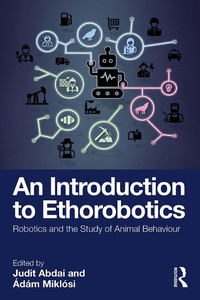
An Introduction to Ethorobotics
Robotics and the Study of Animal Behaviour
1st Edition
Published on 27. September 2024
516 pages
978-1-040-11622-7 (ISBN)
Description

This pioneering text explores the emerging discipline of ethorobotics which brings together the fields of animal behaviour and robotics. It encourages closer collaboration between behavioural scientists and engineers to facilitate the creation of robots with a higher degree of functionality in animal/human environments and to broaden understanding of animal behaviour in new and intriguing ways.
Utilising the knowledge of key ethologists and roboticists in the field today, this book is divided into four major parts. The first part is written for those with little or no background in the biology of animal behaviour, particularly for those coming from an engineering background seeking an accessible introduction to the field and how it can be applied to robotic behaviour. Topics include problem solving in animals, social cognition, and communication (visual, acoustic, olfactory, etc.). The second part is an introduction to the basic construction of robots for non-engineers, and the possibilities offered by current technical achievements and their limitations to the study of animal behaviour. The third part explores the core theme of ethorobotics, the basic framework of the discipline, the field's evolution, and current topics including ethical considerations, autonomy, to 'living' social robots. The fourth and final chapter looks at ethorobotics in practice through key research projects which have had the biggest impact.
This is a ground-breaking interdisciplinary text which will appeal to upper-level undergraduates, postgraduates, and researchers focusing on animal behaviour and cognition, as well as those undertaking courses in engineering, social robotics, biologically inspired robotics, AI, and human-robot and animal-robot interactions.
Utilising the knowledge of key ethologists and roboticists in the field today, this book is divided into four major parts. The first part is written for those with little or no background in the biology of animal behaviour, particularly for those coming from an engineering background seeking an accessible introduction to the field and how it can be applied to robotic behaviour. Topics include problem solving in animals, social cognition, and communication (visual, acoustic, olfactory, etc.). The second part is an introduction to the basic construction of robots for non-engineers, and the possibilities offered by current technical achievements and their limitations to the study of animal behaviour. The third part explores the core theme of ethorobotics, the basic framework of the discipline, the field's evolution, and current topics including ethical considerations, autonomy, to 'living' social robots. The fourth and final chapter looks at ethorobotics in practice through key research projects which have had the biggest impact.
This is a ground-breaking interdisciplinary text which will appeal to upper-level undergraduates, postgraduates, and researchers focusing on animal behaviour and cognition, as well as those undertaking courses in engineering, social robotics, biologically inspired robotics, AI, and human-robot and animal-robot interactions.
Reviews / Votes
This is an important book for engineers, roboticists as well as ethologists. Based on their wealth of knowledge and experience in animal behaviour, the authors provide an innovative approach towards developing robot in general, and specifically interactive, social robots. The authors' ethorobotic framework can revolutionize how we design robots as 'species' that can benefit human society. The book will be greatly appreciated by researchers, students, and anyone interested in the intersection of robotics and ethology.Kerstin Dautenhahn, Director of Social and Intelligent Robotics Research Lab, Department of Electrical and Computer Engineering, University of Waterloo
This book fosters collaboration between behavioural scientists and engineers to create highly functional robots for animal and human environments. It offers an accessible introduction to animal behaviour for engineers, a guide to basic robotic construction for non-engineers, and discusses the evolution and ethical considerations of ethorobotics.
Farshid Amirabdollahian, Professor of Human-Robot Interaction, School of Engineering and Computer Science, the University of Hertfordshire
What can we learn from animal behaviour in designing robots that will work well in everyday human environments? While so much research - and the popular imagination - focuses on 'human-like' robots, Miklosi and Abdai focus on other animals. After all, dogs have been our companions going back into pre-history, yet relatively little effort has been focused on what makes them so attractive to us. Written by longstanding researchers in the field, this book will broaden your horizons, and hopefully stimulate new research directions for socially-capable robots.
Ruth Aylett, Professor of Computer Science at Heriot-Watt University in Edinburgh
An Introduction to Ethorobotics explores how we can create intelligent machines that not only perform tasks but can also take advantage of ethological knowledge to the construction of social robots. Whether you're an undergraduate student, a postgraduate, or a researcher focusing on robotics and cognition, this book offers insightful perspectives and thought-provoking discussions that will leave you pondering the role of ethology in our increasingly robotic world.
Vicente Matellan Olivera, Full Professor of Computer Science, University of Leon
Bridging the gap between animal behavior and robotics, this comprehensive guide is a must-read for biologists, engineers, and anyone curious about how nature can inspire technology.
Iolanda Leite, Associate Professor, School of Electrical Engineering and Computer Science, KTH Royal Institute of Technology
More details
Edition
1. Auflage
Language
English
Place of publication
London
United Kingdom
Publishing group
Taylor & Francis Ltd
Target group
College/higher education
Professional and scholarly
Illustrations
70 Line drawings, black and white; 45 Halftones, black and white; 115 Illustrations, black and white
ISBN-13
978-1-040-11622-7 (9781040116227)
Copyright in bibliographic data and cover images is held by Nielsen Book Services Limited or by the publishers or by their respective licensors: all rights reserved.
Schweitzer Classification
Other editions
Additional editions

Judit Abdai | Adam Miklosi
An Introduction to Ethorobotics
Robotics and the Study of Animal Behaviour
Book
approx. 07/2026
1st Edition
Routledge
€63.50
Not yet published

Judit Abdai | Adam Miklosi
An Introduction to Ethorobotics
Robotics and the Study of Animal Behaviour
Book
10/2024
Taylor & Francis
Unfortunately, price unknown
Available (delivery time upon request)

Judit Abdai | Adam Miklosi
An Introduction to Ethorobotics
Robotics and the Study of Animal Behaviour
Book
09/2024
1st Edition
Routledge
€334.90
Shipment within 10-20 days
Persons
Judit Abdai, Department of Ethology, Eoetvoes Lorand University, Hungary.
Adam Miklosi, Department of Ethology, Eoetvoes Lorand University, Hungary.
Adam Miklosi, Department of Ethology, Eoetvoes Lorand University, Hungary.
Content
Preface Introduction 1. Ethology: The science of animal behaviour 2. Ethorobotics: Ethological approach to interactive, social robots 3. An introduction to robot construction 4. Ethorobotics in practice: past, present and future - case studies
