

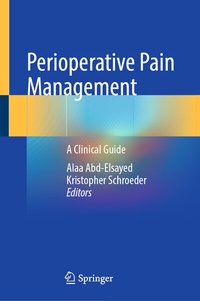
Perioperative Pain Management
Description

Perioperative Pain Management: A Clinical Guide provides a unique and comprehensive approach to pain management, offering effective treatment strategies tailored to various specialties. This collaborative effort includes insights from experts in anesthesiology, pain management, physical medicine, addiction medicine, pharmacy, and surgery, ensuring diverse and inclusive content for all healthcare professionals involved in perioperative pain management.
The book addresses special patient populations, highlighting specific challenges and strategies to meet their analgesic needs. Clinical providers seeking a blueprint for creating optimal perioperative pain management pathways will find this guide invaluable for planning and optimizing their clinical resources.
More details
Other editions
Additional editions
Persons
Alaa Abd-Elsayed is the Medical Director of UW Health Pain services. He has published more than 200 peer reviewed manuscripts, edited 29 books and serves as an editor on several journals. Dr. Abd-Elsayed has edited 4 books with Springer.
Dr. Abd-Elsayed completed his MBBCh and MPH at Assiut University, Assiut, Egypt in 2000 and 2006, respectively. He undertook an internship at Assiut University Hospitals, Assiut, Egypt and completed a Clinical research fellowship in Anesthesiology at Cleveland Clinic, Cleveland, Ohio, USA. He then moved to University of Cincinnati, Cincinnati, Ohio, USA for a further internship, residency in anesthesiology and fellowship in pain medicine. Since 2014 he has worked at UW, School of Medicine and Public Health, Madison, WI, USA, starting as Assistant Professor/Staff Anesthesiologist and now is Medical Director for the UW Pain Clinic and Director of Pain Services for UW Health.
Kristopher Schroeder has worked as an Academic Anesthesiologist at the University of Wisconsin since completion of a fellowship in regional anesthesia and acute pain medicine in 2007. At the University of Wisconsin, Dr. Schroeder worked to build a center of perioperative pain management excellence and formerly served as both division chief and fellowship director before being elevated to lead as a vice chair. During his tenure as leader of the regional anesthesia division, analgesic procedure numbers increased to over 10,000 and a vibrant consult service grew to address the needs of patients presenting with complex perioperative analgesic situations. On a national stage, Dr. Schroeder served the American Society of Regional Anesthesia and Pain Medicine (ASRA Pain Medicine) as the editor of the ASRA News and chair of the ASRA News committee. In this capacity, the ASRA News further established itself as a world-class source of medical information, effectively harnessed the perspectives of authors from around the world, and amplified its impact through increased access opportunities (i.e. podcasts and facebook live presentations). As an active member of the American Society of Anesthesiologists (ASA), Dr. Schroeder serves on multiple committees and provides multiple presentations each year at the annual meeting.
Content
Introduction.- Mechanisms of Pain and Transition from Acute to Chronic Pain.- Scope And Perspective of the Opioid Epidemic.- Patient/Surgical Risk Factors for Chronic Pain and Opioid Dependency.- General Principles of Perioperative Pain Management.- Setting Expectations: Role of Preoperative Clinics and Benefits Of Rehabilitation.- Enhanced Recovery Pathways and their Role in Pain Management.- Chronic Pain Procedures in Anticipation Of Surgery And Pain Status Optimization.- Opioid Taper Management and Rationale.- Analgesics.- Non-Pharmacologic Adjuncts.- Perioperative Management of Implanted Pump and Stimulators.- It Takes A Village: Pharmacy, Physical Therapy, Occupational Therapy, Psychology, Faith Services, Addiction Medicine and Palliative Care.- Regional Anesthesia Techniques.- Role of Inpatient Pain Services in Perioperative Pain Management.- Monitoring Considerations: Identifying High-Risk Respiratory, Depression and Relapse Patients.-Transition Clinics.- Special Patient Populations.- Consent Considerations.- Future Pathways.
