

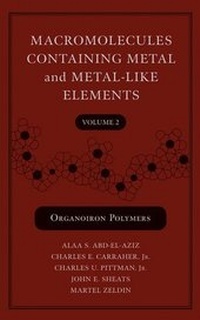
Macromolecules Containing Metal and Metal-Like Elements, Volume 2
Description

Reviews / Votes
"This book is an excellent summary of the field...isrecommended to gain insights in sophisticated polymer synthesis andcharacterization." (Journal of Metals Online, July 21, 2005) "...This text would be a useful addition to anylibrary with a readership in the field..." (PolymerInternational, Vol.54, No.1, January 2005) "...this volume will be a treasure trove for scientistsseeking new ideas and directions..." (Journal of theAmerican Chemical Society, July 21, 2004) "...will be of interest to many organometallicchemists...as well as to polymer and materialsscientists...." (Polymer News)More details
Other editions
Additional editions
Persons
Content
Series Preface.
1. Overview of Organoiron Polymers (Alaa S. Abd-El-Aziz).
I. Introduction.
II. Ferrocene-Based Polymers.
III. Polymers Containing Cyclopentadienyliron-Complexed Arenes.
IV. Polymers Containing Iron Carbonyl Complexes.
V. Iron Polyynes.
VI. Polymers with Iron-Iron Bonds.
VII. Outlook.
VIII. References.
2. Synthesis and Properties of Hyperbranched Polyferrocenylenesilynes (Qunhui Sun, Han Peng, Kaitian Xu, and Ben Zhong Tang).
I. Introduction.
II. Polymer Synthesis.
III. Structural Characterization.
IV. Electronic and Thermal Transitions.
V. Pyrolytic Ceramization.
VI. Ceramic Composition.
VII. Magnetic Susceptibility.
VIII. Summary and Perspectives.
IX. Experimentation.
A. Materials.
B. Instrumentation.
C. Polymerization.
D. Ceramization.
X. Acknowledgments.
XI. References and Notes.
3. Ring-Opened Polyferrocenes: Metal-Containing Polymers for Materials Science, Self-Assembly, and Nanostructure Applications (Paul Cyr, David Rider, and Ian Manners).
I. Introduction.
II. Properties of Polyferrocenylsilanes.
III. Water-Soluble PFS Derivatives for Layer-by-Layer Self-Assembly Applications.
IV. Metal-Containing Block Copolymers: Formation of Self-Assembled, Supramolecular Materials and Nanoscopic Ceramic Patterns.
V. Summary.
VI. Acknowledgments.
VII. References.
4. Synthesis and Solution Self-Assembly of Polyferrocene-Based AB Diblock and ABC Triblock Copolymers (Xiao-Song Wang, Mitchell A. Winnik, and Ian Manners).
I. Introduction.
II. Results and Discussion.
A. Synthesis and Aqueous Micellization of PFS-PDMAEMA,
B. Synthesis and Micellization of PFP-PFS-PDMS,
III. Summary and Outlook,
IV. References,
5. Synthesis and Self-Assembly of Polyisoprene-block-Polyferrocenyldimethylsilane Diblock Copolymers: Fabrication of Ceramic Nanolines on Semiconducting Substrates (Lan Cao, Mitchell A. Winnik, and Ian Manners).
I. Introduction.
II. Experimental.
III. Results and Discussion.
A. Block Copolymer Synthesis.
B. PI-b-PFDMS Micelles.
C. Fabrication of Ceramic Nanolines.
IV. Conclusions.
V. Acknowledgments.
VI. References.
6. Water-Soluble Polyferrocenylsilanes for Supramolecular Assemblies by Layer-by-Layer Deposition (Mark A. Hempenius, Mária Péter, Neil S. Robins, E. Stefan Kooij, Rob G. H. Lammertink, and G. Julius Vancso).
I. Introduction.
II. Synthesis of Polyferrocenylsilane Polyions.
III. Polymer Characterization.
IV. Multilayer Characterization.
V. Patterned Polyferrocenylsilane Multilayer Thin Films.
VI. Summary.
VII. Experimentation.
VIII. Acknowledgment.
IX. References.
7. Metal-Containing Polymers for High-Performance Resist Applications (Rob G. H. Lammertink, Igor Korczagin, Mark A. Hempenius, and G. Julius Vancso).
I. Introduction.
II. Organic Resists.
A. Chemical Amplification.
III. Inorganic Resists.
IV. Organic-Inorganic Composite Resists.
V. Organometallic Polymers.
A. Polyferrocenyldimethylsilane as Reactive Ion Etch Barrier.
B. Printing of Organometallic Polymers by Soft Lithography.
1. Directed Dewetting.
VI. Organic-Organometallic Block Copolymers.
A. Structure Formation via Block Copolymer Self-Assembly.
1. Synthesis of Organometallic-Organic Block Copolymers.
2. Periodic Nanodomain Structures.
3. Thin Films of Block Copolymers.
4. Self-Assembling Resists.
VII. Conclusions and Outlook.
VIII. Acknowledgment.
IX. References.
8. Proton-Coupled Intramolecular Electron Transfer in Ferrocene-Quinone Conjugated Oligomers and Polymers (Masaki Murata and Hiroshi Nishihara).
I. Introduction.
II. Ethynylene-Bridged Ferrocene-Anthraquinone (FcAq) Complexes.
A. Transition Metal Complexes Containing Allenylidene and Cumulenylidene.
B. 1-1-FcAq Complexes.
C. 2-1-FcAq Complexes.
D. A 1-2-FcAq Complex.
E. Polymeric 1-1-FcAq Complexes.
III. Vinylene-Bridged Ferrocene-Benzoquinone Complex.
IV. Concluding Remarks.
V. References.
9. Organization of Ferrocenoyl Amino Acids (Heinz-Bernhard Kraatz).
I. Introduction.
II. Synthesis of Ferrocenoyl Peptides.
III. Structure of Ferrocenoyl Peptides.
A. General Parameters.
B. Hydrogen Bonding and Ordering in the Solid State.
IV. Monolayers of Ferrocene Peptide Conjugates.
V. Summary.
VI. Acknowledgments.
VII. References.
10. Polyaromatic Ethers and Thioethers Coordinated to Cyclopentadienyliron Cations (Alaa S. Abd-El-Aziz and Erin K. Todd).
I. Introduction.
II. Linear Polyaromatic Ethers, Thioethers, and Amines.
A. Polyethers.
B. Polythioethers.
C. Copolymers with Ether-Thioether and Amine-Thioether Spacers.
III. Star-Shaped Polyaromatic Ethers.
IV. Polymers Containing Neutral and Cationic Cyclopentadienyliron Moieties in Their Structures.
V. Polymers Containing Azobenzene Chromophores in Their Sidechains.
VI. Conclusions.
VII. References.
11. Polymerization of Olefinic Monomers Functionalized with Cationic Cyclopentadienyliron Arene Complexes (Alaa S. Abd-El-Aziz, Erin K. Todd, and Rawda M. Okasha).
I. Introduction.
II. Methacrylates.
A. Radical Polymerization of the Methacrylate Groups.
B. Substitution Polymerization of Chloroarene Complexes.
C. Crosslinking.
III. Styrenes.
A. Radical Polymerization of the Styrene Groups.
B. Substitution Polymerization of Chloroarene Complexes.
C. Crosslinking.
IV. Norbornenes.
A. Ring-Opening Metathesis Polymerization of the Norbornene Groups.
B. Substitution Polymerization of Chloroarene Complexes.
C. Crosslinking.
V. Conclusions.
VI. References.
Index.
