

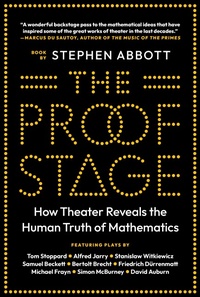
The Proof Stage
How Theater Reveals the Human Truth of Mathematics
1st Edition
Published on 12. July 2023
416 pages
978-0-691-24336-8 (ISBN)
Description

How playwrights from Alfred Jarry and Samuel Beckett to Tom Stoppard and Simon McBurney brought the power of mathematics to life on the stage
The discovery of alternate geometries, paradoxes of the infinite, incompleteness, and chaos theory revealed that, despite its reputation for certainty, mathematical truth is not immutable, perfect, or even perfectible. Beginning in the last century, a handful of adventurous playwrights took inspiration from the fractures of modern mathematics to expand their own artistic boundaries. Originating in the early avant-garde, mathematics-infused theater reached a popular apex in Tom Stoppard's 1993 play Arcadia. In The Proof Stage, mathematician Stephen Abbott explores this unlikely collaboration of theater and mathematics. He probes the impact of mathematics on such influential writers as Alfred Jarry, Samuel Beckett, Bertolt Brecht, and Stoppard, and delves into the life and mathematics of Alan Turing as they are rendered onstage. The result is an unexpected story about the mutually illuminating relationship between proofs and plays-from Euclid and Euripides to Gödel and Godot.
Theater is uniquely poised to discover the soulful, human truths embedded in the austere theorems of mathematics, but this is a difficult feat. It took Stoppard twenty-five years of experimenting with the creative possibilities of mathematics before he succeeded in making fractal geometry and chaos theory integral to Arcadia's emotional arc. In addition to charting Stoppard's journey, Abbott examines the post-Arcadia wave of ambitious works by Michael Frayn, David Auburn, Simon McBurney, Snoo Wilson, John Mighton, and others. Collectively, these gifted playwrights transform the great philosophical upheavals of mathematics into profound and sometimes poignant revelations about the human journey.
The discovery of alternate geometries, paradoxes of the infinite, incompleteness, and chaos theory revealed that, despite its reputation for certainty, mathematical truth is not immutable, perfect, or even perfectible. Beginning in the last century, a handful of adventurous playwrights took inspiration from the fractures of modern mathematics to expand their own artistic boundaries. Originating in the early avant-garde, mathematics-infused theater reached a popular apex in Tom Stoppard's 1993 play Arcadia. In The Proof Stage, mathematician Stephen Abbott explores this unlikely collaboration of theater and mathematics. He probes the impact of mathematics on such influential writers as Alfred Jarry, Samuel Beckett, Bertolt Brecht, and Stoppard, and delves into the life and mathematics of Alan Turing as they are rendered onstage. The result is an unexpected story about the mutually illuminating relationship between proofs and plays-from Euclid and Euripides to Gödel and Godot.
Theater is uniquely poised to discover the soulful, human truths embedded in the austere theorems of mathematics, but this is a difficult feat. It took Stoppard twenty-five years of experimenting with the creative possibilities of mathematics before he succeeded in making fractal geometry and chaos theory integral to Arcadia's emotional arc. In addition to charting Stoppard's journey, Abbott examines the post-Arcadia wave of ambitious works by Michael Frayn, David Auburn, Simon McBurney, Snoo Wilson, John Mighton, and others. Collectively, these gifted playwrights transform the great philosophical upheavals of mathematics into profound and sometimes poignant revelations about the human journey.
More details
Language
English
Place of publication
Princeton, NJ
United States
Publishing group
De Gruyter
Target group
Professional and scholarly
Edition type
Digital original
Product notice
Reflowable
Illustrations
15 color + 82 b/w illus.
File size
52,50 MB
ISBN-13
978-0-691-24336-8 (9780691243368)
Schweitzer Classification
Other editions
Additional editions
Book
approx. 10/2025
Princeton University Press
€22.50
Not yet published
Book
07/2023
Princeton University Press
€37.14
Shipment within 10-20 days
Person
Stephen Abbott is professor of mathematics at Middlebury College, where he has been teaching for thirty years. He is the author of the widely used textbook Understanding Analysis and theater events chair for the Bridges Organization, a professional association dedicated to exploring the intersection of mathematics and art.
Content
- Cover
- Contents
- Prologue
- 1. Stoppard: The Incline from Thinking to Feeling
- Albert's Bridge
- Rosencrantz and Guildenstern Are Dead
- Jumpers
- Hapgood
- Arcadia
- 2. Jarry and Witkiewicz: Geometry of a New Theater
- Euclid's Elements
- Ubu Roi and Ubu Cocu
- Tumor Brainiowicz
- Non-Euclidean Geometry
- Gyubal Wahazar
- The Water Hen
- 3. Beckett: The Language of Incompleteness
- Murphy and Watt
- Endgame
- Russell's Paradox
- Film and Not I
- Principia Mathematica
- Quad
- 4. Dürrenmatt, Frayn, and McBurney: The Shape of Content
- The Physicists
- Copenhagen
- A Disappearing Number
- 5. Stoppard: The Logic of Self-Conscious Theater
- Peano Arithmetic
- Color Plates
- The Real Inspector Hound and Other Plays
- Dogg's Hamlet and Gödel's Code
- The Real Thing
- The Hard Problem
- The Invention of Love
- 6. Whitemore, Wilson, and Mighton: The Dramatic Life of Alan Turing
- Breaking the Code
- The Universal Machine
- Breaking the Code, Continued
- Lovesong of the Electric Bear
- Half Life
- 7. Auburn: Beautiful Proofs
- Acknowledgments
- Notes
- Bibliography
- Index
