

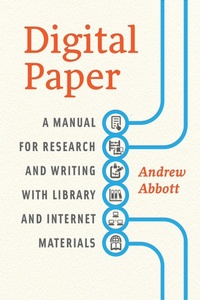
Digital Paper
A Manual for Research and Writing with Library and Internet Materials
1st Edition
Published on 22. December 2022
278 pages
978-0-226-16781-7 (ISBN)
Description

"Shows the reader how to harness new technology while upholding the highest standards of research. The result is a joy to read... a boon for students." -Robert J. Sampson, professor of the social sciences at Harvard University
Today's researchers have access to more information than ever before. Yet the new material is both overwhelming in quantity and variable in quality. How can scholars survive these twin problems and produce groundbreaking research using the physical and electronic resources available in the modern university research library? In Digital Paper, Andrew Abbott provides some much-needed answers to that question.
Abbott tells what every senior researcher knows: that research is not a mechanical, linear process, but a thoughtful and adventurous journey through a nonlinear world. He breaks library research down into seven basic and simultaneous tasks: design, search, scanning/browsing, reading, analyzing, filing, and writing. He moves the reader through the phases of research, from confusion to organization, from vague idea to polished result. He teaches how to evaluate data and prior research; how to follow a trail to elusive treasures; how to organize a project; when to start over; when to ask for help. He shows how an understanding of scholarly values, a commitment to hard work, and the flexibility to change direction combine to enable the researcher to turn a daunting mass of found material into an effective paper or thesis.
More than a mere how-to manual, Abbott's guidebook helps teach good habits for acquiring knowledge, the foundation of knowledge worth knowing. Those looking for ten easy steps to a perfect paper may want to look elsewhere. But serious scholars, who want their work to stand the test of time, will appreciate Abbott's unique, forthright approach and relish every page of Digital Paper.
Today's researchers have access to more information than ever before. Yet the new material is both overwhelming in quantity and variable in quality. How can scholars survive these twin problems and produce groundbreaking research using the physical and electronic resources available in the modern university research library? In Digital Paper, Andrew Abbott provides some much-needed answers to that question.
Abbott tells what every senior researcher knows: that research is not a mechanical, linear process, but a thoughtful and adventurous journey through a nonlinear world. He breaks library research down into seven basic and simultaneous tasks: design, search, scanning/browsing, reading, analyzing, filing, and writing. He moves the reader through the phases of research, from confusion to organization, from vague idea to polished result. He teaches how to evaluate data and prior research; how to follow a trail to elusive treasures; how to organize a project; when to start over; when to ask for help. He shows how an understanding of scholarly values, a commitment to hard work, and the flexibility to change direction combine to enable the researcher to turn a daunting mass of found material into an effective paper or thesis.
More than a mere how-to manual, Abbott's guidebook helps teach good habits for acquiring knowledge, the foundation of knowledge worth knowing. Those looking for ten easy steps to a perfect paper may want to look elsewhere. But serious scholars, who want their work to stand the test of time, will appreciate Abbott's unique, forthright approach and relish every page of Digital Paper.
More details
Other editions
Additional editions
Book
08/2014
University of Chicago Press
€99.04
Shipment within 10-20 days
Person
Andrew Abbott is the Gustavus F. and Ann M. Swift Distinguished Service Professor at the University of Chicago. He edits the
American Journal of Sociology and his books include
The System of Professions,
Department and Discipline,
Chaos of Disciplines, and
Time Matters, all published by the University of Chicago Press.
Content
- Intro
- Contents
- To the Reader
- One: Introduction
- Two: A Library Ethnography
- Three: Fundamentals
- Four: The Preliminary Phase
- Five: Midphase Bibliography
- Six: Midphase Scanning, Browsing, and Brute Force
- Seven: Reading
- Eight: Midphase Files and Organization
- Nine: Midphase Analysis
- Ten: Midphase Writing
- Eleven: Midphase Design
- Twelve: Endphase
- Glossary
- Index
