

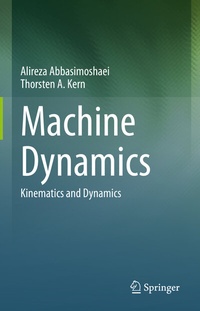
Machine Dynamics
Description

In this book, we aim to give a thorough introduction to machine dynamics. It covers the theoretical basis of dynamics, modelling, mechanical design, practical applications, kinematics and kinetics, principles of mechanics, equations of motion for multibody systems, applications to mechanisms, vehicle dynamics, and static and dynamic balancing. It covers a complete range of mechanisms and concepts, from the determination of degrees of freedom to the design of complex cams. This progression is explained at a reasonable pace so that by the end the reader is able to design and analyze mechanical systems. Throughout the book, we also try to introduce conceptual examples and exercises to make the text more practical and understandable for the reader and also useful as a reference for lectures in universities. In addition, most books in this field are too voluminous and therefore are not suitable as a reference for a lecture. In this book, we have reduced the unnecessary theory part and put more emphasis on practical examples. Moreover, it is written in such a way that it will guide the readers even if they have forgotten the dynamics and basic concept and provide enough information. So this book can be used as a self-study book.
More details
Other editions
Additional editions
Persons
Alireza Abbasimoshaei is currently a postdoc researcher at the Institute for Mechatronics in Mechanics at the Hamburg University of Technology in Germany. Before joining iMEK, he designed and built four robots and controlled them. The last one was at the Technical University of Braunschweig in Germany. He filed two patents for rehabilitation devices and sold a finger rehabilitation robot to a hospital partner. He also developed a new control system for rehabilitation robots in the field of control. He was one of the Editors of the 3rd edition of "Engineering Haptic Devices." He is an expert in mechatronic system design with special emphasis on mechanical, control, and haptic system design.
Thorsten A. Kern received his Dipl.-Ing. and Dr.-Ing. degrees from Darmstadt University of Technology (TUDA), Germany, in the fields of actuator and sensor development for medical human-machine-interfaces (HMIs) in applications like minimally invasive surgery and catheterizations. He is currently the director at Hamburg University of Technology, Germany, of the Institute for Mechatronics in Mechanics. He previously worked in Automotive Industry at Continental as an R&D manager for interior components, leading a team of 300 engineers worldwide. He joined Continental in 2008 covering various functions with the increasing range of responsibility in actuator development, motor-development, and active haptic device development before shifting toward R&D management and product management on Head-Up-Displays. Between 2006 and 2008, he was working in parallel in a startup focusing on medical interventions and was the main editor of the 1st edition of "Engineering Haptic Devices." He joined Hamburg University in January 2019. His interests are specifically focused on all types of electromagnetic sensors and actuators and their system-integration toward larger motor- or sensor-systems in high-dynamic applications.
Content
Chapter 1. Motivation and Introduction to Machine Dynamics.- Chapter 2. Displacement and Velocity Analysis.- Chapter 3. Acceleration Analysis.- Chapter 4. Force Analysis of Mechanisms.- Chapter 5. Cams.- Chapter 6. Gear Trains.- Chapter 7. Balancing.
