

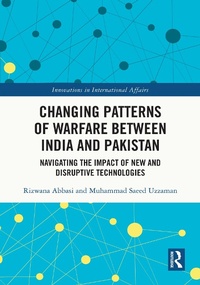
Changing Patterns of Warfare between India and Pakistan
Navigating the Impact of New and Disruptive Technologies
1st Edition
Published on 12. May 2023
192 pages
978-1-000-88226-1 (ISBN)
Description

Changing Patterns of Warfare between India and Pakistan analyzes how advanced nuclear technologies and the advent of disruptive technologies have affected the evolving conflict between India and Pakistan.
Advanced nuclear technologies such as nuclear submarines, aircraft carriers, ballistic missile defence systems (BMDs), multiple independently targetable re-entry vehicles (MIRVs), anti-satellite weapons (ASAT); and disruptive technologies such as hypersonic weapons, artificial intelligence (AI), lethal autonomous weapons (LAWs), unmanned aerial vehicles (UAVs) / drones and space-based and cyber technologies have all complicated crisis dynamics and the domain of warfare in the region. Further, the employment of India's compellence strategy is an indication of a change in its stance that demonstrates smart/surgical strikes are now more likely. The phenomenon of surgical strikes raises the question of how disruptive technologies will be used to gain direct/indirect military control and hence challenge the existing status quo and deterrence stability. Against this backdrop, the authors predict how this conflict may develop in the future and evaluate the ways to stabilize deterrence and regulate the militarization of artificial intelligence and disruptive technologies between India and Pakistan.
This book will be of interest to all those researching and working in the fields of security studies, strategic studies, nuclear policy, deterrence thinking and proliferation/non-proliferation aspects of the nuclear weapons programme within South Asia and beyond. It will also be relevant for the academic community, policy-makers, diplomats, members of international non-governmental organizations (INGOs), professional research institutes and organizations working on India-Pakistan relations.
Advanced nuclear technologies such as nuclear submarines, aircraft carriers, ballistic missile defence systems (BMDs), multiple independently targetable re-entry vehicles (MIRVs), anti-satellite weapons (ASAT); and disruptive technologies such as hypersonic weapons, artificial intelligence (AI), lethal autonomous weapons (LAWs), unmanned aerial vehicles (UAVs) / drones and space-based and cyber technologies have all complicated crisis dynamics and the domain of warfare in the region. Further, the employment of India's compellence strategy is an indication of a change in its stance that demonstrates smart/surgical strikes are now more likely. The phenomenon of surgical strikes raises the question of how disruptive technologies will be used to gain direct/indirect military control and hence challenge the existing status quo and deterrence stability. Against this backdrop, the authors predict how this conflict may develop in the future and evaluate the ways to stabilize deterrence and regulate the militarization of artificial intelligence and disruptive technologies between India and Pakistan.
This book will be of interest to all those researching and working in the fields of security studies, strategic studies, nuclear policy, deterrence thinking and proliferation/non-proliferation aspects of the nuclear weapons programme within South Asia and beyond. It will also be relevant for the academic community, policy-makers, diplomats, members of international non-governmental organizations (INGOs), professional research institutes and organizations working on India-Pakistan relations.
More details
Series
Edition
1. Auflage
Language
English
Place of publication
London
United Kingdom
Publishing group
Taylor & Francis Ltd
Target group
College/higher education
Illustrations
3 Tables, black and white
ISBN-13
978-1-000-88226-1 (9781000882261)
Copyright in bibliographic data and cover images is held by Nielsen Book Services Limited or by the publishers or by their respective licensors: all rights reserved.
Schweitzer Classification
Other editions
Additional editions
Rizwana Abbasi | Muhammad Saeed Uzzaman
Changing Patterns of Warfare between India and Pakistan
Navigating the Impact of New and Disruptive Technologies
Book
10/2024
1st Edition
Routledge
€62.90
Shipment within 10-20 days
Rizwana Abbasi | Muhammad Saeed Uzzaman
Changing Patterns of Warfare between India and Pakistan
Navigating the Impact of New and Disruptive Technologies
Book
05/2023
1st Edition
Routledge
€195.90
Shipment within 10-20 days
Persons
Rizwana Abbasi is an associate professor of Security Studies at the National University of Modern Languages (NUML), Islamabad, Pakistan. Previous publications include Building a Road to Nuclear Disarmament: Bridging the Gap Between Competing Approaches (2021), Nuclear Deterrence in South Asia: New Technologies and Challenges to Sustainable Peace (with Zafar Khan, 2020), and Pakistan and the New Nuclear Taboo: Regional Deterrence and the International Arms Control Regime (2012).
Muhammad Saeed Uzzaman is a lecturer and PhD scholar at NUML, Rawalpindi, Pakistan. His work has been published in many refereed research journals. He also works as a consultant and has conducted numerous projects in collaboration with various civil society organizations.
Muhammad Saeed Uzzaman is a lecturer and PhD scholar at NUML, Rawalpindi, Pakistan. His work has been published in many refereed research journals. He also works as a consultant and has conducted numerous projects in collaboration with various civil society organizations.
Content
Introduction 1. Nuclear Technologies, Doctrines and Conflict Dynamics (1998-2016) 2. Nuclear Force Modernization and Weapon Asymmetry (1998-2016) 3. Surgical Strike Stratagem: Conflict Dynamics and the Manifestation of Offensive Doctrines (2016-2020) 4. Counterforce Strategies and New Warfare Domain 5. Disruptive Technologies and Erosion of Nuclear Deterrence 6. New Mechanisms for Crisis and Deterrence Stability Conclusion
