

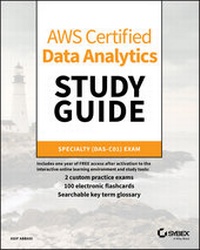
AWS Certified Data Analytics Study Guide
Specialty (DAS-C01) Exam
1st Edition
Published on 20. November 2020
416 pages
978-1-119-64944-1 (ISBN)
Description

Move your career forward with AWS certification! Prepare for the AWS Certified Data Analytics Specialty Exam with this thorough study guide
This comprehensive study guide will help assess your technical skills and prepare for the updated AWS Certified Data Analytics exam. Earning this AWS certification will confirm your expertise in designing and implementing AWS services to derive value from data. The AWS Certified Data Analytics Study Guide: Specialty (DAS-C01) Exam is designed for business analysts and IT professionals who perform complex Big Data analyses.
This AWS Specialty Exam guide gets you ready for certification testing with expert content, real-world knowledge, key exam concepts, and topic reviews. Gain confidence by studying the subject areas and working through the practice questions. Big data concepts covered in the guide include:
* Collection
* Storage
* Processing
* Analysis
* Visualization
* Data security
AWS certifications allow professionals to demonstrate skills related to leading Amazon Web Services technology. The AWS Certified Data Analytics Specialty (DAS-C01) Exam specifically evaluates your ability to design and maintain Big Data, leverage tools to automate data analysis, and implement AWS Big Data services according to architectural best practices. An exam study guide can help you feel more prepared about taking an AWS certification test and advancing your professional career. In addition to the guide's content, you'll have access to an online learning environment and test bank that offers practice exams, a glossary, and electronic flashcards.
This comprehensive study guide will help assess your technical skills and prepare for the updated AWS Certified Data Analytics exam. Earning this AWS certification will confirm your expertise in designing and implementing AWS services to derive value from data. The AWS Certified Data Analytics Study Guide: Specialty (DAS-C01) Exam is designed for business analysts and IT professionals who perform complex Big Data analyses.
This AWS Specialty Exam guide gets you ready for certification testing with expert content, real-world knowledge, key exam concepts, and topic reviews. Gain confidence by studying the subject areas and working through the practice questions. Big data concepts covered in the guide include:
* Collection
* Storage
* Processing
* Analysis
* Visualization
* Data security
AWS certifications allow professionals to demonstrate skills related to leading Amazon Web Services technology. The AWS Certified Data Analytics Specialty (DAS-C01) Exam specifically evaluates your ability to design and maintain Big Data, leverage tools to automate data analysis, and implement AWS Big Data services according to architectural best practices. An exam study guide can help you feel more prepared about taking an AWS certification test and advancing your professional career. In addition to the guide's content, you'll have access to an online learning environment and test bank that offers practice exams, a glossary, and electronic flashcards.
More details
Other editions
Additional editions
Asif Abbasi
Aws Certified Data Analytics Study Guide: Specialty (Das-C01) Exam
Specialty (DAS-C01) Exam
Book
10/2020
Sybex Inc.,U.S.
€56.00
Shipment within 15-20 days
Person
ASIF ABBASI has over 20 years of experience working in various Data & Analytics engineering, consulting and advisory roles with some of the largest customers across the globe to help them in their quest to become more data driven. Asif is the author of Learning Apache Spark 2.0 and is an AWS Certified Data Analytics & Machine Learning Specialist, AWS Certified Solutions Architect (Professional), Hortonworks Certified Hadoop Professional and Administrator, Certified Spark Developer, SAS Certified Predictive Modeler, and Sun Certified Enterprise Architect. Asif is also a Project Management Professional.
Content
- Cover
- Title Page
- Copyright Page
- Acknowledgments
- About the Author
- About the Technical Editor
- Contents at a Glance
- Contents
- Introduction
- What Does This Book Cover?
- Preparing for the Exam
- Registering for the Exam
- Studying for the Exam
- The Night before the Exam
- During the Exam
- Interactive Online Learning Environment and Test Bank
- Exam Objectives
- Assessment Test
- Chapter 1 History of Analytics and Big Data
- Evolution of Analytics Architecture Over the Years
- The New World Order
- Analytics Pipeline
- Data Sources
- Collection
- Storage
- Processing and Analysis
- Visualization, Predictive and Prescriptive Analytics
- The Big Data Reference Architecture
- Data Characteristics: Hot, Warm, and Cold
- Collection/Ingest
- Storage
- Process/Analyze
- Consumption
- Data Lakes and Their Relevance in Analytics
- What Is a Data Lake?
- Building a Data Lake on AWS
- Step 1: Choosing the Right Storage - Amazon S3 Is the Base
- Step 2: Data Ingestion - Moving the Data into the Data Lake
- Step 3: Cleanse, Prep, and Catalog the Data
- Step 4: Secure the Data and Metadata
- Step 5: Make Data Available for Analytics
- Using Lake Formation to Build a Data Lake on AWS
- Exam Objectives
- Objective Map
- Assessment Test
- References
- Chapter 2 Data Collection
- Exam Objectives
- AWS IoT
- Common Use Cases for AWS IoT
- How AWS IoT Works
- Amazon Kinesis
- Amazon Kinesis Introduction
- Amazon Kinesis Data Streams
- Amazon Kinesis Data Analytics
- Amazon Kinesis Video Streams
- AWS Glue
- Glue Data Catalog
- Glue Crawlers
- Authoring ETL Jobs
- Executing ETL Jobs
- Change Data Capture with Glue Bookmarks
- Use Cases for AWS Glue
- Amazon SQS
- Amazon Data Migration Service
- What Is AWS DMS Anyway?
- What Does AWS DMS Support?
- AWS Data Pipeline
- Pipeline Definition
- Pipeline Schedules
- Task Runner
- Large-Scale Data Transfer Solutions
- AWS Snowcone
- AWS Snowball
- AWS Snowmobile
- AWS Direct Connect
- Summary
- Review Questions
- References
- Exercises & Workshops
- Chapter 3 Data Storage
- Introduction
- Amazon S3
- Amazon S3 Data Consistency Model
- Data Lake and S3
- Data Replication in Amazon S3
- Server Access Logging in Amazon S3
- Partitioning, Compression, and File Formats on S3
- Amazon S3 Glacier
- Vault
- Archive
- Amazon DynamoDB
- Amazon DynamoDB Data Types
- Amazon DynamoDB Core Concepts
- Read/Write Capacity Mode in DynamoDB
- DynamoDB Auto Scaling and Reserved Capacity
- Read Consistency and Global Tables
- Amazon DynamoDB: Indexing and Partitioning
- Amazon DynamoDB Accelerator
- Amazon DynamoDB Streams
- Amazon DynamoDB Streams - Kinesis Adapter
- Amazon DocumentDB
- Why a Document Database?
- Amazon DocumentDB Overview
- Amazon Document DB Architecture
- Amazon DocumentDB Interfaces
- Graph Databases and Amazon Neptune
- Amazon Neptune Overview
- Amazon Neptune Use Cases
- Storage Gateway
- Hybrid Storage Requirements
- AWS Storage Gateway
- Amazon EFS
- Amazon EFS Use Cases
- Interacting with Amazon EFS
- Amazon EFS Security Model
- Backing Up Amazon EFS
- Amazon FSx for Lustre
- Key Benefits of Amazon FSx for Lustre
- Use Cases for Lustre
- AWS Transfer for SFTP
- Summary
- Exercises
- Review Questions
- Further Reading
- References
- Chapter 4 Data Processing and Analysis
- Introduction
- Types of Analytical Workloads
- Amazon Athena
- Apache Presto
- Apache Hive
- Amazon Athena Use Cases and Workloads
- Amazon Athena DDL, DML, and DCL
- Amazon Athena Workgroups
- Amazon Athena Federated Query
- Amazon Athena Custom UDFs
- Using Machine Learning with Amazon Athena
- Amazon EMR
- Apache Hadoop Overview
- Amazon EMR Overview
- Apache Hadoop on Amazon EMR
- EMRFS
- Bootstrap Actions and Custom AMI
- Security on EMR
- EMR Notebooks
- Apache Hive and Apache Pig on Amazon EMR
- Apache Spark on Amazon EMR
- Apache HBase on Amazon EMR
- Apache Flink, Apache Mahout, and Apache MXNet
- Choosing the Right Analytics Tool
- Amazon Elasticsearch Service
- When to Use Elasticsearch
- Elasticsearch Core Concepts (the ELK Stack)
- Amazon Elasticsearch Service
- Amazon Redshift
- What Is Data Warehousing?
- What Is Redshift?
- Redshift Architecture
- Redshift AQUA
- Redshift Scalability
- Data Modeling in Redshift
- Data Loading and Unloading
- Query Optimization in Redshift
- Security in Redshift
- Kinesis Data Analytics
- How Does It Work?
- What Is Kinesis Data Analytics for Java?
- Comparing Batch Processing Services
- Comparing Orchestration Options on AWS
- AWS Step Functions
- Comparing Different ETL Orchestration Options
- Summary
- Exam Essentials
- Exercises
- References
- Recommended Workshops
- Amazon Athena Blogs
- Amazon Redshift Blogs
- Amazon EMR Blogs
- Amazon Elasticsearch Blog
- Amazon Redshift References and Further Reading
- Chapter 5 Data Visualization
- Introduction
- Data Consumers
- Data Visualization Options
- Amazon QuickSight
- Getting Started
- Working with Data
- Data Preparation
- Data Analysis
- Data Visualization
- Machine Learning Insights
- Building Dashboards
- Embedding QuickSight Objects into Other Applications
- Administration
- Security
- Other Visualization Options
- Predictive Analytics
- What Is Predictive Analytics?
- The AWS ML Stack
- Summary
- Exam Essentials
- Exercises
- Review Questions
- References
- Additional Reading Material
- Chapter 6 Data Security
- Introduction
- Shared Responsibility Model
- Security Services on AWS
- AWS IAM Overview
- IAM User
- IAM Groups
- IAM Roles
- Amazon EMR Security
- Public Subnet
- Private Subnet
- Security Configurations
- Block Public Access
- VPC Subnets
- Security Options during Cluster Creation
- EMR Security Summary
- Amazon S3 Security
- Managing Access to Data in Amazon S3
- Data Protection in Amazon S3
- Logging and Monitoring with Amazon S3
- Best Practices for Security on Amazon S3
- Amazon Athena Security
- Managing Access to Amazon Athena
- Data Protection in Amazon Athena
- Data Encryption in Amazon Athena
- Amazon Athena and AWS Lake Formation
- Amazon Redshift Security
- Levels of Security within Amazon Redshift
- Data Protection in Amazon Redshift
- Redshift Auditing
- Redshift Logging
- Amazon Elasticsearch Security
- Elasticsearch Network Configuration
- VPC Access
- Accessing Amazon Elasticsearch and Kibana
- Data Protection in Amazon Elasticsearch
- Amazon Kinesis Security
- Managing Access to Amazon Kinesis
- Data Protection in Amazon Kinesis
- Amazon Kinesis Best Practices
- Amazon QuickSight Security
- Managing Data Access with Amazon QuickSight
- Data Protection
- Logging and Monitoring
- Security Best Practices
- Amazon DynamoDB Security
- Access Management in DynamoDB
- IAM Policy with Fine-Grained Access Control
- Identity Federation
- How to Access Amazon DynamoDB
- Data Protection with DynamoDB
- Monitoring and Logging with DynamoDB
- Summary
- Exam Essentials
- Exercises/Workshops
- Review Questions
- References and Further Reading
- Answers to Review Questions
- Chapter 1: History of Analytics and Big Data
- Chapter 2: Data Collection
- Chapter 3: Data Storage
- Chapter 4: Data Processing and Analysis
- Chapter 5: Data Visualization
- Chapter 6: Data Security
- Index
- Online Test Bank
- EULA
