

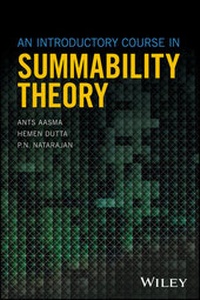
An Introductory Course in Summability Theory
Description

Reviews / Votes
\An Introductory Course in Summability Theory is the ideal rst text in summability theory for graduate students, especially those having a good grasp of real and complex analysis. It is also a valuable reference for mathematics researchers and for physicists and engineers who work with Fourier series, Fourier transforms, or analytic continuation." Mathematical Reviews, Sept 2017More details
Other editions
Additional editions
Persons
Content
Chapter 1
Introduction and General Matrix Methods
1.1 Brief Introduction
The study of the convergence of infinite series is an ancient art. In ancient times, people were more concerned with orthodox examinations of convergence of infinite series. Series that did not converge were of no interest to them until the advent of L. Euler (1707-1783), who took up a serious study of "divergent series"; that is, series that did not converge. Euler was followed by a galaxy of great mathematicians, such as C.F. Gauss (1777-1855), A.L. Cauchy (1789-1857), and N.H. Abel (1802-1829). The interest in the study of divergent series temporarily declined in the second half of the nineteenth century. It was rekindled at a later date by E. Cesàro, who introduced the idea of convergence in 1890. Since then, many other mathematicians have been contributing to the study of divergent series. Divergent series have been the motivating factor for the introduction of summability theory.
Summability theory has many uses in analysis and applied mathematics. An engineer or physicist who works with Fourier series, Fourier transforms, or analytic continuation can find summability theory very useful for his/her research.
Throughout this chapter, we assume that all indices and summation indices run from 0 to , unless otherwise specified. We denote sequences by {xk} or (xk), depending on convenience.
Consider the sequence
which is known to diverge. However, let
proving that
In this case, we say that the sequence converges to in the sense of Cesàro or is summable to . Similarly, consider the infinite series
The associated sequence of partial sums is , which is -summable to . In this case, we say that the series is -summable to .
With this brief introduction, we recall the following concepts and results.
1.2 General Matrix Methods
Definition 1.1
Given an infinite matrix , and a sequence , by the -transform of , we mean the sequence
where we suppose that the series on the right converges. If , we say that the sequence is summable or -summable to . If whenever , then is said to be preserving convergence for convergent sequences, or sequence-to-sequence conservative (for brevity, Sq-Sq conservative). If is sequence-to-sequence conservative with , we say that is sequence-to-sequence regular (shortly, Sq-Sq regular). If , whenever, , then is said to preserve the convergence of series, or series-to-sequence conservative (i.e., Sr-Sq conservative). If is series-to-sequence conservative with , we say that is series-to-sequence regular (shortly, Sr-Sq regular).
In this chapter and in Chapters 2 and 3, for conservative and regular, we mean only Sq-Sq conservativity and Sq-Sq regularity.
If are sequence spaces, we write
if is defined and , whenever, . With this notation, if is conservative, we can write , where denotes the set of all convergent sequences. If is regular, we write
denoting the "preservation of limit."
Definition 1.2
A method is said to be lower triangular (or simply, triangular) if for , and normal if is lower triangular if for every .
Example 1.1
Let be the Zweier method; that is, , defined by the lower triangular method where (see [2], p. 14) and
for . The method is regular. The transformation for can be presented as
Then,
for every that is, .
We now prove a landmark theorem in summability theory due to Silverman-Toeplitz, which characterizes a regular matrix in terms of the entries of the matrix (see [3-5]).
Theorem 1.1 (Silverman-Toeplitz)
is regular, that is, , if and only if
1.1 1.2and
1.3with and .
Proof
Sufficiency. Assume that conditions (1.1)-(1.3) with and hold. Let with . Since converges, it is bounded; that is, , , or, equivalently, , for all .
Now
in view of (1.1), and so
is defined. Now
1.4Since , given an , there exists an , where denotes the set of all positive integers, such that
1.5where is such that
1.6and hence
Using (1.5) and (1.6), we obtain
By (1.2), there exists a positive integer such that
This implies that
Consequently, for every , we have
Thus,
1.7Taking the limit as in (1.4), we have, by (1.7), that
since . Hence, is regular, completing the proof of the sufficiency part.
Necessity. Let be regular. For every fixed , consider the sequence , where
For this sequence , . Since and is regular, it follows that . Again consider the sequence , where for all . Note that . For this sequence , . Since and is regular, we have . It remains to prove (1.1). First, we prove that converges. Suppose not. Then, there exists an such that
In fact, diverges to . So we can find a strictly increasing sequence of positive integers such that
1.8Define the sequence by
Note that and converges. In particular, converges. However,
This leads to a contradiction since diverges. Thus,
To prove that (1.1) holds, we assume that
and arrive at a contradiction.
We construct two strictly increasing sequences and of positive integers in the following manner.
Let . Since , choose such that
Having chosen the positive integers and , , , choose positive integers and such that
1.9 1.10and
1.11Now define the sequence , where
Note that . Since is regular, . However, using (1.9)-(1.11), we have
Thus, diverges, which contradicts the fact that converges. Consequently, (1.1) holds. This completes the proof of the theorem.
Example 1.2
Let be the Cesàro method ; that is, . This method is defined by the lower triangular matrix , where for all . It is easy to see that all of the conditions of Theorem 1 are satisfied. Hence, .
Example 1.3
Let be the method defined by the lower triangular matrix , where and
for . It is easy to see that, in this case, , and condition (1.1) holds. Therefore, does not belong to . However, and , where denotes the set of all sequences converging to 0 (see Exercises 1.1 and 1.4).
Let (or ) denote the set of all bounded sequences. For , define
1.12Then, it is easy to see that is a Banach space and is a closed subspace of with respect to the norm defined by (1.12).
Definition 1.3
The matrix is called a Schur matrix if ; that is, , whenever, .
The following result gives a characterization of a Schur matrix in terms of the entries of the matrix (see [3-5]).
Theorem 1.2 (Schur)
is a Schur matrix if and only if (1.2) holds and
1.13Proof
Sufficiency. Assume that (1.2) and (1.13) hold. Then, (1.13) implies that the series converge, n belongs to N. By (1.2) and (1.13), we obtain that
Thus, for each , we have
Hence,
and so
Thus, if , it follows that converges absolutely and uniformly in . Consequently,
proving that ; that is, , proving the sufficiency part.
Necessity. Let . Then, and so (1.2) holds. Again, since , we get that (1.1) holds; that is,
As in the sufficiency part of the present theorem, it follows that . We write
Then, converges for all . We now claim that
1.14Suppose not. Then,
So,
through some subsequence of positive integers. We also note that
We can now find a positive integer such that
and
Since , we can choose such that
It now follows that
Now choose a positive integer such that
and
Then, choose a positive integer such that
It now follows that
Continuing this way, we find and so that
1.15 1.16and
1.17We now define a sequence as follows: and
if , . Note that and . Now
using (1.15) (1.16) and (1.17).
Consequently, is not a Cauchy sequence and so it is not convergent, which is a contradiction. Thus, (1.14) holds. So, given , there exists a positive integer such that
1.18Since for , we can find a positive integer such that
1.19In view of (1.18) and (1.19), we have
that is, converges uniformly in . Since , it follows that converges uniformly in , proving the necessity part. The proof of the theorem is now complete.
Example 1.4
Let be defined by the lower triangular matrix
1.20...