

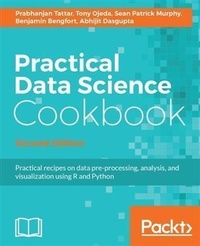
Practical Data Science Cookbook, Second Edition
Data pre-processing, analysis and visualization using R and Python
2nd Edition
Published on 8. July 2025
434 pages
978-1-78712-326-7 (ISBN)
Description

Over 85 recipes to help you complete real-world data science projects in R and Python
Key Features
[*] Tackle every step in the data science pipeline and use it to acquire, clean, analyze, and visualize your data
[*] Get beyond the theory and implement real-world projects in data science using R and Python
[*] Easy-to-follow recipes will help you understand and implement the numerical computing concepts
Book DescriptionAs increasing amounts of data are generated each year, the need to analyze and create value out of it is more important than ever. Companies that know what to do with their data and how to do it well will have a competitive advantage over companies that don't. Because of this, there will be an increasing demand for people that possess both the analytical and technical abilities to extract valuable insights from data and create valuable solutions that put those insights to use. Starting with the basics, this book covers how to set up your numerical programming environment, introduces you to the data science pipeline, and guides you through several data projects in a step-by-step format. By sequentially working through the steps in each chapter, you will quickly familiarize yourself with the process and learn how to apply it to a variety of situations with examples using the two most popular programming languages for data analysis-R and Python. What you will learn
[*] Learn and understand the installation procedure and environment required for R and Python on various platforms
[*] Prepare data for analysis by implement various data science concepts such as acquisition, cleaning and munging through R and Python
[*] Build a predictive model and an exploratory model
[*] Analyze the results of your model and create reports on the acquired data
[*] Build various tree-based methods and Build random forest
Who this book is forIf you are an aspiring data scientist who wants to learn data science and numerical programming concepts through hands-on, real-world project examples, this is the book for you. Whether you are brand new to data science or you are a seasoned expert, you will benefit from learning about the structure of real-world data science projects and the programming examples in R and Python.
Key Features
[*] Tackle every step in the data science pipeline and use it to acquire, clean, analyze, and visualize your data
[*] Get beyond the theory and implement real-world projects in data science using R and Python
[*] Easy-to-follow recipes will help you understand and implement the numerical computing concepts
Book DescriptionAs increasing amounts of data are generated each year, the need to analyze and create value out of it is more important than ever. Companies that know what to do with their data and how to do it well will have a competitive advantage over companies that don't. Because of this, there will be an increasing demand for people that possess both the analytical and technical abilities to extract valuable insights from data and create valuable solutions that put those insights to use. Starting with the basics, this book covers how to set up your numerical programming environment, introduces you to the data science pipeline, and guides you through several data projects in a step-by-step format. By sequentially working through the steps in each chapter, you will quickly familiarize yourself with the process and learn how to apply it to a variety of situations with examples using the two most popular programming languages for data analysis-R and Python. What you will learn
[*] Learn and understand the installation procedure and environment required for R and Python on various platforms
[*] Prepare data for analysis by implement various data science concepts such as acquisition, cleaning and munging through R and Python
[*] Build a predictive model and an exploratory model
[*] Analyze the results of your model and create reports on the acquired data
[*] Build various tree-based methods and Build random forest
Who this book is forIf you are an aspiring data scientist who wants to learn data science and numerical programming concepts through hands-on, real-world project examples, this is the book for you. Whether you are brand new to data science or you are a seasoned expert, you will benefit from learning about the structure of real-world data science projects and the programming examples in R and Python.
More details
Edition
2nd Revised edition
Language
English
Place of publication
Birmingham
United Kingdom
Target group
Professional and scholarly
US School Grade: College Graduate Student
Edition type
Revised edition
File size
13,09 MB
ISBN-13
978-1-78712-326-7 (9781787123267)
Copyright in bibliographic data and cover images is held by Nielsen Book Services Limited or by the publishers or by their respective licensors: all rights reserved.
Schweitzer Classification
Other editions
Additional editions
Prabhanjan Tattar | Tony Ojeda | Sean Patrick Murphy
Practical Data Science Cookbook, Second Edition
Book
06/2017
Packt Publishing
€57.20
Shipment within 3-4 weeks
Persons
Tattar Prabhanjan Narayanachar :
Prabhanjan Narayanachar Tattar is a lead statistician and manager at the Global Data Insights & Analytics division of Ford Motor Company, Chennai. He received the IBS(IR)-GK Shukla Young Biometrician Award (2005) and Dr. U.S. Nair Award for Young Statistician (2007). He held SRF of CSIR-UGC during his PhD. He has authored books such as Statistical Application Development with R and Python, 2nd Edition, Packt; Practical Data Science Cookbook, 2nd Edition, Packt; and A Course in Statistics with R, Wiley. He has created many R packages.Purushottam Joshi Bhushan :
Bhushan Purushottam Joshi is a teacher of computer science and has around 11 years of experience in teaching. He started his career as a programmer in a software firm but found true joy in teaching. He is a teacher by choice and not by chance. He teaches computer science courses such as MCA, MSc IT, BSc IT, and BSc CS at various colleges in Mumbai. He is a master at presenting technical as well as conceptual subjects in the most simplified manner. He has exemplary skills in relating daily life examples to technical concepts, which facilitates understanding of the subject matter. He enjoys teaching technical as well as conceptual subjects such as web design, Java, C#, C++, operating systems, computer networks, data structures, and ethical hacking. He is quite popular and appreciated among his students for his able guidance in their project workMurphy Sean P :
Sean Patrick Murphy spent 15 years as a senior scientist at The Johns Hopkins University, Applied Physics Laboratory, where he focused on machine learning, modeling and simulation, signal processing, and high performance computing in the Cloud. Now, he acts as an advisor and data consultant for companies in San Francisco, New York, and Washington DC. He completed graduation from The Johns Hopkins University and got his MBA from the University of Oxford. He currently co-organizes the Data Innovation DC meetup and co-founded the Data Science MD meetup. He is also a board member and cofounder of Data Community DC.DASGUPTA ABHIJIT :
Abhijit Dasgupta is a data consultant working in the greater DC-Maryland-Virginia area, with several years of experience in biomedical consulting, business analytics, bioinformatics, and bioengineering consulting. He has a PhD in biostatistics from the University of Washington and over 40 collaborative peer-reviewed manuscripts, with strong interests in bridging the statistics/machine-learning divide. He is always on the lookout for interesting and challenging projects, and is an enthusiastic speaker and discussant on new and better ways to look at and analyze data. He is a member of Data Community DC and a founding member and co-organizer of Statistical Programming DC (formerly R Users DC)
Ojeda Anthony :
Tony Ojeda is an accomplished data scientist and entrepreneur, with expertise in business process optimization and over a decade of experience creating and implementing innovative data products and solutions. He has a master's degree in finance from Florida International University and an MBA with a focus on strategy and entrepreneurship from DePaul University. He is the founder of District Data Labs, is a cofounder of Data Community DC, and is actively involved in promoting data science education through both organizations.
Prabhanjan Narayanachar Tattar is a lead statistician and manager at the Global Data Insights & Analytics division of Ford Motor Company, Chennai. He received the IBS(IR)-GK Shukla Young Biometrician Award (2005) and Dr. U.S. Nair Award for Young Statistician (2007). He held SRF of CSIR-UGC during his PhD. He has authored books such as Statistical Application Development with R and Python, 2nd Edition, Packt; Practical Data Science Cookbook, 2nd Edition, Packt; and A Course in Statistics with R, Wiley. He has created many R packages.Purushottam Joshi Bhushan :
Bhushan Purushottam Joshi is a teacher of computer science and has around 11 years of experience in teaching. He started his career as a programmer in a software firm but found true joy in teaching. He is a teacher by choice and not by chance. He teaches computer science courses such as MCA, MSc IT, BSc IT, and BSc CS at various colleges in Mumbai. He is a master at presenting technical as well as conceptual subjects in the most simplified manner. He has exemplary skills in relating daily life examples to technical concepts, which facilitates understanding of the subject matter. He enjoys teaching technical as well as conceptual subjects such as web design, Java, C#, C++, operating systems, computer networks, data structures, and ethical hacking. He is quite popular and appreciated among his students for his able guidance in their project workMurphy Sean P :
Sean Patrick Murphy spent 15 years as a senior scientist at The Johns Hopkins University, Applied Physics Laboratory, where he focused on machine learning, modeling and simulation, signal processing, and high performance computing in the Cloud. Now, he acts as an advisor and data consultant for companies in San Francisco, New York, and Washington DC. He completed graduation from The Johns Hopkins University and got his MBA from the University of Oxford. He currently co-organizes the Data Innovation DC meetup and co-founded the Data Science MD meetup. He is also a board member and cofounder of Data Community DC.DASGUPTA ABHIJIT :
Abhijit Dasgupta is a data consultant working in the greater DC-Maryland-Virginia area, with several years of experience in biomedical consulting, business analytics, bioinformatics, and bioengineering consulting. He has a PhD in biostatistics from the University of Washington and over 40 collaborative peer-reviewed manuscripts, with strong interests in bridging the statistics/machine-learning divide. He is always on the lookout for interesting and challenging projects, and is an enthusiastic speaker and discussant on new and better ways to look at and analyze data. He is a member of Data Community DC and a founding member and co-organizer of Statistical Programming DC (formerly R Users DC)
Ojeda Anthony :
Tony Ojeda is an accomplished data scientist and entrepreneur, with expertise in business process optimization and over a decade of experience creating and implementing innovative data products and solutions. He has a master's degree in finance from Florida International University and an MBA with a focus on strategy and entrepreneurship from DePaul University. He is the founder of District Data Labs, is a cofounder of Data Community DC, and is actively involved in promoting data science education through both organizations.
Content
Table of Contents
Preparing Your Data Science Environment
Driving Visual Analysis with Automobile Data with R
Creating Application-oriented Analyses Using Tax Data with Python
Modeling Stock Market Data
Visually Exploring Employment Data
Driving Visual Analyses with Automobile Data
Working with Social Graphs
Recommending Movies at Scale
Harvesting and Geolocating Twitter Data
Forecasting New Zealand Overseas Visitors
German Credit Data Analysis
Preparing Your Data Science Environment
Driving Visual Analysis with Automobile Data with R
Creating Application-oriented Analyses Using Tax Data with Python
Modeling Stock Market Data
Visually Exploring Employment Data
Driving Visual Analyses with Automobile Data
Working with Social Graphs
Recommending Movies at Scale
Harvesting and Geolocating Twitter Data
Forecasting New Zealand Overseas Visitors
German Credit Data Analysis
