

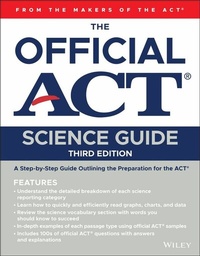
The Official ACT Science Guide
Description

Master the science section of the ACT with the only official guide prepared by the creators and administrators of the test
The Official ACT Science Guide, 3rd Edition, is the most recent and authoritative update to the leading study resource for the widely used college admissions test. This comprehensive guide shows you what to expect on test day, offering intuitive and concept-based instruction, actual test questions from previous exams, and expert insights that reduce test anxiety and build confidence.
This book reflects the most recent changes to the ACT science section and delivers a complete review of every science concept tested. With both print and customizable online practice questions, students can prepare in the way they feel most comfortable while working through problems organized by question type.
You'll also find:
- Real ACT sciencequestions from previous test administrations combined with detailed explanations for every problem
- A concept-based approach that helps students understand the science topics they'll encounter on test day
- Comprehensive review of the entire sciencesection so students know exactly what to expect
- Online access to the complete question pool for personalized, customizable practice sessions
- Organization by question type to help students identify strengths and target areas needing improvement
Ideal for high school students preparing for college admissions or scholarship qualification, The Official ACT Science Guide is a detailed and authoritative resource designed to help students of all skill levels perform at their highest level on test day.
More details
Other editions
Additional editions
Previous edition
Content
Chapter 1:
An Overview of the ACT Science Test
The ACT science test presents a passage or scientific scenario that is followed by several questions related to the passage. Many questions rely only on information in the passage: for example, a question that asks about how the value of one variable changes when another variable increases. Other items require that you integrate prior science knowledge with information from the passage to engage in three-dimensional scientific sense making using science and engineering practices, crosscutting concepts in science, and science content knowledge to answer the question.
Passage Types
The ACT science test uses three types of passages: Data Representation, Research Summary, and Conflicting Viewpoints. Data Representation passages have a short passage that introduces the scientific phenomena that is displayed in the graphics which may include tables, graphs, and diagrams. These are covered more fully in chapter 2. Research Summary passages are of medium length and describe one or more related experiments including information about the methods and tools used in the experiment which may include diagrams. Specific information for each experiment is separated by headers such as Experiment 1 or Study 2. These typically include several graphics (tables, graphs, or diagrams). These are covered in chapter 3. The Conflicting Viewpoints passage begins with an overview of a scientific phenomenon. This is followed by two to four scientific explanations or models (each separated by a header such as Student 1 or Scientist 2) that provide a causal explanation with supporting evidence and reasoning. These are the longest passages on the ACT science test and are covered in chapter 4.
Overall Test Structure and Content Coverage
The ACT science test contains 40 items and 7 passages that must be answered in 40 minutes. Six of the seven passages count towards your score and the remaining passage includes six items that do not count toward your score. Since you cannot tell which passage is not scored, you should do your best on all the passages. Overall, the test has 34 scored items that all count for one point and six field test items that do not count towards your score.
Type of Passage Number of Operational Passages Passage Length Data Representation 2 Short (approximately 100 standard words) Research Summary 3 Medium (approximately 275 standard words) Conflicting Viewpoints 1 Long (approximately 350 standard words)Science Content Coverage
Each passage has a primary focus on a specific science discipline: Biology, Chemistry, Physics, or Earth and Space Science. Some passages, like science itself, are interdisciplinary involving information from more than one discipline, but the primary focus is used to identify the passage. For example, if a passage measures the impact of acid rain on plant growth, the primary focus is biology (plant growth in response to environmental factors) and the passage would count as a biology passage even if some items required you to use chemistry knowledge like acids have a pH below 7. ACT's Recommended Core Curriculum for science is that you should take three credits of lab-based science classes including Biology and either Chemistry or Physics and following that curriculum will help you develop the science knowledge and skills in class that will help prepare you to do well not only on the ACT science test but also in your college science courses.
Additionally, some passages will have a secondary focus for Engineering and Design Thinking (EDT). EDT passages involve using science to solve real world problems which may include experiments to identify the extent of the problem or tests of possible solutions. Every ACT science test has at least one passage with an EDT focus in addition to its primary content focus. It is entirely possible to have EDT passages for any passage type and with any science discipline. The table below shows how many passages in each discipline and a brief sample of specific topics in each discipline.
Science Discipline Number of Passages Example topics Biology 2 Genetics, cells, natural selection, ecology Chemistry 1-2 Chemical reactions, acids, bonding Physics 1-2 Kinematics, magnetism, friction, optics Earth and Space Science 1-2 Plate tectonics, rock cycle, atmospheric composition, properties of stars and planets SECONDARY FOCUS: Engineering and Design Thinking 1-3Reporting Categories
For many years, the ACT science test has focused on science practices and skills that are transferable not only among the sciences but also with other disciplines. Most state science standards refer to this kind of knowledge as Science and Engineering Practices (SEP) and Crosscutting Concepts in Science (CCC). SEP are things that scientists, and by extension student scientists, do like interpret data, plan and carry out investigations, and engage in scientific argument from evidence using a claim-evidence-reasoning model of argument. CCC are how scientists and students think, like looking for patterns, cause and effect relationships, and constructing and using models (both physical and conceptual). These have been viewed as more important by college instructors than the third dimension of science knowledge and learning, Disciplinary Content Information (DCI). Together these make up the three strands of the science standards. All items require the use of SEP and CCC, while 15%-25% of items require integrating content knowledge with SEP and CCC to answer the question. The ACT science test clusters these skills into three reporting categories: Interpretation of Data (IOD), Evaluating Models and Scientific Arguments with Evidence (EMI), and Scientific Investigation (SIN). These are covered in greater detail in chapters 5, 6, and 7, respectively. Since every item is only counted towards one reporting category based on the most cognitively demanding step, it is important to know that some EMI and SIN items require an underlying IOD skill to get to the correct answer. For example, to evaluate a claim about a trend in the data (EMI), you may first need to find the data in the graphic and determine how the dependent variable changes in response to the independent variable (IOD). Consequently, the skills in the IOD domain are used on over half of the items on the science test, even when they are not the most challenging or apex skill.
Reporting Category Number of Scored Items Percentage of Scored Items Interpretation of Data (IOD) 13-17 38%-50% Scientific Investigation (SIN) 6-11 18%-32% Evaluation of Models and Scientific Arguments with Evidence (EMI) 8-13 24%-38%Test Timing and Time Management
The ACT science test has 40 items and 40 minutes to complete them. ACT recently conducted a reading rate study and it found that students, when not rushing, read at approximately 225-250 standard words per minute. This study found rates similar to other researchers and that this reading rate is similar to students over the last several decades. That means that a typical student should spend approximately half a minute on the Data Representation passage reading the passage and making sense of the graphics (headers, legends, keys, etc. discussed in chapter 9). The Research Summary and the Conflicting Viewpoints passages should both take between one and two minutes to read. You may take a little longer if you are making notes for online testing or marking up the passage for paper testing. However, the majority of the time on the ACT science test should be used to answer questions.
ACT Research in cognitive labs found that for most students the most efficient way to answer questions correctly was to read the passage first and then answer the questions. Many students who answered correctly made notes in the margins of a paper test or on scratch paper to help them find answers quickly and efficiently. It is important to note that the ACT science test is an open book test in that you do not need to read to memorize the facts of the passage but should read at a pace that you understand the main idea of each viewpoint and key aspects of the experiments. You should generally only re-read a part of the passage in order to answer a specific question. It is important to remember that you only get points for answering questions correctly, so you need to spend the majority of your time answering questions. Some students find that it is more effective for them to read only the information until the first subheading or graphic. Other students have found that going to the questions first works best for them, especially if they are short on time and know that they are willing to guess and move...
