

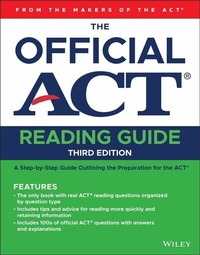
The Official ACT Reading Guide
Description

Master the reading section of the ACT with the only official guide prepared by the creators and administrators of the test
The Official ACT Reading Guide, 3rd Edition, is the most recent and authoritative update to the leading study resource for the widely used college admissions test. This comprehensive guide shows you what to expect on test day, offering intuitive and concept-based instruction, actual test questions from previous exams, and expert insights that reduce test anxiety and build confidence.
This book reflects the most recent changes to the ACT reading section and delivers a complete review of every reading concept tested. With both print and customizable online practice questions, students can prepare in the way they feel most comfortable while working through problems organized by question type.
You'll also find:
- Real ACT reading questions from previous test administrations combined with detailed explanations for every problem
- A concept-based approach that helps students understand the reading topics they'll encounter on test day
- Comprehensive review of the entire reading section so students know exactly what to expect
- Online access to the complete question pool for personalized, customizable practice sessions
- Organization by question type to help students identify strengths and target areas needing improvement
Ideal for high school students preparing for college admissions or scholarship qualification, The Official ACT Reading Guide is a detailed and authoritative resource designed to help students of all skill levels perform at their highest level on test day.
More details
Other editions
Additional editions
Previous edition
Content
Chapter 2:
General Reading Skills
Skimming
Skimming is essentially speed reading with a low level of comprehension. Use the structured nature of the humanities, social science, and natural science passages to help you vary your reading speed. For example, the first and last sentences of each paragraph are typically the most important, and the introduction and conclusion of each passage typically give the broadest framework for the content of the passage as a whole. Therefore, you can gather a great deal of information by focusing on comprehending these parts of the passage.
You might be surprised by how much you can understand from looking only at these portions of the text. The following exercise will deconstruct a text in this way for you.
Look at the following key sentences from a passage adapted from Biomimicry: Innovation Inspired by Nature by Janine M. Benyus (©1997 by Janine M. Benyus). Read through all of them, and then reflect on the main point or points that the collection of sentences conveys. Do you think you have an understanding of what the passage as a whole will be about just based on these sentences?
INFORMATIONAL: This passage is adapted from Biomimicry: Innovation Inspired by Nature by Janine M. Benyus (©1997 by Janine M. Benyus).
Introduction First Sentence
If anybody's growing biomass, it's us. To keep our system from collapsing on itself, industrial ecologists are attempting to build a "no-waste economy."
Introduction Last Sentence
The first examples of this no-waste economy are collections of companies clustered in an ecopark and connected in a food chain, with each firm's waste going next door to become the other firm's raw material or fuel.
Topic Sentence of the First Body Paragraph
In Denmark, the town of Kalundborg has the world's most elaborate prototype of an ecopark.
Topic Sentence of the Second Body Paragraph
Waste steam from the power company is used by Novo Nordisk to heat the fermentation tanks that produce insulin and enzymes.
Topic Sentence of the Third Body Paragraph
Meanwhile, back at the Statoil Refinery, waste gas that used to go up a smokestack is now purified.
Topic Sentence of the Fourth Body Paragraph
Although Kalundborg is a cozy co-location, industries need not be geographically close to operate in a food web as long as they are connected by a mutual desire to use waste.
Topic Sentence of the Fifth Body Paragraph
So far, we've talked about recycling within a circle of companies.
Topic Sentence of the Sixth Body Paragraph
Traditionally, manufacturers haven't had to worry about what happens to a product after it leaves their gates.
First Sentence of the Conclusion
When the onus shifts in this way, it's suddenly in the company's best interest to design a product that will either last a long time or come apart easily for recycling or reuse.
Last Sentence of the Conclusion
Today's bags, which have nine thin layers made of seven different materials, will no doubt be replaced by one material that can preserve freshness and can easily be remade into a new bag.
Synthesis of the Main Idea Based on the Previous Information
Companies are beginning to take responsibility for using materials in a sustainable way that considers the life cycle of the materials used to produce goods.
INFORMATIONAL: This passage is adapted from Biomimicry: Innovation Inspired by Nature by Janine M. Benyus (©1997 by Janine M. Benyus).
If anybody's growing biomass, it's us. To keep our
system from collapsing on itself, industrial ecologists
are attempting to build a "no-waste economy." Instead
of a linear production system, which binges on virgin
5 raw materials and spews out unusable waste, they envision
a web of closed loops in which a minimum of raw
materials comes in the door, and very little waste
escapes. The first examples of this no-waste economy
are collections of companies clustered in an eco-park
10 and connected in a food chain, with each firm's waste
going next door to become the other firm's raw material
or fuel.
In Denmark, the town of Kalundborg has the
world's most elaborate prototype of an eco-park. Four
15 companies are co-located, and all of them are linked,
dependent on one another for resources or energy. The
Asnaesverket Power Company pipes some of its waste
steam to power the engines of two companies: the
Statoil Refinery and Novo Nordisk (a pharmaceutical
20 plant). Another pipeline delivers the remaining waste
steam to heat thirty-five hundred homes in the town,
eliminating the need for oil furnaces. The power plant
also delivers its cooling water, now toasty warm, to
fifty-seven ponds' worth of fish. The fish revel in the
25 warm water, and the fish farm produces 150 tons of sea
trout and turbot each year.
Waste steam from the power company is used by
Novo Nordisk to heat the fermentation tanks that produce
insulin and enzymes. This process in turn creates
30 700,000 tons of nitrogen-rich slurry a year, which used
to be dumped into the fjord. Now, Novo bequeaths it
free to nearby farmers-a pipeline delivers the fertilizer
to the growing plants, which are in turn harvested to
feed the bacteria in the fermentation tanks.
35 Meanwhile, back at the Statoil Refinery, waste gas
that used to go up a smokestack is now purified. Some
is used internally as fuel, some is piped to the power
company, and the rest goes to Gyproc, the wallboard
market next door. The sulfur squeezed from the gas
40 during purification is loaded onto trucks and sent to
Kemira, a company that produces sulfuric acid. The
power company also squeezes sulfur from its emissions,
but converts most of it to calcium sulfate (industrial
gypsum), which it sells to Gyproc for wallboard.
45 Although Kalundborg is a cozy co-location, industries
need not be geographically close to operate in a
food web as long as they are connected by a mutual
desire to use waste. Already, some companies are
designing their processes so that any waste that falls on
50 the production-room floor is valuable and can be used
by someone else. In this game of "designed offal," a
process with lots of waste, as long as it's "wanted
waste," may be better than one with a small amount of
waste that must be landfilled or burned. As author
55 Daniel Chiras says, more companies are recognizing
that "technologies that produce by-products society
cannot absorb are essentially failed technologies."
So far, we've talked about recycling within a
circle of companies. But what happens when a product
60 leaves the manufacturer and passes to the consumer and
finally to the trash can? Right now, a product visits one
of two fates at the end of its useful life. It can be buried
in a landfill or incinerated, or it can be recaptured
through recycling or reuse.
65 Traditionally, manufacturers haven't had to worry
about what happens to a product after it leaves their
gates. But that is starting to change, thanks to laws now
in the wings in Europe (and headed for the United
States) that will require companies to take back their
70 durable goods such as refrigerators, washers, and cars
at the end of their useful lives. In Germany, the take-back
laws start with the initial sale. Companies must
take back all their packaging or hire middlemen to do
the recycling. Take-back laws mean that manufacturers
75 who have been saying, "This product can be recycled,"
must now say, "We recycle our products and
packaging."
When the onus shifts in this way, it's suddenly in
the company's best interest to design a product that will
80 either last a long time or come apart easily for recycling
or reuse. Refrigerators and cars will be assembled using
easy-open snaps instead of glued-together joints, and
for recyclability, each part will be made of one material
instead of twenty. Even simple things, like the snack
85 bags for potato chips, will be streamlined. Today's
bags, which have nine thin layers made of seven different
materials, will no doubt be replaced by one material
that can preserve freshness and can easily be
remade into a new bag.
Now that you have read through the whole passage, how do the main point or points compare to the ones you identified after reading only the deconstructed version of the passage? How accurately were you able to gauge what the passage is about?
Based on your experience with the previous exercise, you should be able to identify the correct answer to the following "big-picture" question.
It can reasonably be inferred that the author's proposed solution to what she sees as the problem of an increasing amount of biomass is to:
- change the process by which manufacturers produce their products.
- make consumers responsible for recycling the products they buy.
- encourage traditional businesses to compete with new, innovative businesses.
- encourage companies that produce similar products to cluster together in...
