

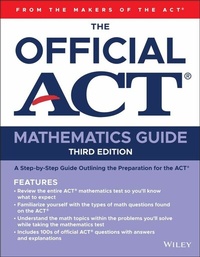
The Official ACT Mathematics Guide
Description

Master the math section of the ACT with the only official guide prepared by the creators and administrators of the test
The Official ACT Mathematics Guide, 3rd Edition, is the most recent and authoritative update to the leading study resource for the widely used college admissions test. This comprehensive guide shows you what to expect on test day, offering intuitive and concept-based instruction, actual test questions from previous exams, and expert insights that reduce test anxiety and build confidence.
This book reflects the most recent changes to the ACT mathematics section and delivers a complete review of every math concept tested. With both print and customizable online practice questions, students can prepare in the way they feel most comfortable while working through problems organized by question type.
You'll also find:
- Real ACT math questions from previous test administrations combined with detailed explanations for every problem
- A concept-based approach that helps students understand the mathematical topics they'll encounter on test day
- Comprehensive review of the entire mathematics section so students know exactly what to expect
- Online access to the complete question pool for personalized, customizable practice sessions
- Organization by question type to help students identify strengths and target areas needing improvement
Ideal for high school students preparing for college admissions or scholarship qualification, The Official ACT Mathematics Guide is a detailed and authoritative resource designed to help students of all skill levels perform at their highest level on test day.
More details
Other editions
Additional editions
Previous edition
Content
Chapter 2:
Number and Quantity
Number and Quantity tests your ability to apply real and complex number systems in various forms, including integer and rational exponents, vectors, and matrices.
Real Numbers
A real number is any number that appears on the number line, whether positive, negative, or zero. Real numbers include all rational and irrational numbers.
An integer is any number, positive, negative, or zero, that can be written without a fractional or decimal component.
A whole number is any positive integer and doesn't include zero.
Numbers that do not exist on the real number line are discussed later in this chapter.
A rational number is any number or fraction that can be expressed as a terminating or repeating decimal. For example, the fraction can be expressed as the decimal 0.25, which both terminates and expresses the true value of the decimal. The fraction can be expressed as the decimal , which doesn't terminate but is considered rational because it repeats. The fraction , equivalent to , is also considered rational because the 18 in the decimal repeats.
A non-rational or irrational number is a real number that cannot be written as a fraction or a terminating or repeating decimal. Examples of non-rational numbers are and .
Number Line and Absolute Value
The number line represents the spectrum of all real numbers and symbolically extends infinitely in both directions.
Absolute value represents an expression's distance from 0 on the number line. Absolute value is always positive, because a distance is always positive. Because -5 is 5 units from 0, the absolute value of -5, written as , is 5.
You can take the negative of an absolute value, but the absolute value itself is always positive. For example, is the same thing as , which equals -7. Take the calculations step by step: , and the negative of 7 is -7.
Reporting Category Quiz: Integrating Essential Skills
- Which of the following lists orders , 0.28, , , 0.37, and from least to greatest?
- 0.28, , , 0.37, ,
- 0.28, , , , 0.37,
- 0.28, , , , , 0.37
- 0.28, 0.37, , , ,
- |5(-4)+3(6)| = ?
- -2
- 2
- 10
- 38
- On the real number line given, with coordinates as labeled, an object moves according to the following set of instructions: From point the object moves right to , then left to , then right to , and finally left until it returns to its original position at . What is the closest estimate of the total length, in coordinate units, of the movements this object makes?
- 12
- 16
- 24
- 36
- If the in equality is true, then which of the following must be true?
DO YOUR FIGURING HERE.
Reporting Category Quiz: Preparing for Higher Mathematics | Number and Quantity
- A ticket for a movie at the Hazelnut Cinema costs $12. Latoya treats her younger brother to a movie at the Hazelnut Cinema. She gives him the money she brought with her, for his ticket and a candy. When he asks to play a video game, she gives him $3. That leaves Latoya exactly enough money to buy her own ticket. How much money did Latoya bring with her?
- $15
- $24
- $27
- $30
- Vehicle A averages 19 miles per gallon of gasoline, and Vehicle B averages 37 miles per gallon of gasoline. At these rates, how many more gallons of gasoline does Vehicle A need than Vehicle B to make a 1,406-mile trip?
- 28
- 36
- 38
- 56
- Melissa knows that 30 miles per hour is equivalent to 44 feet per second. If Melissa drives at a speed of 70 miles per hour, which of the following is closest to her speed in feet per second?
- 31
- 48
- 103
- 127
DO YOUR FIGURING HERE.
Multiples, Factors, and Prime Numbers
A multiple is an integer that results from the product of two other integers. For example, to find multiples of 7, multiply 7 by -2, -1, 0, 1, 2, 3, and so on, resulting in -14, -7, 0, 7, 14, 21, and so on. Note that every integer is a multiple of itself: 23 is a multiple of 23.
A factor is an integer that results from dividing two other integers. For example, to find the factors of 30, find the pairs of numbers that multiply to 30: ±5 and ±6, ±3 and ±10, ±2 and ±15, and ±1 and ±30. Note that 1 is a factor of every integer, and every integer is a factor of itself. For example, factors of 52 include 1 and 52.
A prime number is a whole number greater than 1 that has exactly two positive factors: 1 and itself. For example, 13 is a prime number, because its only positive factors are 1 and 13. Note that 2 is the only even prime number; 1 and 0 are not considered prime.
A composite number is a whole number greater than 1 that isn't prime; that is, it has more than two positive factors. For example, 12 is a composite number, because its positive factors are 1, 2, 3, 4, 6, and 12. Prime factorization is the factoring of a composite number to its primes, including duplicates. For example, the prime factorization of 30 is 2 × 3 × 5. Note that prime factorization doesn't include 1 as a factor.
These composite numbers can be prime factored:
- 20
- 36
- 48
Results:
- 20 = 2 × 2 × 5
- 36 = 2 × 2 × 3 × 3
- 48 = 2 × 2 × 2 × 2 × 3
Reporting Category Quiz: Integrating Essential Skills
- Mr. Dietz is a teacher whose salary is $78,000 for this school year, which has 200 days. In Mr. Dietz's school district, substitute teachers are paid $125 per day. If Mr. Dietz takes a day off without pay and a substitute teacher is paid to teach Mr. Dietz's classes, how much less does the school district pay in salary by paying a substitute teacher instead of paying Mr. Dietz for that day?
- $125
- $257
- $265
- $390
- Nick needs to order 500 pens from his supplier. The catalog shows that these pens come in cases of 24 boxes with 10 pens in each box. Nick knows that he may not order partial cases. What is the fewest number of cases he should order?
- 2
- 3
- 21
- 50
- What is the least common multiple of 20, 30, and 70?
- 40
- 120
- 420
- 42,000
- Mary takes 2 medications throughout the day and night. One medication is to be taken every 6 hours and the other is to be taken every 4 hours. Mary begins taking both medications at 7:00 a.m. and takes both medications on schedule. How many hours later will it be when she next takes both medications at the same time?
- 6
- 10
- 12
- 24
- For integers and such that , which of the following is not a possible value of ?
- -8
- -6
- 1
- 2
DO YOUR FIGURING HERE.
Fractions
A fraction is a numerical quantity that is not a whole number, such as . The reciprocal of a fraction is the switching of its numerator and denominator. For example, the reciprocal of is . Placing a 1 on top of a fraction yields its reciprocal. For example, .
- Add and subtract fractions by giving them common denominators: .
- Multiply fractions by multiplying the numerators then the denominators:
- Divide fractions by multiplying the first fraction by the reciprocal of the second fraction: .
If an ACT mathematics test question involves multiplying fractions that have large numerators or denominators,you can often simplify the math work by reducing and cancelling the numbers before multiplying. In this example, the numerator 500 is a multiple of the denominator 250, so reducing these numbers before multiplying saves math work: .
Reporting Category Quiz: Integrating Essential Skills
- Of the 804 graduating seniors in a certain high school, approximately are going to college and approximately of those going to college are going to a state university. Which of the following is the closest estimate for how many of the graduating seniors are going to a state university?
- 80
- 160
- 200
- 280
- What is the least common denominator when adding the simplified fractions , , , and ?
- 45
- 90
- 270
- 810
DO YOUR FIGURING HERE.
Reporting Category Quiz: Preparing for Higher Mathematics | Number and Quantity
- When Angela was cleaning her refrigerator, she found 2 bottles of catsup. Looking at the labels, she noticed that the capacity of the larger bottle was twice the capacity of the smaller bottle. She estimated that the smaller bottle was about full of catsup and the larger bottle was about full of catsup. She poured all the catsup from the smaller bottle into the larger bottle. Then, about how full was the larger bottle?
- full
- full
- full
- Completely...
